"Oil tank leak repair cost" encompasses far more than fixing or replacing the tank itself. The total financial picture includes initial leak inspection, tank repair or replacement, soil testing, and potentially extensive environmental remediation. These costs vary dramatically based on leak severity, tank location (underground vs. aboveground), and how quickly the problem is detected. This guide breaks down every cost stage—from minor repairs to worst-case remediation scenarios—and explains what drives costs up or down, so you can budget realistically and avoid financial shock.
Key Takeaways
- Total costs range from $500 for minor repairs to $100,000+ for full environmental remediation
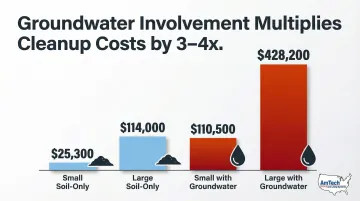
- Groundwater contamination multiplies cleanup costs by 3-4x compared to soil-only leaks
- Every day of delay allows contamination to spread, turning a $5,000 problem into a $50,000+ crisis
- Tank relining caught early costs far less than full replacement and eliminates remediation expenses entirely
- Standard homeowners insurance excludes liquid fuel spills; a specific rider covers them, usually under $100/year
How Much Does an Oil Tank Leak Repair Cost?
There's no single price for oil tank leak repair—costs depend on whether you need a minor patch, full tank replacement, or environmental remediation of contaminated soil. The financial outcome is determined primarily by how far the leak has progressed and how quickly it's addressed.
What often goes wrong when costs are misunderstood:
- Homeowners budget only for the tank fix and are blindsided by five-figure remediation bills
- Delaying action allows contamination to spread underground, multiplying cleanup costs several times over
- Hiring the cheapest contractor without verifying environmental compliance results in fines or repeat work
The three scenarios below — minor repair, full replacement, and environmental remediation — each carry a distinct cost profile. Here's what to expect at each level.
Typical Cost Ranges
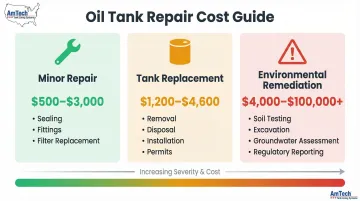
| Repair Type | Cost Range | What's Included |
|---|---|---|
| Minor Repair | $500–$3,000 | Sealing small leaks, replacing fittings, filter replacement |
| Tank Replacement | $1,200–$4,600 | Full tank removal, disposal, new tank installation, permits |
| Environmental Remediation | $4,000–$100,000+ | Soil testing, excavation, groundwater assessment, disposal, regulatory reporting |
Minor Repairs and Patching
Minor repairs are viable when leaks are caught early, soil contamination is absent, and the tank is under 15 years old with otherwise sound structure. Filter replacement runs $100–$150; corroded fittings and small sealing jobs bring the total to $500–$3,000.
EPA regulations (40 CFR 280.33) set clear limits on what qualifies as a legitimate repair:
- Metal pipe sections that released product due to corrosion must be replaced — not patched
- Repaired tanks must pass tightness testing within 30 days
- Cathodic protection systems must be tested within 6 months of repair
Tank Replacement
Replacement covers complete removal and disposal of the old tank, new tank installation, labor, and permits. Costs shift significantly based on tank location and type.
| Tank Location | Average Cost | Key Cost Factors |
|---|---|---|
| Aboveground Indoor (Basement) | $550–$3,000 | Lowest labor costs—no excavation required |
| Aboveground Outdoor | $1,200–$2,500 | Requires concrete base but no excavation |
| Underground (UST) | $1,600–$4,600 | Most expensive—excavation adds $1,000–$2,000 |
Removing an old tank costs $400–$3,000 (average $1,700), assuming no environmental issues. Double-wall tanks cost $1,200–$5,300 vs. $1,000–$2,100 for single-wall designs. Regional differences matter: Northeast replacements run $1,900–$4,025 due to stricter regulations and higher demand, compared to $1,500–$1,700 in the South.
Replacement makes the most economic sense for tanks showing extensive corrosion, age over 15–20 years, or structural failure that makes repair uneconomical.
Environmental Remediation
When oil migrates into soil, toward drainage systems, or near a water supply, remediation isn't optional — state and federal environmental regulations mandate it. Scope includes soil testing, excavation of contaminated material, groundwater assessment, petroleum-impacted disposal, and regulatory closure reporting.
Real-World Cost Example: A 2025 case in North Attleboro, Massachusetts illustrates worst-case scenarios. A 20-year-old outdoor heating oil tank leaked 190 gallons. Oil migrated under the home's slab, into the crawl space, and into a French drain that pumped contamination toward the street. Initial cleanup cost $90,000, with total projected costs reaching $400,000. The homeowners' insurance denied the claim because their policy excluded liquid fuel spills.
EPA data reveals the cost multiplier effect of groundwater involvement:
- Small soil-only release: $25,300 total cost
- Large soil-only release: $114,000 total cost
- Small release with groundwater: $110,500 total cost
- Large release with groundwater: $428,200 total cost
Key Factors That Affect the Cost of Oil Tank Leak Repair
Oil tank leak repair costs vary widely — two seemingly similar leaks can carry dramatically different price tags depending on five core variables.
Severity and Duration of the Leak
The longer a leak goes undetected, the more oil saturates surrounding soil. Even small pinhole leaks can release hundreds of gallons over months or years if the tank is regularly refilled. EPA analysis shows that a one-day increase in project duration corresponds with a $116 increase in total project costs.
The volume of contaminated soil—measured in terms of plume length, depth, and width—is the primary driver of remediation cost. A leak contained to a 5-foot radius around the tank costs far less than one that has migrated 50 feet toward a property line or water source.
Tank Type and Location
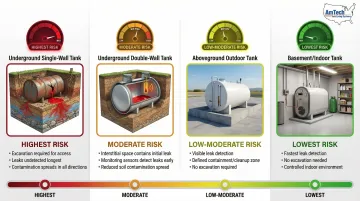
Tank placement and construction directly determine how quickly a leak is caught and how far contamination spreads:
- Underground tanks are the most expensive to address — excavation is required, leaks go unnoticed longer, and contamination spreads in all directions through the soil
- Aboveground and basement tanks are detected faster; cleanup involves removing a defined volume of soil rather than excavating an expanding underground plume
- Single-wall tanks have no secondary barrier — once the wall fails, product immediately enters surrounding soil
- Double-wall tanks with interstitial monitoring detect leaks before product escapes the outer containment, significantly reducing environmental cleanup costs
Extent of Soil and Groundwater Contamination
Oil migrating into groundwater or toward municipal drainage systems triggers regulatory involvement and significantly higher cleanup costs. Groundwater contamination requires long-term monitoring wells, pump-and-treat systems, or monitored natural attenuation — processes that can take years and cost hundreds of thousands of dollars.
Soil testing ranges from $125 per sample for basic petroleum hydrocarbon screening to $928–$1,100 per sample for full hazardous waste classification. A typical Phase 2 Environmental Site Assessment runs $8,000–$15,000 for commercial properties with suspected contamination.
Tank Age and Material
Bare steel tanks corrode faster and are more likely to develop multiple leak points. Unprotected underground steel tanks have a life expectancy of about 15 years, while heating oil tanks generally last 15–20 years. Tanks beyond that range carry significantly higher leak risk.
Tanks over 15–20 years old often cannot be economically repaired — replacement becomes the standard recommendation. Material makes a measurable difference in long-term durability:
- Bare steel (unprotected): 15-year service life; prone to multiple corrosion points
- Steel with cathodic protection or coating: Substantially longer service life
- Fiberglass/FRP tanks: 30–40 year lifespan; resistant to corrosion
Geographic Location and Regulatory Requirements
Northeast states (Massachusetts, New Jersey, Connecticut, New York) impose stricter regulations and have higher demand for remediation services, driving up costs. Permits, professional oversight requirements, and state environmental agency reporting add both time and expense.
New Jersey requires commercial property owners to hire a Licensed Site Remediation Professional (LSRP) at approximately $181/hour to manage cleanup without direct state pre-approval.
Massachusetts requires a Licensed Site Professional (LSP) to oversee cleanups under the Massachusetts Contingency Plan (MCP). Response Action Outcomes (RAOs) submitted within 120 days avoid a $750 fee, incentivizing rapid response.
Full Cost Breakdown: From Immediate Repair to Remediation
The total cost of an oil tank leak goes far beyond replacing the tank. There are multiple cost stages, and skipping any one can result in regulatory fines, incomplete cleanup, or long-term environmental liability.
Stage 1 — Inspection and Assessment
Cost Type: One-time
What's Included: Visual inspection, soil probe testing, professional leak diagnosis
Typical Costs:
- Basic leak inspection: $500–$1,500
- Soil probe testing: $125 per sample
- Ultrasonic tank wall testing: $800–$2,000
Early assessment reduces total project cost. EPA regression analysis indicates that a 1% increase in the proportion of total costs spent on site assessment correlates with a $221–$296 decrease in total site costs. Thorough upfront testing prevents costly surprises later.
Once the leak is confirmed and its extent understood, the next step is stopping it.
Stage 2 — Immediate Containment and Tank Repair or Replacement
Cost Type: One-time
What's Included: Tank patching, relining, or full tank removal and replacement
Tank relining using protective coating systems or cementitious linings can extend tank life and is often more cost-effective than full replacement when structural integrity is intact. Contractors like AmTech Tank Lining & Repair apply proprietary lining systems that restore tanks to full service life — at a fraction of replacement cost and with far less operational disruption.
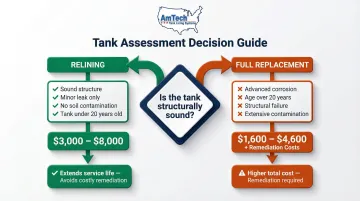
When relining makes sense:
- Tank structure is fundamentally sound (confirmed by ultrasonic testing)
- Leak is minor and localized
- No significant soil contamination has occurred
- Tank is under 20 years old with no widespread corrosion
Relining costs typically run $3,000–$8,000 depending on tank size and access, compared to $1,600–$4,600 for full aboveground tank replacement plus associated costs.
With the tank addressed, testing the surrounding soil is the critical next step before assuming the problem is contained.
Stage 3 — Soil Testing and Environmental Site Assessment
Cost Type: One-time
What's Included: Soil boring, laboratory analysis, determination of contamination extent
Typical Costs:
- Phase 2 Environmental Site Assessment: $8,000–$15,000
- Individual soil sample analysis: $125–$1,100 per sample
- Groundwater monitoring well installation: $2,820 (shallow) to $9,950 (deep)
Without proper testing, there's no way to confirm whether contamination has spread beyond the immediate tank area. Incomplete cleanup leads to future liability, repeat work, and potential regulatory enforcement — costs that far exceed the price of a Phase 2 assessment.
Stage 4 — Remediation and Regulatory Closure
Cost Type: Recurring/ongoing depending on contamination extent
What's Included: Excavation of petroleum-impacted soils, off-site disposal, groundwater monitoring if needed, regulatory reporting and closure filing
Typical Costs:
- Soil disposal: $48–$73 per ton
- Soil excavation and hauling: $500–$2,000 depending on volume
- Groundwater monitoring (if required): $5,000–$20,000+ annually
- LSRP/LSP oversight: $150–$200/hour
Cleanup timelines vary widely: sites without active remediation average 445 days to closure, while sites requiring active remediation average 1,842 days (over 5 years). Monitored natural attenuation projects can take 17+ years.
Repair, Reline, or Replace — What Makes Financial Sense?
Not every leaking tank needs to be scrapped. The right decision depends on the tank's structural condition, age, and extent of any contamination.
Tank relining or structural repair is the most cost-efficient path when:
- The tank is structurally sound (confirmed by ultrasonic testing and visual inspection)
- The leak is minor and detected early
- No significant soil contamination has occurred
- The tank is under 20 years old with intact structural integrity
Industry data supports relining economics: 98% of double-walled tanks are sufficiently sound to be returned to full-term useful life expectancy after professional repair and lining. This approach costs a fraction of full replacement while avoiding remediation expenses entirely.
Full replacement makes sense when:
- Corrosion is advanced with multiple failure points
- Tank age exceeds 20 years with widespread deterioration
- Structural integrity is compromised beyond economical repair
- Soil contamination is already extensive (replacement becomes part of larger remediation project)
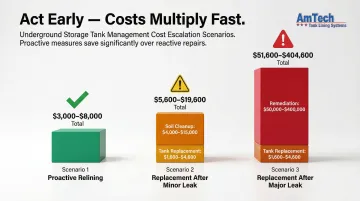
Those replacement scenarios carry a steep price. Proactive relining before a leak occurs costs far less than post-leak remediation — consider the numbers:
- Proactive tank relining: $3,000–$8,000
- Tank replacement after minor leak: $1,600–$4,600 (tank) + $4,000–$15,000 (soil cleanup) = $5,600–$19,600
- Tank replacement after major leak: $1,600–$4,600 (tank) + $50,000–$400,000 (remediation) = $51,600–$404,600 total
Double-wall tanks, properly lined tanks, and well-maintained tanks consistently show lower long-term cost profiles than those left unprotected. AmTech Tank Lining & Repair performs this work directly — lining fuel storage tanks with DuraChem® polyurea systems and converting single-wall USTs to double-wall compliance through the Genesis Double Wall Retrofit program — for commercial, industrial, and municipal operators across all 50 states.
What Most People Get Wrong About Oil Tank Leak Costs
Focusing only on tank replacement price while ignoring environmental testing and remediation. The tank itself is often the smallest cost in a major leak scenario. A $2,400 tank replacement becomes a $90,000+ project when soil contamination is involved.
Assuming homeowners insurance covers the damage. Standard policies typically exclude liquid fuel spills. The insurance industry abandoned "sudden and accidental" pollution coverage in the late 1980s, replacing it with absolute pollution exclusions.
Liquid fuel riders (often under $100/year) provide coverage—Massachusetts law requires insurers to offer at least $50,000 per occurrence, with many policies offering $100,000 for property damage and $300,000 for environmental cleanup. But there's no legal requirement for brokers to inform homeowners this coverage exists, leading to major uninsured losses.
Waiting to address a suspected leak. Every day of delay allows contamination to spread. A leak that could have been contained for $5,000 becomes a $50,000+ remediation project within months as the petroleum plume expands underground.
Hiring the lowest-cost contractor without verifying environmental licensing. Improper cleanup that doesn't meet state regulatory standards requires repeat work and triggers enforcement actions. Verify that contractors hold appropriate state environmental licenses and comply with EPA/state remediation protocols before signing anything.
Conclusion
Oil tank leak repair costs vary enormously—from a few hundred dollars for a minor fix to six figures for full environmental remediation. The outcome is largely determined by how quickly the leak is detected and addressed.
Understanding the full cost picture helps you budget realistically and avoid financial shock. That picture typically includes:
- Inspection and testing to confirm leak location and severity
- Repair or full tank replacement depending on structural condition
- Soil and groundwater testing if contamination is suspected
- Environmental remediation if contamination has spread
Every cost decision in this process balances immediate repair economics against long-term liability. Working with certified, experienced tank repair specialists is critical to avoiding incomplete or non-compliant work that creates bigger problems down the road.
Frequently Asked Questions
How much does it cost to replace a leaking oil tank?
Tank replacement costs $1,200–$4,600 depending on location (underground tanks cost most due to excavation). However, if soil contamination is present, environmental cleanup costs are separate and can far exceed the tank replacement cost—often reaching $10,000–$100,000+ for extensive contamination.
What to do if a home oil tank is leaking?
Stop using the tank immediately to prevent further contamination. Call a licensed tank professional or environmental contractor for an emergency assessment. Contact your insurance provider before any work begins to check for liquid fuel coverage—standard homeowners policies typically exclude these spills without a specific rider.
Is it worth fixing a leaking oil tank?
Relining is worth it when the tank is structurally sound and contamination is minimal—professional relining costs $3,000–$8,000 and can extend service life 10–15+ years. Tanks over 15–20 years old or with extensive corrosion are generally more economical to replace.
Is an oil tank leak covered by homeowners insurance?
Standard homeowners policies exclude liquid fuel spills, but a liquid fuel rider (often under $100/year) can be added separately. These riders typically cover $50,000–$100,000 in property damage and up to $300,000 for environmental cleanup—insurers rarely offer them proactively, so you must request one.
How much does environmental cleanup from an oil tank leak cost?
Cleanup ranges from roughly $4,000 for minor contained leaks to well over $100,000 when oil reaches groundwater or drainage systems. EPA data shows large groundwater cleanups average $428,200 versus $114,000 for large soil-only releases. Extent of contamination is the primary cost driver.
How long does oil tank leak remediation take?
Minor remediation involving limited soil excavation can be completed in days to weeks. Complex cases involving groundwater contamination or regulatory closure processes take much longer—sites requiring active remediation average 1,842 days (over 5 years) to reach closure, while monitored natural attenuation projects can extend beyond 17 years.