Introduction
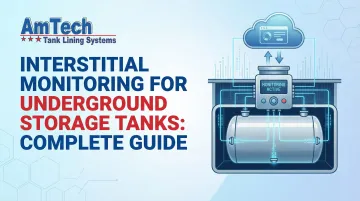
Interstitial monitoring is a federally required leak detection method for double-walled underground storage tank (UST) systems. It continuously checks the annular space between a tank's inner and outer walls, capturing any leaked product before it can reach soil or groundwater.
The consequences of failed monitoring are steep. According to an EPA cleanup cost study, average active remediation costs for leaking USTs hit $255,491 per site, with over 53,000 active cleanup sites nationally as of late 2025. Undetected leaks bring environmental contamination, regulatory fines, and remediation expenses that can cripple a facility's finances.
Understanding how interstitial monitoring works — and what can go wrong — is the foundation for staying compliant and avoiding those costs. This guide covers the types of systems available, regulatory requirements, warning signs of failure, and inspection scheduling guidelines.
Key Takeaways
- Interstitial monitoring detects leaks in the space between inner and outer walls before product escapes into the environment
- Federal EPA regulations require checking the interstitial monitor at least once every 30 days, with annual equipment testing also required
- All USTs installed or replaced after April 11, 2016 must use secondary containment with interstitial monitoring
- Monitoring systems range from manual dipsticks to fully automated electronic sensors
- A suspected release triggered by a monitoring alarm requires reporting to the state UST authority within 24 hours
What Is Interstitial Monitoring for USTs?
Interstitial monitoring is a release detection method that checks the annular (interstitial) space between the primary tank wall and a secondary containment barrier. This space is designed to capture any fuel that leaks through the inner wall before it can reach the soil or groundwater.
Understanding Secondary Containment
Federal regulations (40 CFR §280.12) strictly define secondary containment as a system with an inner and outer barrier with an interstitial space that is monitored for leaks. The barrier can be:
- A double-walled (jacketed) tank
- An internally fitted liner (bladder)
- A leakproof excavation liner surrounding the tank
Earthen materials like clay cannot serve as barriers—federal regulations explicitly exclude them. Any excavation-zone barrier must consist of artificially constructed material with permeability ≤ 10⁻⁶ cm/sec.
Comprehensive Coverage
Interstitial monitoring applies to both the tank and associated underground piping, giving it broader regulatory coverage than most other release detection methods under federal UST rules.
Monitoring Port Location
The interstitial monitoring port is typically located at the lowest point of the interstitial space—whether in the tank's annular area or within a containment sump. This placement ensures that any leaked product that pools in the annular space is captured and detected early.
What Monitors Detect
Monitors detect two categories of conditions:
- Physical presence of leaked liquid or vapor in the interstitial space
- Change in condition signaling a breach in the inner wall (e.g., loss of vacuum pressure or a shift in monitoring liquid levels)
Why Interstitial Monitoring Matters
Environmental Protection
A functioning interstitial monitoring system means a leak through the primary tank wall is caught before it reaches groundwater or soil, preventing contamination that can affect drinking water supplies and surrounding ecosystems. The EPA reports 581,676 cumulative confirmed UST releases since 1984, underscoring the critical need for effective early detection.
Regulatory and Legal Compliance
Federal EPA regulations (40 CFR §280.20) mandate release detection for all regulated USTs, and secondary containment with interstitial monitoring is one of the approved methods. Non-compliance can result in significant fines, forced facility closure, and mandatory corrective action orders.
Financial Risk of Undetected Leaks
The relatively low cost of maintaining an interstitial monitoring system contrasts sharply with the potential six- or seven-figure expense of environmental remediation, third-party liability, and regulatory penalties when a release goes undetected. Project duration is a significant cost driver—each additional day corresponds to approximately $116 in increased total project costs.
Secondary Containment Integrity
The monitoring system can only perform correctly if the secondary containment barrier remains intact and undamaged. Degraded linings or damaged outer walls compromise the interstitial space and produce false alarms or missed detections.
This is where professional tank lining inspection and repair becomes critical. AmTech Tank Lining & Repair provides comprehensive UST secondary containment assessment and restoration services, including ultrasonic testing to identify small permeations and pinholes before they escalate.
Their field crews repair corrosion holes at the locations most likely to fail: striker plates, weld points, and tank bottoms. Restoring these areas directly protects the integrity of the interstitial space and keeps monitoring systems performing as designed.
Operational Benefits
Early leak detection lets operators stay ahead of failures rather than react to them. Key operational advantages include:
- Schedule repairs during planned downtime instead of scrambling after an unplanned shutdown
- Avoid product loss and inventory discrepancies tied to slow, undetected leaks
- Reduce liability exposure by demonstrating active, documented monitoring compliance
Types of Interstitial Monitoring Systems
Interstitial monitoring systems vary widely in technology, complexity, cost, and automation level. The right choice depends on tank design, site conditions, the product stored, and your regulatory requirements.
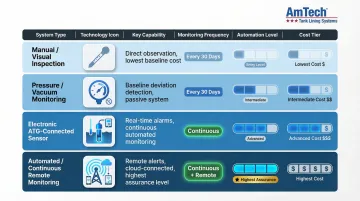
Manual/Visual Monitoring (Dipstick or Gauge Stick)
An operator physically inserts a gauge stick or dipstick into the interstitial access port at the lowest containment point to check for the presence of liquid (fuel or water) in the annular space. Results are recorded as "dry" or "liquid detected."
This is the simplest and lowest-cost option. It requires a physical inspection and recorded reading at least once every 30 days — no exceptions. Best suited for lower-volume or lower-risk installations where automation isn't justified.
Pressure and Vacuum Monitoring
Some double-walled tanks are designed with a pressurized or vacuum-maintained interstitial space. A gauge monitors for changes in pressure or vacuum level—a deviation from baseline indicates a breach in either the inner or outer wall.
Like manual systems, gauge readings must be checked and recorded every 30 days. Any deviation from the established baseline is treated as a potential leak indicator and requires follow-up.
Electronic Sensor Monitoring (ATG-Connected)
Electronic sensors (liquid-sensing probes) are installed within the interstitial space and wired to an Automatic Tank Gauge (ATG) console. The ATG continuously monitors for the presence of product or water in the annular space and provides real-time alarm notifications.
The ATG console acts as both the monitoring system and alarm interface. Operators must retrieve a sensor status report at least once every 30 days to confirm no liquid has been detected and satisfy recordkeeping requirements.
Key advantages over manual methods:
- Provides continuous monitoring rather than point-in-time checks
- Generates automatic alarms on liquid detection — no waiting for the next inspection cycle
- Consolidates interstitial data with other tank monitoring functions
Automated/Continuous Monitoring Systems
Fully automated systems use advanced sensor arrays and software to provide continuous, uninterrupted monitoring with remote alerts. These systems are most common at high-volume fuel facilities, fleet operations, and multi-tank sites.
Automated monitoring eliminates the human error risk of scheduled inspections and integrates with broader facility management platforms. The upfront cost is the highest of any monitoring type, but they offer the strongest assurance of continuous compliance — particularly for sites where a missed 30-day check carries significant regulatory exposure.
Regulatory Requirements and Compliance Standards
Core Federal EPA Requirements
Under 40 CFR §280.40 and §280.41, operators must meet three primary monitoring obligations:
- 30-Day Monitoring: Interstitial monitors must be checked at least once every 30 days.
- 3-Year Sump Testing: Containment sumps must be tested for liquid tightness every three years using vacuum, pressure, or liquid testing — or use double-walled sumps with periodic interstitial monitoring.
- Annual Equipment Testing: Release detection equipment must be tested and inspected each year, covering:
- Alarm operability
- Battery backup function
- Sensor communication
- Sensor residue inspection
- System configuration verification
Record-Keeping Obligations
- Results of interstitial monitoring system activity must be kept for the most recent 12 months
- Calibration, maintenance, and repair records for release detection equipment must be retained for at least one year
- Electronic equipment records must be retained for three years
- ATG systems can automate most of this record storage
Compliance Mandate for Newer Tanks
Staying on top of record-keeping is only part of the picture — installation standards carry equal weight. USTs installed or replaced after April 11, 2016 must be secondarily contained and use interstitial monitoring under federal regulation. State-level regulations may be more stringent than federal minimums, so operators should verify requirements with their state UST program.
Signs Your Interstitial Monitoring System Needs Attention
Triggered Alarms and Anomalous Readings
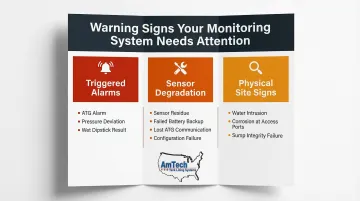
An ATG alarm, a change in pressure/vacuum gauge reading from baseline, or a "wet" result on a manual dipstick check signal a potential release or system malfunction. Under 40 CFR §280.50, these must be investigated and reported to the state UST authority within 24 hours. Never assume an alarm is a false positive without qualified investigation.
Sensor or Equipment Degradation
Signs that monitoring equipment itself needs service or replacement include:
- Residue or buildup on sensors
- Failed battery backup tests during annual inspection
- Loss of sensor communication with the ATG controller
- Inability to verify system configuration
Physical Signs During Routine Site Checks
Watch for these physical warning signs during routine inspections:
- Water intrusion into containment sumps, which interferes with liquid-sensing monitors
- Visible corrosion or damage around monitoring access ports
- Sump integrity failures that can compromise both the secondary containment system and the reliability of your interstitial monitoring
When secondary containment shows signs of structural compromise, a certified tank contractor should assess the lining and barrier integrity — not just the monitoring equipment. AmTech Tank Lining & Repair's NLPA Special Inspector uses ultrasonic testing to detect wall thinning or breaches in the primary tank wall before any release reaches the interstitial space.
AmTech reports that 98% of double-walled tanks assessed are structurally sound enough to be restored to full useful life expectancy through repair and lining.
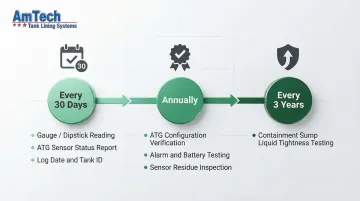
Interstitial Monitoring Inspection and Maintenance Schedule
Federal regulations set minimum inspection intervals for interstitial monitoring, and many state programs add requirements on top of those. Operators should formalize these intervals in a written inspection and maintenance plan to stay audit-ready and avoid compliance gaps.
Monthly (Every 30 Days)
Check and record results of interstitial monitoring:
- Manual gauge/dipstick reading
- Pressure/vacuum gauge reading
- ATG sensor status report printout
Log method used, date, tank ID, and result.
Annual
Test all release detection equipment for proper operation:
- Verify ATG system configuration
- Test alarm operability and battery backup
- Inspect sensors for residue buildup
- Confirm sensor-to-controller communication
- Check handheld non-electronic equipment for operability and serviceability
Retain records for at least one year (three years for electronic equipment).
Every 3 Years
Test containment sumps used for interstitial monitoring for liquid tightness using vacuum, pressure, or liquid testing per manufacturer requirements or a nationally recognized code of practice. Alternatively, use double-walled sumps with monitored interstitial space.
Operational and Site-Specific Factors
Site conditions can warrant checks beyond the regulatory minimums:
- High groundwater areas may need secondary containment systems that fully surround the tank to prevent moisture from interfering with sensors
- Sites with corrosive soils or extreme temperature swings should schedule more frequent visual inspections
- Always observe manufacturer service intervals for specific equipment alongside the federal and state requirements
Conclusion
Interstitial monitoring is a regulatory requirement and a critical environmental safeguard for any UST operation using secondary containment — not optional, and not interchangeable. The right monitoring method (manual, pressure/vacuum, electronic, or automated) must match the site, tank design, and operational volume.
The system is only as reliable as the secondary containment barrier it monitors. Sustained compliance depends on keeping all components in good working order:
- Calibrate monitoring equipment on the manufacturer's recommended schedule
- Keep inspection and alarm records current for regulatory review
- Maintain the containment lining in sound condition — cracks, delamination, or chemical degradation compromise detection accuracy
- Schedule periodic professional assessments of containment barriers before problems appear
Effective interstitial monitoring isn't a standalone task. It works alongside regular tank inspection and preventative maintenance to protect against costly remediation and unplanned downtime.
Frequently Asked Questions
What is interstitial monitoring?
Interstitial monitoring is a leak detection method that checks the annular space between a UST's primary tank wall and its secondary containment barrier for the presence of leaked product. It detects releases before they reach the surrounding environment.
How often must the interstitial monitor be checked?
Federal EPA regulations require the interstitial monitor to be checked at least once every 30 days, with results recorded. Annual equipment testing and containment sump integrity testing every three years are also required.
What are interstitial monitors used to detect?
Monitors detect either the physical presence of leaked liquid or vapor in the interstitial space, or a change in condition (such as a loss of vacuum or pressure) that indicates a breach in the inner tank wall.
What are the acceptable methods of UST release detection monitoring?
The EPA accepts several release detection methods: interstitial monitoring, automatic tank gauging, statistical inventory reconciliation, manual tank gauging, vapor monitoring, groundwater monitoring, and monthly inventory control. Interstitial monitoring is required for all USTs installed or replaced after April 11, 2016.
Can interstitial monitoring be used in piping?
Yes, secondary containment with interstitial monitoring can also be applied to underground piping associated with UST systems, providing release detection coverage beyond the tank itself.
Where is the interstitial monitoring port typically located?
The monitoring port or sensor access point is positioned at the lowest point of the interstitial space, whether in the tank's annular area or within a containment sump. This placement ensures any leaked product that pools there is detected as early as possible.