NFPA 22 (Standard for Water Tanks for Private Fire Protection) defines how these tanks must be designed, installed, and maintained to ensure reliable performance when seconds matter. This guide covers what facility managers, building owners, contractors, and safety professionals need to know about staying compliant with NFPA 22 requirements—from initial design through long-term maintenance.
Key Takeaways
- NFPA 22 sets minimum requirements for design, construction, installation, and maintenance of water storage tanks used for private fire protection
- Covers gravity tanks, suction tanks, pressure tanks, and bolted/welded steel tanks
- NFPA 25 governs ongoing inspection and maintenance, including periodic internal evaluations
- Non-compliance triggers stop-work orders, voided insurance, occupancy denial, and legal liability
- Interior tank condition directly impacts compliance—corrosion and sediment reduce usable capacity
What Is NFPA 22 and Who Does It Apply To?
NFPA 22, Standard for Water Tanks for Private Fire Protection, is published by the National Fire Protection Association and governs water tanks that supplement or replace public water supply for fire suppression systems including sprinklers, standpipes, and private hydrants. The 2023 edition added one notable update: pump suction pressure must now be explicitly factored into tank capacity calculations.
NFPA 22 does not prescribe fixed tank sizes. It requires that sizing and elevation be calculated based on the hydraulic demand, required pressure, and duration of the specific fire protection system the tank supports. Tanks must be engineered to deliver adequate flow and pressure for the design duration—typically 30 to 90 minutes depending on occupancy hazard classification.
NFPA 22 compliance is typically required in four scenarios:
- New construction where municipal supply is inadequate in flow, pressure, or reliability
- Major renovation that updates or replaces the fire protection system
- Change of use or occupancy that increases fire hazard classification
- AHJ (Authority Having Jurisdiction) or insurance carrier mandate as a condition of coverage or occupancy permit
According to the International Fire Code (IFC) Section 507.2.2, water tanks for private fire protection shall be installed in accordance with NFPA 22. The IFC explicitly grants Authorities Having Jurisdiction (AHJs)—fire marshals, building inspectors, or local code officials—the power to mandate private fire protection water supplies when municipal infrastructure is inadequate.
That insurer pressure is backed by hard data. According to FM Global, 80% of sprinkler failures trace back to valve, impairment, or inspection/testing/maintenance (ITM) issues—which is exactly why carriers increasingly require reliable private water supplies backed by NFPA 22-compliant tanks.
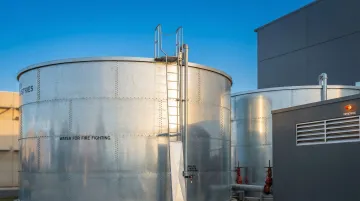
Tank Types and Materials Covered Under NFPA 22
The 2023 edition of NFPA 22 covers six tank configurations for private fire protection:
Approved Tank Types:
- Gravity tanks — elevated to provide hydrostatic pressure for direct sprinkler feed
- Suction tanks — ground-level tanks feeding fire pumps
- Pressure tanks — air-pressurized for immediate water delivery
- Welded steel tanks — constructed per AWWA D100 standards
- Bolted steel tanks — factory-coated, assembled on-site per AWWA D103
- Embankment-supported coated fabric tanks — flexible membrane tanks for suction applications
Approved Construction Materials (NFPA 22 Section 4.4):
| Material | Applicable Standard |
|---|---|
| Steel | AWWA D100 (welded), AWWA D103 (bolted) |
| Concrete | ACI 318, ACI 350 |
| Wood | NFPA 22 Chapter 10 |
| Fiberglass-Reinforced Plastic (FRP) | NFPA 22 Chapter 8 |
| Coated Fabrics | NFPA 22 Chapter 9 |
Not every water tank sold commercially qualifies as an NFPA 22-compliant fire protection tank. The material, structural design, appurtenances, and engineering documentation must all meet the standard's requirements, unless the tank demonstrates equivalency to the AHJ under NFPA 22 Section 1.4. FM 4020 is the Approval Standard for Steel Tanks for Fire Protection, outlining specific criteria for ground-supported and elevated steel tanks.
Compliance doesn't stop at structural design. Interior surfaces of steel tanks exposed to water immersion must be coated in accordance with AWWA D102, which governs protective coating systems for both the interior and exterior surfaces of steel water storage tanks.
Key NFPA 22 Design and Installation Requirements
Capacity and Elevation Framework
NFPA 22 Chapter 4 establishes the baseline criteria that govern how a water storage tank must be sized, positioned, and sourced. Key requirements include:
- Tank capacity and elevation must reflect actual fire demand calculations (flow rate × duration)
- Water source must be "adequate and dependable"
- Tank placement must minimize exposure to fire hazards with clear access for inspection and fire department use
- Net usable capacity (between overflow inlet and discharge outlet) must meet design demand
The 2023 edition updated tank sizing requirements to account for pump suction pressure. Annex A.4.1.6 specifies that suction tanks must provide adequate fire pump net positive suction head (NPSH) per NFPA 20.
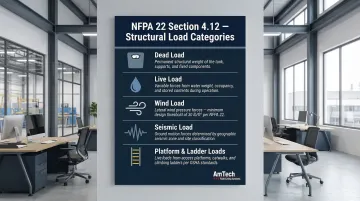
Structural Load Requirements (NFPA 22 Section 4.12)
Tanks must be engineered for:
- Dead load — tank weight and fittings
- Live load — full water capacity including overflow
- Wind load — minimum 30 lb/ft² on vertical surfaces (or greater per local code)
- Seismic load — per local building code adoption
- Platform/ladder loads — per OSHA requirements
Under IBC Table 1604.5 and ASCE 7 Table 1.5-1, fire suppression water storage facilities are classified as Risk Category IV essential facilities — the same category as hospitals and emergency response infrastructure.
This classification applies higher seismic and wind importance factors than standard commercial tanks. The intent is straightforward: these tanks must remain functional after the events most likely to demand them.
Roof, Venting, and Appurtenances
Beyond structural loads, NFPA 22 specifies physical components that must be present and properly configured.
Roof requirements:
- Must support personnel weight during installation, inspection, and maintenance
- Airtight steel roofs require a substantial vent positioned above the maximum fill line
- Vents must be fitted with corrosion-resistant screens to prevent contamination
Mandatory appurtenances:
- Properly sized inlet, overflow, and discharge piping
- Valves with appropriate supervision
- Frost-proof casing where applicable
- Ladders meeting OSHA safety requirements
- Confined space entry signage at each shell manway
- Heating systems in cold climates
- Fill line discharge located a minimum of 10 pipe diameters from the suction pipe
Contractor Documentation Requirements (NFPA 22 Sections 4.5–4.7)
To achieve AHJ compliance, contractors must submit and receive approval for the following before installation proceeds:
- Engineering stress sheets
- Structural drawings and calculations
- Seismic bracing details
- Pipe and valve layouts
- Heat-loss calculations (if heating required)
- Maintenance plans
NFPA 22 vs. NFPA 25: Inspection, Testing, and Ongoing Maintenance
NFPA 22 is a design and installation standard: it governs what the tank must be when it is built. NFPA 25 (Standard for the Inspection, Testing, and Maintenance of Water-Based Fire Protection Systems) governs what must happen to keep the tank operational over its service life. Both standards apply to the same tank; neither replaces the other.
NFPA 25 Inspection Schedule
The 2023 edition of NFPA 25 defines strict frequency windows:
| Inspection Type | Frequency | NFPA 25 Reference |
|---|---|---|
| Visual checks (water level, exterior, heating) | Monthly | 9.2.4.1 / 9.2.5.1 |
| Valve and alarm testing | Quarterly | Chapter 13 |
| Comprehensive inspection | Annual | 9.2.4.4 / 9.2.5.4 |
| Internal inspection (steel tanks with corrosion protection) | 5 years | 9.2.5.1.2 / 9.2.6.1.2 |
| Internal inspection (steel tanks without corrosion protection) | 3 years | 9.2.5.1.1 / 9.2.6.1.1 |
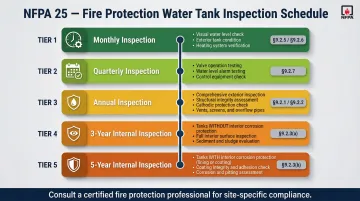
Critical Note: The presence of interior corrosion protection directly impacts required inspection frequency. Steel tanks without protective coatings require internal inspections every 3 years instead of 5 years, raising lifecycle inspection costs noticeably over the tank's service life.
What Inspectors Evaluate
During NFPA 25 inspections, qualified inspectors assess:
- Corrosion on shell or roof panels
- Sediment depth at tank bottom
- Valve operability and proper positioning
- Pressure conditions and system integrity
- Leaks at seams or fittings
- Water level relative to design demand
- Condition of interior coatings or liners
- Cathodic protection systems (if present)
- Freeze protection and heating systems
- Venting and overflow systems
Deficiency Classifications Under NFPA 25
NFPA 25 uses three classifications to categorize what inspectors find:
| Classification | What It Means | Required Response |
|---|---|---|
| Impairment | System is out of order and cannot function in a fire event | Immediate corrective action |
| Critical Deficiency | Has a material effect on the system's ability to function as intended | Remediation within specified timeframes |
| Noncritical Deficiency | Does not materially affect function, but falls short of standard requirements | Correction required, less urgent timeline |
Unresolved deficiencies risk occupancy suspension, voided insurance coverage, or AHJ enforcement action.
Record-Keeping Requirements
All inspection logs, test results, and maintenance records must be retained and made available to fire marshals, insurance adjusters, and AHJs:
- Life of system: As-built drawings, hydraulic calculations, original acceptance test records, device manufacturer data sheets
- Minimum 1 year: Inspection, testing, and maintenance records (retained until next inspection of that type)
Failure to produce documentation can itself trigger a non-compliance finding independent of the physical condition of the tank.
How Tank Interior Condition Affects NFPA Compliance
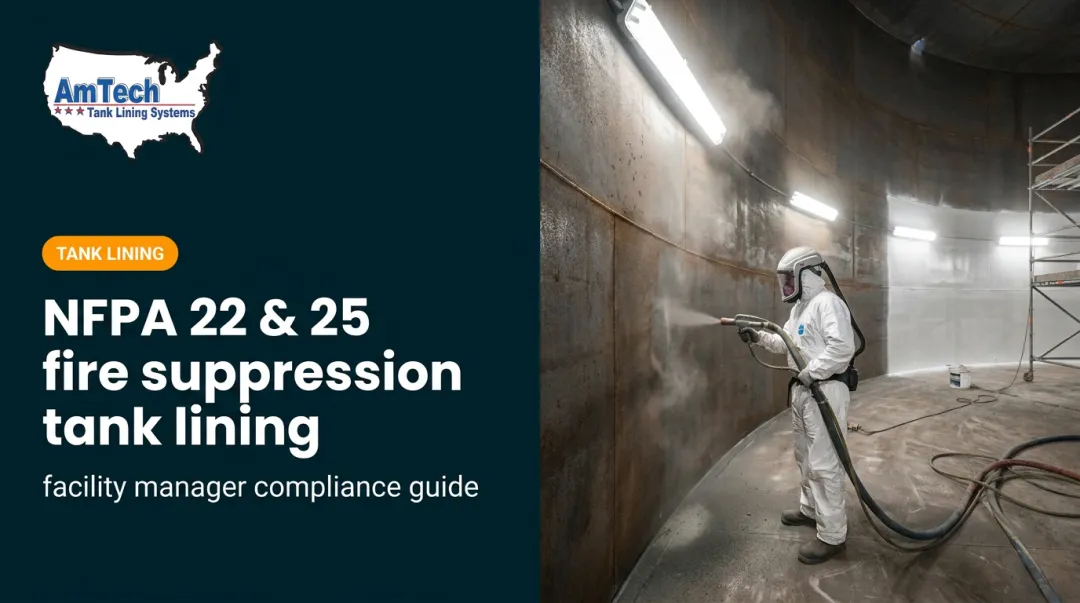
Interior deterioration poses a hidden compliance risk: corrosion on tank walls and floor, sediment accumulation at the outlet, and lining failure can reduce the tank's usable water volume below what the fire protection system requires. This makes a structurally-installed tank non-compliant with NFPA 22's capacity requirements.
What 5-Year Internal Inspections Reveal
Common findings in aging fire suppression tanks include:
- Coating breakdown — protective paint systems failing after 10-15 years
- Rust streaks and pitting on steel surfaces, particularly near welds and seams
- Sediment accumulation that raises the effective "dead" volume at tank bottom
- Liner delamination in tanks with membrane systems
- Corrosion perforation in severe cases requiring immediate repair
These findings carry direct compliance consequences. Research confirms that pitting corrosion can appear on galvanized steel even in neutral drinkable water, and when pitting, corrosion, or coating failures are discovered, NFPA 25 requires follow-up testing — including ultrasonic thickness measurement — to determine whether the tank remains fit for service.
The Role of Interior Tank Linings in Long-Term Compliance
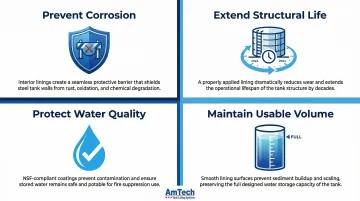
Protective coatings and cementitious or polymer linings serve four critical functions:
- Prevent corrosion — creating a barrier between water and steel substrate
- Extend structural life — protecting against pitting and perforation
- Protect water quality — preventing rust contamination
- Maintain usable volume — preserving the full capacity the system was designed around
AWWA D102 and D130 provide guidance on minimum coating thicknesses referenced by fire protection engineers for steel tanks. Interior surfaces exposed to water immersion must be cleaned to SSPC SP 10 and painted in accordance with AWWA D102.
Tank Relining: Restoring Compliance Without Full Replacement
When the 5-year internal inspection reveals interior degradation, facility managers face a choice between full tank replacement and professional relining. A hybrid environmental life-cycle assessment published in the Journal of Infrastructure Systems found that refurbishing an existing tank is preferable to new tank construction across all environmental impact categories, with economic analyses also favoring tank refurbishment.
Relining with a properly specified system can restore full compliance and extend service life by decades at a fraction of tank replacement cost.
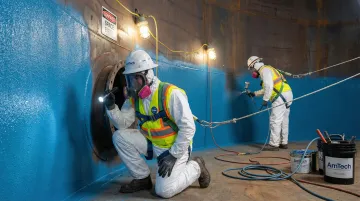
AmTech Tank Lining & Repair applies several field-proven lining systems specifically suited to fire suppression water tanks, each selected based on tank condition, water chemistry, and compliance requirements:
- DuraChem® 500 series polylining — 100% solids instant cure system with NSF and ANSI 61 compliance, providing up to 1965 PSI adhesion strength
- HydraStone Alkrete® cementitious lining — capable of withstanding temperatures up to 900°F with a 40-year proven performance history
- AmTech Pro-Line® Epoxy Linings — offering 15+ year service life when properly applied
AmTech's engineer-led field crews have relined fire suppression water tanks for municipal, commercial, and industrial facilities across all 50 US states for 55+ years. Surface preparation meets SSPC, NACE, and ASTM standards — a requirement for any lining system to achieve its rated service life and maintain NFPA compliance.
Compliance Triggers, Legal, and Insurance Implications
Enforcement Pathway
Authorities Having Jurisdiction (AHJs)—typically fire marshals, building inspectors, or local code officials—enforce NFPA 22 and NFPA 25 compliance during:
- Plan review for new construction
- Site inspections during installation
- Renovation permitting
- Occupancy renewal
- Routine fire safety inspections
Many jurisdictions formally adopt NFPA standards into local law, making them legally binding rather than advisory. For example, Maryland officially adopted the 2024 edition of NFPA 1 (and thereby NFPA 25-2023) effective June 23, 2025.
Insurance Implications
Many commercial and industrial insurers require NFPA 22-certified tank systems as a precondition for property coverage, especially for facilities with inadequate municipal water supply. The Insurance Services Office (ISO) Fire Suppression Rating Schedule weights Water Supply at 40% of the total community fire protection score, directly impacting property insurance premiums.
Key Insurance Considerations:
- NFPA 25 compliance directly affects premium rates — lapses can trigger rate increases
- Documented inspection records support your position as a low-risk insured
- Non-compliant tank systems can result in reduced or denied coverage when fire claims are filed
- Insurers may require inspection schedules and written deficiency remediation plans
Legal Liability Exposure
NFPA codes establish a recognized standard of care in the industry. In the event of fire damage or personal injury, non-compliance with NFPA 22 or NFPA 25 can be introduced as evidence of negligence in civil proceedings.
In Washington Dept. of Labor & Industries v. Phillips 66, the Washington Court of Appeals upheld citations against a refinery for failing to inspect the interior of its fire water system's storage tank. The court affirmed that the fire water system falls within the Process Safety Management (PSM) rule's definition of a "process" and that the employer failed to comply with NFPA 25 Section 9.2.6.1.2 (5-year internal inspection requirement).
Property owners, facility managers, and contractors each carry potential liability for compliance failures within their scope of responsibility.
Frequently Asked Questions
Which NFPA standard covers water tanks for private fire protection?
NFPA 22 (Standard for Water Tanks for Private Fire Protection) is the governing standard, covering design, construction, installation, and maintenance requirements for tanks that supply sprinklers, standpipes, and private hydrants when public water is inadequate.
How often do water tanks for private fire protection need to be inspected?
NFPA 25 requires monthly visual checks, quarterly valve testing, annual comprehensive inspections, and 5-year internal inspections. Steel tanks without corrosion protection are inspected internally every 3 years instead of 5.
What is the difference between NFPA 22 and NFPA 25?
NFPA 22 governs the design and installation of fire protection water tanks, while NFPA 25 governs the ongoing inspection, testing, and maintenance of water-based fire protection systems—including the same tanks—over their operational life. Both standards apply; neither replaces the other.
What tank types and materials does NFPA 22 approve?
NFPA 22 approves gravity tanks, suction tanks, pressure tanks, bolted steel tanks, welded steel tanks, and embankment-supported fabric tanks. Approved materials include steel (per AWWA D100/D103), concrete (per ACI 318/350), wood, FRP, and coated fabrics, with each required to meet relevant structural performance standards.
What happens if a fire protection water tank fails an NFPA 25 inspection?
NFPA 25 classifies deficiencies and mandates remediation timelines based on severity. Unresolved findings can trigger occupancy restrictions, insurance complications, and AHJ enforcement actions including stop-work orders or occupancy denial.
Do fire protection water tanks require interior linings or coatings to meet NFPA 22 standards?
NFPA 22 does not prescribe a specific lining product, but requires materials that maintain structural integrity and usable capacity. Interior coatings are typically required for steel tanks to prevent corrosion, with AWWA D102 and D130 providing coating guidance referenced by engineers and AHJs.