Introduction
Atmospheric storage tanks form the backbone of industrial liquid containment worldwide. From underground fuel tanks at neighborhood gas stations to massive crude oil tanks at refineries and municipal water towers serving entire communities, these vessels keep daily operations running across countless facilities.
Yet the operating mechanics of atmospheric tanks — how they manage pressure, handle liquid movement, and protect their contents — remain poorly understood beyond surface-level definitions. That knowledge gap leads to preventable maintenance errors, premature tank failures, and safety incidents that cost facilities thousands in downtime and emergency repairs.
Key Takeaways
- Atmospheric storage tanks hold liquids at ambient pressure up to 0.5 psig, vented directly to prevent pressure buildup
- Core operation depends on a venting system that equalizes pressure as liquid levels and temperatures shift
- Fixed roof tanks suit low-volatility liquids; floating roof tanks minimize vapor loss for volatile hydrocarbons
- Used across petroleum, chemical, water/wastewater, and manufacturing industries for cost-effective bulk storage
- Proper vent sizing and tank lining are critical to preventing structural failure and extending service life
What Is an Atmospheric Storage Tank?
An atmospheric storage tank is a storage vessel designed to hold liquids at internal pressures ranging from ambient atmospheric pressure up to 0.5 psi gauge (approximately 3.45 kPa), with the tank vented directly to the surrounding atmosphere. According to OSHA 29 CFR 1910.106(a)(2), this pressure threshold strictly defines the atmospheric classification — exceeding 0.5 psig requires design under different codes.
These tanks exist to store large volumes of water, petroleum, chemicals, and hydrocarbons that don't require pressurized containment — at a scale that pressure vessels simply can't match economically. A 500,000-gallon atmospheric tank costs a fraction of an equivalent pressure vessel while safely containing liquids with low vapor pressures.
Atmospheric tanks differ fundamentally from low-pressure tanks (which operate up to 15 psig) and pressure vessels used for liquefied gases like LPG and liquid nitrogen. Underground gasoline station tanks operate at atmospheric pressure; propane tanks are pressure vessels requiring reinforced construction.
The EPA reports 533,277 active underground storage tanks operating at atmospheric pressure across approximately 190,000 U.S. facilities — a scale that underscores how central this tank type is to industrial and commercial infrastructure.
Design and construction must meet rigorous industry standards, including:
- API 650 — Welded Tanks for Oil Storage (structural requirements, material selection, venting)
- UL 142 — Steel Aboveground Tanks for Flammable and Combustible Liquids
- OSHA 29 CFR 1910.106 — defines the 0.5 psig atmospheric pressure threshold
- API 653 — governs inspection, repair, and alteration of in-service tanks
In terms of physical scale, these thin-walled vessels range from roughly 5,000 gallons (20 cubic meters) to over 5,000,000 gallons (19,000 cubic meters), constructed above ground or installed underground depending on application requirements.
How Does an Atmospheric Storage Tank Work?
An atmospheric storage tank functions through continuous balance between liquid volume, vapor space, and atmospheric pressure — with a venting system at the center of that balance, allowing the tank to respond to both mechanical and thermal changes without structural damage.
The Venting Mechanism: How a Tank "Breathes"
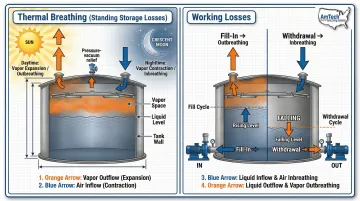
Two distinct loss mechanisms drive venting behavior:
- Thermal breathing — what the EPA calls "standing storage losses." As daytime temperatures rise, liquid expands and vapors heat up, increasing internal pressure; the vent releases excess vapor to prevent overpressure. Overnight, cooling vapors contract and the vent draws in outside air to prevent the underpressure (vacuum) that can collapse thin tank walls.
- Working losses — generated during every transfer operation. Liquid pumping in displaces vapor out through the vent (outbreathing); liquid withdrawing creates partial vacuum that pulls air in (inbreathing). API Standard 2000 provides the definitive guidance for sizing vents to handle both conditions — undersized vents are a primary failure mode.
Vent types include:
- Open vents — simple atmospheric vents for non-volatile contents like water
- Pressure-vacuum (PV) valves — conservation vents for volatile liquid tanks that limit vapor loss and prevent ignition risk
- Emergency vents — designed to relieve excessive pressure from abnormal events such as external fire exposure
Filling and Withdrawal Operations
Fill and withdrawal cycles each place distinct demands on the venting system:
Fill cycles: Liquid enters via inlet nozzles (typically at the bottom or side), raises the liquid level, compresses the vapor space, and triggers outbreathing through the vent. Bottom-filling and dip-pipe filling minimize splashing and reduce electrostatic charge buildup — a critical safety consideration for flammable contents. API RP 2003 limits initial fill velocity to 1 meter per second until the fill pipe is submerged by at least two pipe diameters.
Withdrawal cycles: Pumps draw liquid out through outlet nozzles, the liquid level drops, the vapor space expands, and the vent introduces outside air (or inert gas in blanketed systems) to equalize pressure and prevent tank collapse.
Pressure and Safety Controls
While atmospheric tanks aren't pressure vessels, they still require active pressure management. Both overpressure (from thermal expansion, volatile vapor generation, or rapid filling) and underpressure (from rapid withdrawal or sudden temperature drops) can cause structural damage, tank rupture, or implosion.
The consequences of getting this wrong are severe. The EPA documented catastrophic failures where improperly vented atmospheric tanks failed at shell-to-bottom seams, propelling 30-foot tanks over 50 feet into the air.
Secondary safety controls include:
- Emergency pressure-relief vents opening at set overpressure thresholds
- Tank diking and secondary containment berms capturing spills per EPA SPCC regulations
- Flame arresters on vents preventing external ignition sources from reaching vapor space inside tanks storing Class IB and IC flammable liquids
Types of Atmospheric Storage Tanks
Fixed Roof Tanks
Fixed roof tanks feature a cylindrical steel shell with a permanently welded roof in cone, dome, or flat configurations. The roof and shell don't move. These tanks store liquids with True Vapor Pressure (TVP) below 10 kPa absolute (approximately 1.5 psia), including gas oil, fuel oil, water, and kerosene.
Because there's always a fixed vapor space between the liquid surface and the roof, these tanks experience evaporative breathing losses. EPA AP-42 provides calculation methods for estimating standing and working losses, which can be substantial for volatile products. Properly sized vents are essential to manage pressure fluctuations during filling, withdrawal, and temperature changes.
Floating Roof Tanks
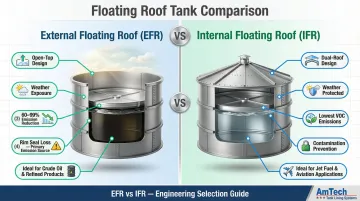
Floating roof tanks feature a roof structure that physically floats on the liquid surface and rises or falls with the liquid level. This eliminates or dramatically reduces vapor space and associated evaporative losses, making these tanks ideal for petroleum products with TVP between 10.3 and 76.5 kPa absolute.
Two configurations are used depending on the application:
- External floating roof (EFR): Open-top cylindrical tanks where the floating deck is exposed to weather. Used for large-volume crude oil and refined product storage, EFR tanks can reduce emissions by 60–99% compared to fixed roof tanks but remain susceptible to wind-induced rim seal losses.
- Internal floating roof (IFR): A permanent fixed outer roof with a floating roof inside. The fixed roof blocks wind and weather, cutting VOC emissions further and eliminating wind-dependent loss components. IFR tanks are standard for jet fuel and other applications where air or water contamination must be excluded. Aviation fuel facilities favor this design specifically to prevent debris contamination and reduce fire risk.
Where Atmospheric Storage Tanks Are Used
Atmospheric storage tanks serve as primary containment across diverse industrial environments:
- Petroleum refining and oil & gas: Crude oil, gasoline, diesel, and kerosene at refineries, terminals, and distribution facilities. The U.S. Energy Information Administration tracks working and net available shell capacity across U.S. facilities.
- Chemical processing: Acids, solvents, and process chemicals requiring corrosion-resistant containment — for example, fiberglass tanks storing ferric chloride at wastewater treatment plants.
- Municipal water and wastewater: Potable water towers, fire suppression reservoirs, equalization basins, clarifiers, and digesters.
- Food and beverage: Edible oils, syrups, and liquid ingredients in food-grade containment.
- Manufacturing: Bulk liquid raw material storage supporting production operations.
Why atmospheric tanks are preferred: When stored liquids have low vapor pressures, don't require refrigerated or pressurized containment, are needed in large volumes, and cost-effective code-compliant construction is a priority, atmospheric tanks offer the best balance of capacity, cost, and regulatory manageability.
Critical maintenance consideration: Tanks in corrosive or chemically aggressive service — petroleum, wastewater, chemical storage — are particularly vulnerable to interior wall degradation over time. API 653 inspections frequently identify severe soil-side bottom corrosion and product-side pitting, with depths reaching 0.200 inches in documented cases.
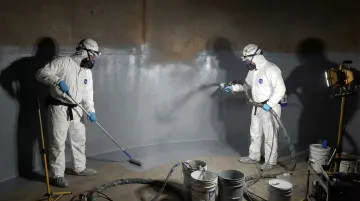
Proper tank lining systems are essential to extending service life and preventing contamination or structural failure. AmTech Tank Lining & Repair applies field-proven lining systems — including DuraChem 500 series polylining and HydraStone Alkrete cementitious lining — across all of these service environments throughout the U.S., Canada, and the Caribbean.
Conclusion
Atmospheric storage tanks operate through a deliberate engineering balance: vented to equalize pressure, built with the right roof geometry for the vapor pressure of stored contents, and constructed to code standards that hold up across decades of fill-and-drain cycles.
Understanding those fundamentals — venting, roof design, and interior condition — gives facility operators, engineers, and maintenance teams a clearer basis for:
- Selecting the right tank type for the application
- Extending service life through timely inspection
- Scheduling relining before corrosion or lining failure forces unplanned downtime
With a sound lining system and routine maintenance, an atmospheric tank is a long-term asset. Without it, early-stage corrosion quietly compounds until the repair cost dwarfs what a proactive relining would have run.
Frequently Asked Questions
What is an atmospheric storage tank?
An atmospheric storage tank is a storage vessel designed to hold liquids at pressures from ambient atmospheric pressure up to 0.5 psig, vented directly to the atmosphere to prevent pressure buildup. These tanks are used widely in petroleum, chemical, water, and industrial applications for cost-effective bulk liquid storage.
What is the difference between an atmospheric tank and a pressure tank?
Atmospheric tanks operate at or near ambient pressure (up to 0.5 psig) and are vented to the environment, while pressure tanks are sealed, reinforced vessels designed to contain fluids at significantly higher pressures. Pressure vessels are used for substances like LPG, liquid nitrogen, or steam and are not vented to atmosphere.
What are two types of atmospheric tanks?
The two primary types are fixed roof tanks and floating roof tanks. Fixed roof tanks have permanently welded roofs and are used for lower vapor pressure liquids like water and fuel oil; floating roof tanks have a roof that rises and falls with the liquid level to minimize vapor space, making them the standard choice for volatile hydrocarbons like gasoline and crude oil.
What does an atmospheric tank contain?
Atmospheric tanks store a wide range of liquids including water, crude oil, gasoline, diesel, kerosene, chemical products, hydrocarbons, and wastewater — any liquid that can be held safely at or near ambient pressure.
What is an atmospheric water tank?
An atmospheric water tank stores potable water, fire suppression water, or service water at ambient pressure. Because water has negligible vapor pressure, these tanks typically use open-top or fixed roof designs without the need for vapor control measures.
What atmospheric hazards would be expected in a gasoline storage tank?
Primary hazards include flammable vapor accumulation (especially in fixed roof tanks), ignition risk from electrostatic charge or external sources, and overpressure/underpressure events from rapid filling or temperature swings. The 2009 CAPECO terminal incident illustrated these dangers when an overflowing gasoline tank generated a vapor cloud that ignited, triggering secondary explosions — all preventable through proper vent design, flame arresters, bonding and grounding, and correct roof type selection.