How often should storage tanks be inspected?
API Standard 653 requires above-ground atmospheric storage tanks to undergo formal internal inspections at intervals not exceeding 10 years, with external inspections conducted at least every 5 years. However, these are maximum intervals—actual inspection frequency should be based on stored product corrosivity, operating conditions, tank age, and regulatory requirements. Facilities storing highly corrosive chemicals, wastewater, or petroleum products in aggressive environments may require annual or biennial inspections. Tanks with known corrosion issues or past failures need more frequent monitoring. AmTech recommends developing a risk-based inspection program that accounts for your specific operational profile, regulatory obligations, and asset criticality.
What does an above-ground storage tank inspection include?
A comprehensive AmTech tank inspection includes ultrasonic thickness testing to detect wall thinning and permeations, visual assessment of interior and exterior surfaces for corrosion and structural damage, coating condition evaluation to identify lining failures, weld seam inspection, nozzle and penetration integrity checks, tank bottom floor pan assessment, roof structural evaluation for atmospheric tanks, and documentation of findings with repair recommendations. Our engineer-led teams provide detailed reports with ultrasonic thickness maps, photographic evidence, API 653 compliance verification, and prioritized repair specifications. The inspection scope can be customized based on tank type, stored product, regulatory requirements, and your specific concerns.
Can you inspect tanks without taking them out of service?
AmTech offers external inspection services that can be performed on in-service tanks, including ultrasonic thickness testing from the exterior, visual assessment of accessible surfaces, nozzle and piping connection evaluation, and coating condition surveys. However, comprehensive interior inspections require the tank to be drained, cleaned, and ventilated to ensure inspector safety and allow thorough assessment of internal surfaces, lining systems, and floor pans. For critical assets that cannot be taken offline, we can develop phased inspection programs or utilize specialized remote inspection technologies where applicable. Our team works with your operational schedule to minimize downtime impact.
What inspection methods do you use to detect hidden corrosion?
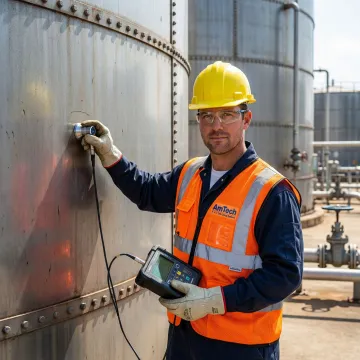
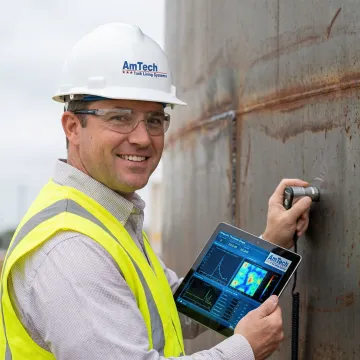
AmTech employs ultrasonic testing (UT) as the primary non-destructive method for detecting hidden corrosion, wall thinning, and micro-permeations invisible to visual inspection. Our technicians use calibrated ultrasonic thickness gauges that send high-frequency sound waves through the tank wall, measuring the time required for the wave to reflect back from the opposite surface. This provides precise wall thickness measurements accurate to thousandths of an inch, revealing internal corrosion, pitting, and substrate degradation beneath coatings or scale. For fiberglass tanks, we use specialized UT techniques and visual indicators to detect delamination and resin matrix degradation. Our inspection reports include detailed thickness mapping that documents corrosion patterns and progression rates.
How long does a tank inspection take?
Inspection duration depends on tank size, complexity, accessibility, and the scope of assessment required. A basic external inspection of a small above-ground storage tank (5,000-10,000 gallons) typically takes 4-8 hours. Comprehensive internal inspections of larger petroleum or chemical storage tanks (50,000+ gallons) can require 2-5 days including tank preparation, entry procedures, systematic ultrasonic scanning, coating evaluation, and documentation. Multi-tank facilities may require a week or more for complete site assessment. AmTech provides realistic timeline estimates during project scoping and works efficiently to minimize facility downtime. Emergency inspections for suspected failures or regulatory compliance issues can be expedited with rapid crew mobilization.
What certifications do your inspectors hold?
AmTech's inspection teams include NLPA Special Inspectors, OSHA 10 and OSHA 30 certified technicians, and field engineers trained in API Standard 653 inspection protocols for atmospheric storage tanks. Our inspectors maintain current certifications in ultrasonic testing (UT) techniques and non-destructive examination methods. The company operates as an ANSI-compliant, NSF-compliant, and API-compliant organization, ensuring all inspection work meets or exceeds industry standards. Our field engineering staff provides technical oversight on complex assessments, and all inspection reports are reviewed by licensed engineers before delivery. This multi-layered approach ensures you receive accurate, defensible inspection data that satisfies regulatory requirements.
What happens if your inspection finds serious problems?
When our inspection reveals significant corrosion, structural damage, or lining failure, we provide a detailed engineering report with prioritized repair recommendations, estimated repair costs, and timeline options. AmTech can immediately mobilize repair crews to address critical issues—we maintain our own experienced field teams equipped with proprietary repair materials including DuraChem 500 series polylinings, HydraStone cementitious systems, fiberglass repair laminates, and welding equipment for structural steel work. For emergency situations requiring immediate containment, we offer temporary sealing solutions while permanent repairs are scheduled. Our integrated inspection-to-repair capability eliminates coordination delays and ensures your tank is restored using the same technical standards applied during assessment.
Do you provide inspection reports for regulatory compliance?
Yes, AmTech delivers comprehensive inspection reports formatted to meet EPA, API Standard 653, state environmental agency, and local fire marshal requirements. Reports include detailed ultrasonic thickness data with location mapping, photographic documentation of observed conditions, coating assessment findings, structural integrity evaluations, compliance status verification, and engineering recommendations for repairs or continued service. Our NLPA Special Inspectors and field engineers ensure all documentation meets the technical rigor required for regulatory submittals, insurance reviews, and due diligence assessments. We can coordinate directly with your regulatory contacts and provide testimony or clarification as needed to support your compliance obligations.