Introduction
A fuel tank leak is a serious safety hazard and regulatory liability. Whether you operate a commercial underground storage tank (UST) at a service station or find fuel pooling beneath a vehicle, leaks create immediate fire and explosion risks from volatile fuel vapors.
Beyond the safety risks, leaks cause ongoing fuel loss and environmental contamination of soil and groundwater. For commercial operators, the stakes climb higher: EPA violations carry steep fines, and mandatory remediation costs can exceed $250,000.
This guide covers the root causes of fuel tank leaks, warning signs you shouldn't ignore, repair options ranging from temporary patches to permanent relining, realistic cost ranges for each approach, and the critical decision framework for repair versus replacement. You'll also learn how proactive inspection and lining programs prevent leaks before they start—protecting your operation from unplanned downtime, liability exposure, and remediation costs.
Key Takeaways
- Most fuel tank leaks stem from corrosion, physical impact damage, or degraded seals at connection points
- Warning signs include persistent fuel odor, visible pooling or staining, unexpected fuel loss, and EVAP system codes (P0440–P0457) on vehicles
- Repair options include professional welding, seal replacement, internal relining, and full tank replacement — epoxy patches are temporary and not code-compliant for commercial tanks
- Vehicle repairs run $150–$500 for minor fixes and $1,657–$1,869 for full tank replacement; commercial relining costs vary by tank size and damage extent
- Professional tank relining adds 20+ years of service life and is the most cost-effective long-term fix for commercial and industrial tanks
What Causes Fuel Tank Leaks?
Corrosion and Internal Degradation
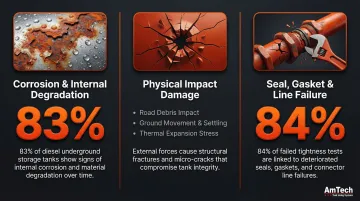
Metal fuel tanks corrode from the inside out over time due to moisture, condensation, and water contamination. Road salt accelerates external corrosion on vehicle tanks, while underground storage tanks face particularly aggressive internal corrosion. An EPA field study found that 83% of inspected diesel USTs exhibited moderate-to-severe internal corrosion, heavily accelerated by microbiologically influenced corrosion (MIC) in modern fuel blends.
Water bottoms in tanks create ideal conditions for microbial growth that produces corrosive organic acids, eating through protective coatings and tank walls.
Physical Damage and External Impact
Fuel tanks suffer structural damage from multiple sources:
- Road debris, gravel strikes, and undercarriage impacts cause dents, cracks, and stress fractures in vehicle tanks
- Ground movement, soil settlement, and inadequate cathodic protection distort underground tank shells
- Equipment impacts, foundation settlement, and thermal expansion stresses open leak pathways in aboveground tanks
- Improper backfill, inadequate support, and poor foundation design accelerate structural failure across all tank types
Seal, Gasket, and Fuel Line Failure
Connection points represent the weakest links in fuel systems. O-rings, gaskets around tank fittings, filler necks, and rubber fuel lines degrade from age, heat cycling, and chemical exposure. Historical EPA analyses show that 84% of UST tightness test failures stem from loose fittings and faulty piping rather than tank body breaches.
These failures often go undetected during visual inspections because they occur at dispenser sumps, transition piping, and underground fittings.
Warning Signs You Have a Fuel Tank Leak
Fuel Odor and Visible Pooling
A persistent smell of gasoline or diesel, especially after parking or during warm weather, is the most immediate warning sign. The odor indicates fuel vapor escaping from the tank or fuel system.
Visible wet spots, puddles, or dark staining on the ground beneath a vehicle or around a storage tank base confirm active leakage. For underground tanks, dead or discolored vegetation above tank locations and fuel lines signals subsurface contamination.
Unexpected Fuel Loss and Inventory Discrepancies
For commercial and industrial operations, unexplained drops in fuel inventory between delivery and usage signal potential leaks. Automatic tank gauges (ATG) and inventory management systems detect slow leaks that visual checks miss. Under 40 CFR 280.50, operators must report suspected releases within 24 hours of discovering conditions including sudden inventory loss or unexplained water in the tank.
Secondary and Instrument-Based Indicators
For vehicles:
- Check engine light triggered by EVAP system faults
- OBD-II codes P0440 (general malfunction), P0442 (small leak), P0455 (large leak), P0456 (very small leak), or P0457 (fuel cap leak)
- Difficulty starting or rough idle from fuel pressure loss
Storage tanks have their own set of instrument-based signals to monitor:
For storage tanks:
- ATG alarms indicating sudden level changes
- Interstitial monitoring alarms on double-wall tanks
- Rust staining or product seepage on tank exterior
- Erratic dispenser behavior or pump performance issues
- Unexplained water accumulation in tank bottoms
Fuel Tank Leak Repair Options
Temporary DIY Fixes (Sealant Kits and Epoxy Patches)
Fuel-resistant epoxy putty and two-part sealant kits (such as J-B Weld TankWeld) provide short-term stopgap solutions for pinhole leaks on personal vehicles. These retail kits cost $6–$14 and can temporarily seal minor breaches.
Critical limitations:
- Appropriate only for very minor leaks on non-regulated personal vehicles
- Not code-compliant for commercial or industrial storage tanks
- Strictly violate 40 CFR 280.33 requirements for regulated USTs, which mandate repairs follow recognized codes like API RP 1631
- Provide no warranty or compliance documentation
- Fail quickly under thermal cycling and fuel immersion
Welding and Metal Repair for Structural Leaks
Small-to-moderate cracks in metal tanks can be professionally welded after the tank is safely drained, purged, and cleaned. Welding restores structural integrity for localized damage.
Critical safety requirements:
- Must only be performed by certified professionals
- Requires strict gas-free protocols following OSHA 29 CFR 1910.146 and NFPA 326
- Mandates atmospheric testing for oxygen, flammable gases, and toxic contaminants
- Hot work without proper purging and certification creates fatal explosion risks
Welding is appropriate for external shell repairs, nozzle reinforcement, and structural crack repair when the surrounding metal remains sound.
Seal, Gasket, and Fuel Line Replacement
When leaks originate at connection points—filler neck, fuel pump module, or line fittings—replacing the failed seal, gasket, or fuel line section is the most targeted repair. This approach restores integrity without requiring full tank work and often represents the least expensive professional repair option. Labor typically runs 1–3 hours, with total costs ranging $150–$500 depending on parts accessibility and labor rates.
Tank Lining and Relining as a Permanent Repair
For industrial, commercial, and municipal fuel storage tanks where corrosion or interior degradation causes leaks, professional tank relining restores the full structural barrier, eliminates corrosion pathways, and extends service life by decades. Internal lining systems—epoxy coatings, cementitious liners, or 100% solids polyurethane systems—address the root cause rather than masking symptoms.
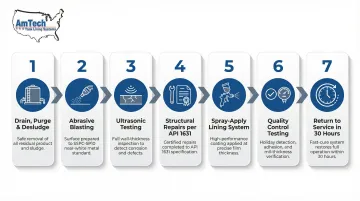
How tank relining works:
- Tank is drained, vapor-purged, and desludged
- Interior surfaces are abrasive-blasted to create proper surface profile
- Ultrasonic testing identifies weak or permeated areas
- Structural repairs are completed per API 1631 or NLPA 631 standards
- High-build lining system is spray-applied to create monolithic barrier
- Quality control testing verifies uniform thickness and coverage
- Tank returns to service within 30 hours
Compliance-grade lining systems:
AmTech's Armor Shield and DuraChem 500 series are UL-listed, ANSI/NSF/API-compliant systems field-proven in oil, fuel, and petrochemical storage tanks. These 100% solids polyurethane systems achieve up to 1,965 PSI adhesion strength, cure in minutes, and accommodate thermal expansion without disbonding—advantages traditional epoxy coatings cannot match. The DuraChem DK2 variant is specifically formulated for constant immersion with diesel, kerosene, and #2 oil.
Full Tank Replacement
When damage is too severe for repair or relining, full replacement is the final option. It involves disconnection, excavation (for USTs), removal, site preparation, permitting, new tank installation, and system testing. Only pursue this path after a licensed engineer confirms the tank is beyond economic repair.
Fuel Tank Leak Repair Costs
Minor Repair Cost Ranges
DIY and temporary fixes:
- Epoxy patch kits: $6–$14 (not compliant for commercial tanks)
- Fuel cap replacement: $15–$50
Professional minor repairs:
- Seal or gasket replacement: $150–$350
- Fuel line section replacement: $200–$500
- Minor weld repairs (small cracks): $300–$600
Moderate Repair Costs
- Professional fuel line replacement (complete): $400–$800
- Filler neck repair or replacement: $300–$700
- Minor structural repairs with welding: $500–$1,200
- Labor rates vary by region, technician certifications, and shop overhead — mobile repair services typically add a premium for on-site work
Professional Tank Lining and Relining Costs for Industrial Tanks
Commercial and industrial storage tank relining costs depend on multiple variables:
Primary cost drivers:
- Tank capacity (gallons/barrels)
- Tank material (steel, fiberglass, concrete)
- Number of coats and lining system specified
- Required surface preparation extent
- Access difficulty and confined space requirements
- Compliance testing and documentation needs
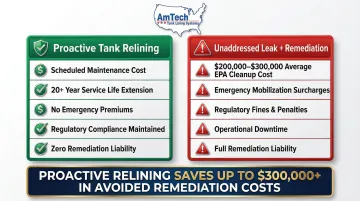
Request a site assessment from a qualified contractor before budgeting — variables like access, surface condition, and compliance requirements can shift costs dramatically. EPA's 2022 Leaking Underground Storage Tank Cleanup Cost Study found average remediation costs exceeded $200,000–$300,000 when leaks went unaddressed. Proactive relining is almost always the cheaper path.
Full Tank Replacement Cost Range
Vehicle fuel tanks:
- Average replacement cost: $1,657–$1,869 (parts and labor)
- Varies significantly by make and model
- Ford F-150: $1,610–$1,974
- Honda Civic: $3,353–$3,564
- Often recommended concurrently with fuel pump replacement ($1,150–$1,400)
Commercial storage tanks:
- Small USTs (2,000–6,000 gallons): $8,000–$20,000+
- Large USTs (10,000–20,000 gallons): $25,000–$60,000+
- Includes excavation, removal, disposal, permitting, new tank, installation, piping, and testing
- AST replacement varies widely by size and construction
Factors That Drive Cost Variation
| Cost Factor | Impact on Price |
|---|---|
| Tank size and capacity | Larger tanks require more material, labor hours, and equipment |
| Tank material | Steel, fiberglass, and concrete require different repair approaches |
| Location (above-ground vs. underground) | USTs require excavation; ASTs need scaffolding and access equipment |
| Damage severity and extent | Multiple leak points or extensive corrosion increase repair scope |
| Labor rates and regional market | Urban areas and specialized contractors command premium rates |
| Compliance testing requirements | Pressure testing, tightness testing, and certification add cost |
| Emergency/expedited service | After-hours or rapid-response mobilization carries surcharges |
Repair vs. Replace: How to Decide
When Repair or Relining Is the Right Choice
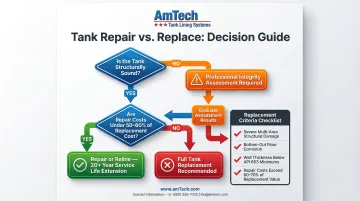
If the tank is structurally sound and the leak is contained to surface corrosion, a failed seal, or a localized crack, professional repair or internal relining is cost-effective. As a general rule, if repair costs are less than 50–60% of full replacement cost and the tank has remaining useful service life, repair or relining is the smarter investment.
Tank relining can add 20+ years of service life to commercial and industrial storage tanks. In practice, the majority of double-walled tanks that undergo professional integrity assessment are found structurally sound enough to be restored to full service life through repair and relining — without incurring the capital expense of full replacement.
When Replacement Is Necessary
Replacement becomes the safer long-term choice when:
- The tank has suffered severe structural damage across multiple areas
- Multiple simultaneous leak points indicate systemic failure
- Bottom-out corrosion has perforated the tank floor
- Professional integrity assessment shows wall thickness below minimum safe levels (per API 653 standards)
- The tank cannot be brought into regulatory compliance through repair alone
- Repair costs exceed 60–70% of replacement cost
What a Professional Inspection Actually Tells You
The repair-vs.-replace decision should never be made by visual inspection alone or on cost estimates alone. An independent professional inspection — including ultrasonic testing, pressure testing, and interior assessment — provides accurate data for both the decision and the insurance/compliance documentation trail.
Professional inspections identify:
- Exact wall thickness measurements via ultrasonic gauging
- Location and extent of corrosion or permeation
- Structural integrity of welds, seams, and connection points
- Whether damage falls within allowable repair criteria per API 1631 and NLPA 631 standards
- Remaining useful life projections
With that data in hand, owners and facility managers can justify the repair path — or the replacement path — with documented evidence rather than guesswork. That documentation also matters when reporting to regulators or insurers.
Preventing Future Fuel Tank Leaks
Establish a Routine Inspection and Testing Program
Periodic professional inspections catch corrosion, seal degradation, and structural issues before they become leaks. For commercial and industrial tanks, follow EPA, NLPA, and API inspection standards:
- Cathodic protection systems must be tested within 6 months of installation and every 3 years thereafter
- Impressed current systems require inspection every 60 days
- 30-day walkthrough inspections for spill prevention equipment and release detection
- Annual inspections for containment sumps and hand-held detection equipment
- API 653 requires monthly visual inspections, formal external inspections every 5 years, and internal inspections at intervals determined by corrosion rates
For vehicle tanks, routine undercarriage checks during service visits are sufficient to catch early signs of damage or corrosion.
Proactive Tank Lining as a Leak Prevention Strategy
Applying a professional-grade internal lining before corrosion progresses prevents leaks from developing in the first place. For commercial and industrial operators, proactive relining is more cost-effective than emergency repair or full replacement. AmTech Tank Lining & Repair—with 55+ years serving oil, gas, petrochemical, and municipal facilities—performs this work with in-house field crews, no subcontractors.
Why proactive lining beats emergency repair:
- Stops corrosion before it perforates tank walls
- Extends service life by 20+ years
- Allows scheduled maintenance during planned shutdowns
- Avoids emergency mobilization premiums
- Maintains regulatory compliance
- Prevents environmental contamination and remediation costs
AmTech's Blue Check warranty program backs proactively lined tanks with documented service quality assurance — covering workmanship and material performance over the life of the lining system.
Frequently Asked Questions
How serious is a fuel tank leak?
Fuel tank leaks are serious safety hazards. Flammable vapors create fire and explosion risks, and leaks also cause environmental contamination — with regulatory penalties added for commercial tanks. Any confirmed leak requires immediate action.
What causes a fuel tank leak?
Corrosion is the most common cause, particularly in aging metal tanks exposed to moisture and water contamination. Other frequent culprits include physical impact damage, ground movement, and degraded seals, gaskets, or fuel lines.
How much does it cost to fix a leak in your gas tank?
Minor fixes run $150–$500 for vehicles, while commercial/industrial tank repairs or relining vary significantly by tank size and damage extent. Full vehicle tank replacement averages $1,657–$1,869.
Is it safe to drive with a leaking fuel tank?
No. Driving with a leaking fuel tank is unsafe due to fire and explosion risk from fuel vapors near ignition sources (hot exhaust, electrical sparks). The vehicle should be stopped, the engine turned off, and professional repair arranged before resuming use.
How long does it take to fix a leaking gas tank?
Minor repairs such as seal or gasket replacement take 1–3 hours. Welding or relining requires additional cure time. Industrial tank lining projects vary by tank size but many return to service within 30 hours of completion.
Are gas leaks covered by insurance?
Coverage depends on cause and policy type. Sudden accidental damage is more likely covered under vehicle or commercial property insurance, while gradual corrosion is often excluded. Review your policy before proceeding with repairs.