Introduction
Industrial operators face a critical decision when selecting storage tanks for corrosive, high-pressure, or chemically aggressive environments. Traditional steel and concrete tanks often fail prematurely in these conditions, causing costly replacements, environmental risks, and unplanned downtime. FRP (Fiber Reinforced Plastic) tanks have become a proven alternative across water treatment, chemical processing, petroleum, and municipal sectors.
FRP tanks eliminate the corrosion problems that plague metal tanks while offering design flexibility that concrete cannot match. This article covers what FRP tanks are, how they're built, their material properties, industrial applications, advantages over steel and concrete, known limitations, and what to expect for lifespan and maintenance, including when professional relining becomes necessary.
Key Takeaways
- FRP tanks are composite storage vessels made from glass fibers embedded in polymer resin, engineered for industrial, chemical, and water storage
- Corrosion resistance, high strength-to-weight ratios, and minimal maintenance set them apart from steel or concrete
- Common applications include chemical plants, water/wastewater treatment, oil and gas, food processing, and pharma
- FRP tanks typically outlast steel by 10-20 years in corrosive environments without requiring rust treatment or repainting
- When corrosion barriers degrade, periodic inspection and professional relining services restore full service life
What Is an FRP Tank?
FRP stands for Fiber Reinforced Plastic—a composite material created by embedding glass fibers (or sometimes carbon or aramid fibers) within a polymer resin matrix. An FRP tank is a storage vessel manufactured from this composite, deployed wherever conventional steel or concrete tanks fail due to corrosion or excessive weight.
The term GRP (Glass Reinforced Plastic) is closely related to FRP. GRP specifically refers to composites using glass fibers, making it a subset of the broader FRP category. In practice, most industrial storage tanks labeled "FRP tanks" use glass fiber reinforcement, so FRP and GRP are functionally interchangeable in tank applications—though FRP remains the broader technical term.
How Are FRP Tanks Constructed?
FRP tanks are fabricated through three primary methods, each suited to different environments and performance requirements:
| Method | Process | Best For |
|---|---|---|
| Filament Winding (ASTM D3299) | Automated: glass fiber rovings wound onto a rotating mandrel under resin impregnation | Cylindrical tanks requiring high hoop strength; achieves 60–75% glass content |
| Contact Molding / Hand Lay-up (ASTM D4097) | Manual: chopped-strand mat or woven roving saturated with polyester, vinyl ester, or epoxy resin | Complex shapes, custom fittings, and non-cylindrical vessels |
| Dual Laminate Construction | Thermoplastic liner (PP, PVC, PTFE, or PVDF) bonded to an FRP structural shell | Extreme chemical environments; recognized under ASME RTP-1 Appendix M-12 and BS EN 13121-3 |
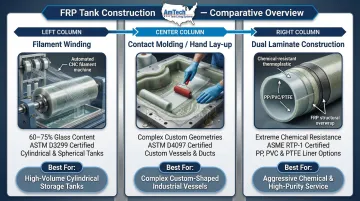
All three methods are governed by recognized design standards: ASME RTP-1 covers aboveground U.S. vessels operating under 15 psig, while BS EN 13121 applies to European vessels rated up to 10 bar.
FRP tanks range from under one meter to over 20 meters in diameter, with capacities spanning a few hundred gallons up to several million gallons depending on the application.
Key Properties of FRP Tanks
Corrosion and Chemical Resistance
Unlike steel, FRP does not corrode, rust, or degrade when exposed to acids, alkalis, chlorides, brine, or aggressive industrial chemicals. This inherent resistance means no protective coatings, cathodic protection systems, or internal linings are needed from day one.
Chemical resistance is resin-dependent:
- Polyester resins: General-purpose applications, limited to 60-93°C
- Vinyl ester resins: Excellent for acids and alkalis, up to 100°C
- Epoxy novolac vinyl esters: Severe oxidizing environments, up to 200°C in specific applications
The corrosion barrier typically consists of 2.5-6.3 mm of resin-rich layers reinforced by surfacing veils, protecting the structural laminate beneath.
High Strength-to-Weight Ratio
FRP is up to 75% lighter than steel while maintaining comparable tensile strength. Pound-for-pound, fiberglass delivers stronger performance than sheet metal or carbon steel in hoop strength—the critical load direction for cylindrical tanks.
Filament-wound laminates meet minimum ultimate tensile strengths ranging from 9,000 psi (62 MPa) to 15,000 psi (103 MPa) depending on wall thickness and glass content. That weight reduction translates directly into lower transportation and installation costs compared to steel or concrete tanks.
Design Flexibility and Customizability
FRP tanks can be fabricated on-site or off-site in virtually any shape, size, and wall thickness. Custom features include:
- Specialized nozzle placements and sizes
- Sloped or flat bottoms
- Access ports and manholes
- Integrated level gauges and instrumentation
Steel fabrication and concrete casting rarely accommodate this range of options without significant cost premiums.
Thermal and Electrical Properties
FRP is a poor conductor of both heat and electricity, offering two advantages:
- Thermal insulation: Reduces heat transfer to stored liquids, important for temperature-sensitive fluids
- Electrical isolation: Eliminates risks associated with electrical conductivity and galvanic corrosion
Standard polyester resins limit service to 60-93°C. High-performance isophthalic resins extend this to 150°C, and epoxy novolac vinyl esters can handle up to 200°C in specific gaseous environments. Resin manufacturer data sheets are the authoritative source for precise limits for a given application.
Low Maintenance Profile
Because FRP does not rust or corrode, it eliminates:
- Annual repainting cycles
- Anti-corrosion treatments
- Cathodic protection systems (required for steel per API RP 651)
- Internal linings (required for steel per API RP 652)
Routine care consists of periodic visual inspection, interior liner checks, and cleaning as appropriate for stored media.
Taken together, these properties make FRP tanks a strong candidate for applications where corrosion resistance, structural performance, and low long-term maintenance costs all matter — conditions common across chemical processing, water treatment, and industrial storage.
Common Uses and Applications of FRP Tanks
Chemical Industry
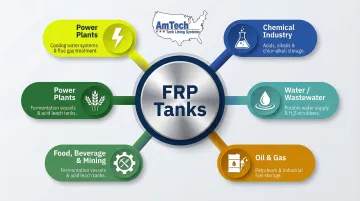
FRP tanks are the material of choice in chlor-alkali manufacturing, fertilizer production, metal extraction, electroplating, brine processing, and pharmaceutical facilities. Concentrated acids, alkalis, and reactive compounds rapidly degrade steel or concrete, making FRP essential.
Tanks in these settings often require custom resin formulations matched to specific chemical exposure profiles. For example, epoxy novolac vinyl esters are specified for highly oxidizing substances like chlorine, while standard bisphenol-A vinyl esters handle general acids and alkalis.
Water and Wastewater Treatment
FRP tanks are widespread in municipal and industrial water treatment plants for storing potable water, process water, and treated wastewater.
Potable water applications require NSF/ANSI 61 certification, which establishes minimum health-effects requirements for materials contacting drinking water. Manufacturers like Xerxes and Design Tanks produce NSF/ANSI 61 certified FRP tanks specifically for this purpose.
Wastewater facilities extensively use FRP for odor control scrubbers—wet chemical scrubbers and biological trickling filters that remove hydrogen sulfide (H₂S) and volatile organic compounds (VOCs). Because H₂S converts to highly corrosive sulfuric acid, FRP packed tower scrubbers achieve 98% H₂S removal in wastewater treatment plants.
Oil, Gas, and Petroleum
FRP tanks store petroleum products, fuel, and chemicals across upstream and downstream operations. They resist hydrocarbon corrosion and suit both above-ground and underground installation.
API Specification 12P governs the material, design, and fabrication of above-ground atmospheric FRP tanks in oil production. The global FRP tank market is projected to reach $3.48 billion by 2035, driven by expanding oil and gas infrastructure and demand for corrosion-resistant storage.
Food and Beverage, Mining, and Power
FRP tanks also appear across several other industries where chemical exposure or corrosion rules out conventional materials:
- Food and beverage processors use FRP vessels for vinegar fermentation, food-grade liquid storage, and processing applications
- Pulp and paper mills rely on FRP for chemical storage supporting pulping operations
- Mining operations deploy acid leach tanks, brine storage, and metal extraction vessels built from FRP
- Power plants integrate FRP into cooling water systems, chemical feed tanks, and flue gas treatment equipment
FRP Tanks vs. Other Materials
FRP competes directly with steel, concrete, and thermoplastics across most storage applications. How it stacks up depends on service conditions — but the patterns are consistent.
vs. Steel
Steel offers high structural strength, familiar fabrication methods, and wide availability. In non-corrosive applications, it remains a practical choice. In corrosive service, however, the maintenance burden adds up fast.
Steel drawbacks in corrosive environments:
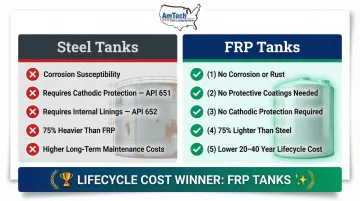
- Susceptible to corrosion and rust without ongoing maintenance
- Requires cathodic protection per API 651 and internal linings per API 652
- Significantly heavier (75% heavier than FRP)
- Higher long-term maintenance costs in corrosive service
FRP eliminates most corrosion-related maintenance, ships and installs lighter, and can be manufactured thinner while maintaining structural integrity due to superior hoop strength. Lifecycle cost analyses show FRP delivers lower total cost of ownership over 20–40 years in corrosive environments.
vs. Concrete
Concrete tanks are common in municipal water and wastewater applications, but they carry significant structural and chemical vulnerabilities:
- Heavy, requiring specialized foundations
- Prone to micro-cracking over time
- Requires semi-annual cleaning to prevent algae growth
- Difficult to modify once cast
- Highly susceptible to biogenic sulfide corrosion in wastewater headspaces
- Requires expensive protective coating systems
FRP is lighter, easier to install, significantly more resistant to chemical attack, and simpler to customize or modify after installation.
vs. HDPE and PVC
For smaller tanks (generally under ~2,000 gallons / 7,500 liters), HDPE and PVC offer cheaper upfront alternatives. FRP becomes more cost-effective and structurally sound at larger volumes or where higher pressure ratings, chemical resistance, or structural load requirements come into play.
Note: This volume threshold is a vendor-driven market heuristic, not an engineering standard. Actual material selection should be based on project-specific variables: temperature, pressure, chemical concentration, and site footprint.
Limitations of FRP Tanks
UV Degradation
Prolonged ultraviolet light exposure causes chemical changes in FRP—leading to surface embrittlement, reduced impact resistance, fiber blooming (exposed glass fibers), and pore formation that allows styrene to wick from tank walls.
Mitigation strategies:
- Exterior gelcoats: 10-20 mil thick opaque barrier deflecting UV energy
- UV inhibitors: Absorbers or stabilizers incorporated directly into resin
- Testing: ASTM G154 and G155 accelerated weathering protocols verify long-term outdoor performance
Temperature Constraints
Thermoplastic resins used in FRP are susceptible to creep at elevated temperatures — a critical consideration when selecting a resin system for hot process fluids. Typical upper service limits:
- Standard polyester: 60-93°C (140-200°F)
- Vinyl ester: 100°C (212°F)
- Epoxy novolac vinyl ester: 150-200°C (302-392°F) in specific environments
Applications involving very high-temperature fluids may require alternative materials or specialized high-temperature resin systems.
Size and Economic Constraints
FRP has a practical size window where it delivers the best value:
- Tanks larger than ~4 meters in diameter become difficult to ship as single units; above 20 meters, field-fabricated steel or concrete is typically more economical
- Tanks smaller than ~7,500 liters are often cheaper to build from HDPE or PVC — though pressure ratings and chemical compatibility may still favor FRP
How Long Do FRP Tanks Last — and How to Maintain Them
FRP Tank Lifespan and Maintenance Guide
Lifespan Expectations
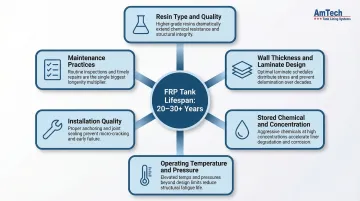
A properly designed and installed FRP tank typically provides 20-30+ years of serviceable life in industrial environments—often outperforming steel tanks in corrosive service. EN 13121 design formulas based on 1,000-hour creep testing establish design factors ensuring a 25-year (approximately 200,000 hours) safe operational life.
Factors affecting lifespan:
- Resin type and quality
- Wall thickness and laminate design
- Stored chemical and concentration
- Operating temperature and pressure
- Installation quality
- Maintenance practices
In highly aggressive environments, lifespan may be reduced. For example, a 2017 study on tanks storing 35% hydrochloric acid estimated a safe lifetime of 15-20 years due to gradual acid diffusion into the laminate.
Maintenance Best Practices
FRP tanks require minimal routine maintenance:
- Periodic visual inspection for surface cracking, delamination, or UV damage
- Interior checks for liner integrity and signs of chemical attack
- Cleaning as appropriate for the stored media
- Ultrasonic testing to identify minute permeations, pinholes, and wall thinning invisible to the naked eye
Catching liner degradation early keeps minor issues from becoming structural failures.
When Lining and Repair Become Necessary
Aging FRP tanks, or those handling particularly aggressive chemicals, often require professional lining services to extend service life and restore containment integrity.
Common FRP tank failure modes include:
- Nozzle cracking and leaking at bond lines
- Delamination of composite layers
- Corrosion barrier breakthrough
- Chemical permeation into structural laminate
- UV degradation and surface embrittlement
- Impact damage from equipment or tools
AmTech Tank Lining & Repair addresses these failure modes through its AT BiFlex fiberglass lining system, which applies custom-assembled composite materials (glass, Kevlar, and carbon veils with compatible resins) to repair structural damage and rebuild degraded corrosion barriers. The system adds a protective layer between stored product and the tank wall, restoring containment without full tank replacement.
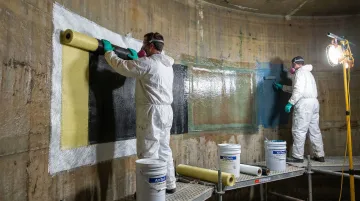
AmTech's field crews service single and double-wall FRP tanks across all 50 states, Canada, and the Caribbean, handling repairs, relining, corrosion coat restoration, and nozzle work.
Frequently Asked Questions
What does FRP stand for in tanks?
FRP stands for Fiber Reinforced Plastic—a composite material made from glass fibers embedded in a polymer resin matrix. The term "fiberglass tank" is often used synonymously, as glass fiber is by far the most common reinforcement in industrial storage tank applications.
What is an FRP tank and what is it used for?
An FRP tank is a storage vessel constructed from fiber-reinforced plastic composite. Primary uses include chemical storage, water and wastewater treatment, petroleum and fuel storage, food processing, pharmaceutical manufacturing, and air pollution control scrubbers in industrial facilities.
What is the difference between FRP tanks and fiberglass tanks?
The terms are functionally interchangeable in most industrial contexts. "Fiberglass tank" specifically refers to glass fiber reinforcement, while FRP is the broader category that can technically include carbon or aramid fiber reinforcement—though glass fiber dominates storage tank applications in practice.
Is FRP stronger than steel?
FRP has a higher strength-to-weight ratio than carbon steel, particularly in tensile (hoop) strength, meaning it outperforms steel pound-for-pound. Steel has higher absolute compressive strength, but FRP maintains structural integrity at significantly lower weight with no corrosion risk.
How long does an FRP tank last?
A well-manufactured and properly maintained FRP tank typically lasts 20–30 years or more. Lifespan is influenced by resin type, stored chemical, operating temperature and pressure, and quality of maintenance, including periodic inspection and professional lining repair when needed.
Can FRP tanks be repaired or relined?
Yes, FRP tanks can be repaired and relined by specialists. Damaged surfaces, delaminated liners, or chemically degraded interiors can be restored using professional fiberglass lining systems such as AT BiFlex, making relining a cost-effective alternative to full tank replacement.