Introduction
Most concrete tanks were designed for a 30-year lifespan — yet many have been in service for 50+ years. U.S. wastewater plants built in the 1970s, when the Clean Water Act passed, are now hitting or exceeding those limits. That reality turns structural assessment from a recommended practice into a hard requirement for safety, compliance, and budget control.
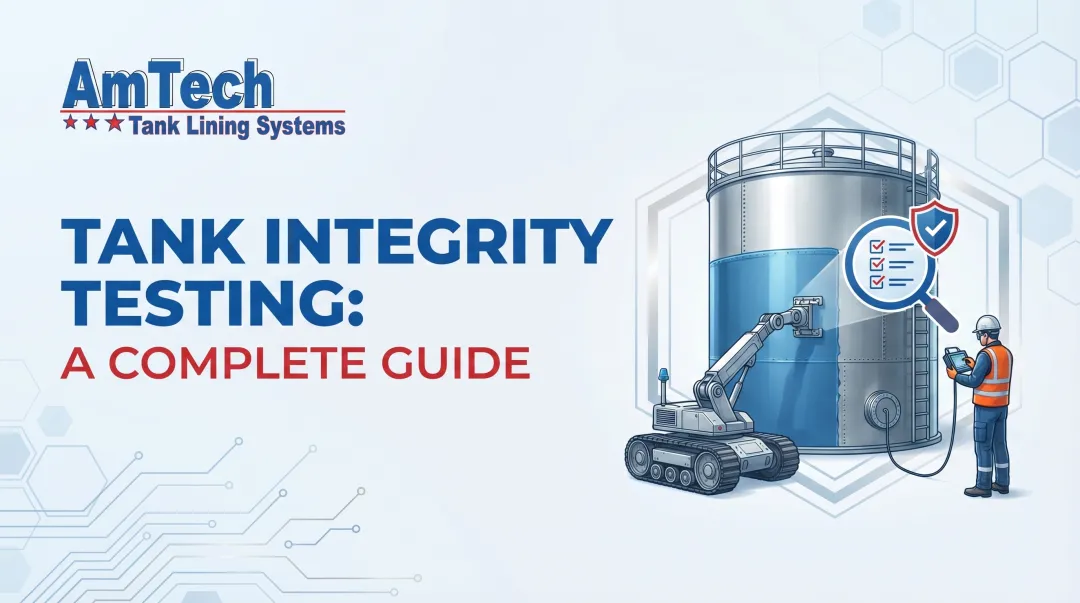
Non-destructive testing (NDT) allows engineers to detect rebar corrosion, cracking, wall loss, and subsurface defects without taking the tank out of service or drilling into the structure. The cost math is straightforward: concrete tank rehabilitation runs roughly 33–38% of full replacement cost, while emergency reactive repairs cost 3 to 5 times more than planned maintenance.
TLDR
- NDT evaluates structural integrity, rebar corrosion, wall thickness, and subsurface defects without damaging the asset
- Common methods: GPR, Impact-Echo, Ultrasonic Pulse Echo, Rebound Hammer, and Half-Cell Potential Mapping
- Used across water, wastewater, chemical, petroleum, and fire suppression tank types
- Inspection follows planning, visual assessment, NDT application, analysis, and formal reporting
- Findings inform targeted repairs or full relining to extend service life by decades
What Is Non-Destructive Testing for Concrete Tanks?
Non-destructive testing (NDT) for concrete tanks is a suite of diagnostic techniques that assess structural condition, material properties, and subsurface defects without drilling cores, removing rebar, or decommissioning the structure. These methods allow engineers to evaluate tank integrity while the asset remains in service, minimizing operational disruption and avoiding the cost of taking a tank offline.
NDT applies across the entire tank lifecycle. Common applications include:
- Routine condition monitoring between scheduled inspections
- Pre-repair assessment to define the scope and location of damage
- Post-repair verification to confirm work quality
- Compliance-driven inspections for potable water, wastewater, chemical, and petroleum tanks
Regular NDT-guided inspections help facility owners detect deterioration early, prioritize repairs by severity, and plan capital expenditures proactively.
That proactive value becomes clearer when comparing NDT to destructive testing methods such as core extraction and rebar sampling. Destructive testing provides direct material samples but creates permanent structural damage that requires patching. NDT reduces how many destructive tests are needed by first identifying the highest-risk areas through non-invasive screening — targeting intervention precisely rather than broadly.
Why NDT Is Critical for Concrete Tank Integrity
Concrete tanks face degradation mechanisms that work silently beneath the surface until structural failure or leakage occurs. Understanding these threats makes clear why proactive NDT is essential.
Primary Degradation Mechanisms:
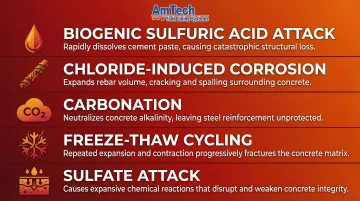
- Biogenic sulfuric acid (H2S) attack: In wastewater environments, sulfide-oxidizing bacteria produce sulfuric acid that drops surface pH to between 1 and 2, causing severe decalcification with concrete loss rates reaching up to 14 mm per year
- Chloride-induced corrosion: Chloride ions penetrate concrete and trigger corrosion of steel reinforcement when moisture and oxygen are present, leading to spalling and structural compromise
- Carbonation: Carbon dioxide reacts with calcium hydroxide in concrete, lowering alkalinity and causing uniform corrosion around steel reinforcement
- Freeze-thaw cycling: Water in critically saturated concrete freezes and expands, causing cracking, spalling, and surface scaling
- Sulfate attack: Contact with sulfate-bearing soil or groundwater causes extensive cracking, expansion, and loss of bond between cement paste and aggregates
Cost Savings: What the Numbers Show
The cost data for NDT-guided maintenance is hard to argue with. Early-stage repairs consistently cost less than emergency remediation or full tank replacement:
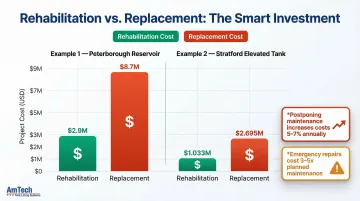
- The Peterborough Reservoir rehabilitation project was completed for $2,900,000 — roughly a third of the estimated $8.7M demolish-and-replace cost
- The Stratford Elevated Tank evaluation estimated rehabilitation at $1,033,000 compared to $2,695,000 for a new 0.5 MG composite tank
- Postponing maintenance increases repair costs by 5–7% annually
- Emergency repairs cost 3–5 times more than planned preventive maintenance
Those numbers reflect a consistent pattern across tank types and service environments — and the financial benefits are only part of the picture.
Operational Benefits of NDT Programs
NDT can be performed with minimal service interruption, tests are repeatable (making them ideal for trend monitoring over time), and results enable owners to prioritize repairs by severity rather than guessing.
With proper maintenance, AWWA D110 Type I prestressed concrete tanks can achieve an estimated 100-year service life — far beyond their original 30–50 year design assumptions.
Key NDT Methods for Concrete Tanks
No single NDT method provides a complete picture — effective tank assessment typically combines methods that address structural strength, subsurface defects, and corrosion condition. Here's how each method contributes to comprehensive assessment.
Structural Strength and Concrete Quality
Rebound Hammer Test (ASTM C805)
The Rebound Hammer delivers a rapid, cost-effective estimate of in-place concrete strength by measuring surface rebound when a spring-driven steel hammer impacts the concrete. The rebound number reflects near-surface properties and requires project-specific calibration with core samples for accurate strength estimation.
Key limitations to keep in mind:
- Carbonation densifies the surface and yields falsely high rebound values that mask interior degradation
- Results represent surface conditions only — not full-depth concrete quality
- Best used as a comparative tool across the tank wall to identify zones of relative weakness, not for absolute strength measurement
Ultrasonic Pulse Velocity (UPV) (ASTM C597)
UPV measures the speed of ultrasonic waves through concrete to assess quality, homogeneity, and uniformity. Higher velocities indicate denser, higher-quality concrete; lower velocities suggest voids, cracks, or deterioration.
UPV can be combined with Rebound Hammer results to estimate in-place concrete strength and crack depth when only one-sided access is available. Standard applications require two-sided access, and results are affected by rebar placement and moisture content.
Subsurface Defect Detection
Ultrasonic Pulse Echo (UPE) (ACI 228.2R)
UPE uses shear waves to detect subsurface voids, delamination, and internal disintegration from one side of the wall — a significant advantage when tank contents cannot be emptied. The method generates A, B, and C scan images that reveal internal defects and is particularly useful for evaluating post-tensioning grout condition in prestressed tanks.
Penetration depths are limited to about 250 mm, but the one-sided access capability makes UPE invaluable for in-service tank assessment.
Impact-Echo (ASTM C1383)
Impact-Echo uses stress wave reflections generated by a short-duration mechanical impact to estimate concrete thickness, locate subsurface cracks and honeycombing, and assess debonding — all from one-sided access. The method monitors surface motion from the impact, with wave reflections indicating internal interfaces and defects.
It's especially useful for concrete tank walls, tunnel linings, and culvert walls where interior access is restricted. Note that thickness calculations require a 0.96 multiplier correction factor for P-wave speed.
Structural Detail and Corrosion Assessment
Once structural integrity is mapped, corrosion-focused methods identify where active deterioration is already underway.
Ground Penetrating Radar (GPR) (ASTM D6432)
GPR uses high-frequency electromagnetic pulse waves to locate rebar, embedded conduits, and subsurface anomalies, and to measure concrete cover thickness and wall depth. Depths to reflecting interfaces are calculated from electromagnetic wave arrival times.
GPR is highly effective for mapping rebar configuration, but it cannot directly measure corrosion rates or mechanical strength. It works best as a first-pass screening tool that guides placement of more targeted methods.
Half-Cell Corrosion Potential Mapping (ASTM C876)
Half-Cell testing maps the likelihood of active rebar corrosion across a tank wall surface by measuring the electrical potential of uncoated reinforcing steel. If potentials over an area are more negative than −0.35 V CSE, there is greater than 90% probability that reinforcing steel corrosion is occurring.
The numeric magnitude does not indicate corrosion rate — only the probability of active corrosion.
Surface Electrical Resistivity (AASHTO T 358)
Electrical resistivity testing evaluates the concrete's resistance to chloride penetration and permeability. Lower resistivity indicates higher moisture content and greater susceptibility to chloride ingress and corrosion. Together with Half-Cell testing, resistivity mapping gives a complete picture of how vulnerable the tank is to ongoing corrosion-driven deterioration.
How an NDT Inspection Works: Step by Step
Concrete tank NDT inspections require careful upfront planning to minimize downtime, meet confined space entry regulations, and ensure data quality. Rushed inspections miss the most critical defects.
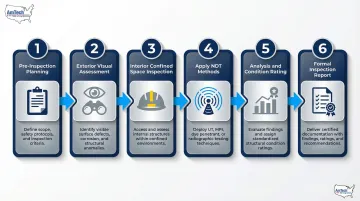
Step 1 – Pre-Inspection Planning
Start by pulling all available documentation:
- Original structural drawings
- Previous inspection reports and repair history
- Operational records (tank age, contents, turn rates, known incidents)
- Access permits and confined space entry requirements
Identify areas of prior concern to target during testing and determine the NDT method mix based on tank type and exposure conditions. Thorough planning cuts mobilization costs and ensures the field team arrives with the right equipment.
Step 2 – Exterior Visual Assessment
Walk the full exterior of the tank to document observable distress:
- Active cracks and crack patterns
- Spalling and delamination
- Staining and efflorescence (white mineral deposits indicating water movement)
- Vegetation intrusion at foundation
- Bulging or displacement
- Signs of prior repairs that may have failed
Photograph and map all findings on wall elevations as a baseline before entering the structure. Crack patterns and staining locations identified here often dictate where interior testing resources get concentrated.
Step 3 – Interior Inspection Under Confined Space Protocols
OSHA 29 CFR 1910.146 requires permit-required confined space protocols before entry. Between 2011 and 2018, 1,030 workers died from occupational injuries involving confined spaces, making compliance non-negotiable.
Required safety measures include:
- Atmospheric testing for oxygen levels, explosive gases, and toxic substances
- Continuous forced-air ventilation
- Fall protection and retrieval systems
- Trained attendants and entry supervisors
- Emergency rescue procedures
Once inside, the inspection covers:
- Connection walls and hopper slopes
- Roof beams and structural connections
- Moisture marks and active seepage
- Crack patterns and spalling
- Evidence of waterproofing failure or prior lining breakdown
Step 4 – Apply NDT Methods Systematically
Deploy NDT methods according to the testing plan in two tiers:
- Rapid-coverage tools first — Rebound Hammer, GPR, and UPV establish a condition map across the full tank surface
- High-resolution methods second — UPE, Impact-Echo, and Half-Cell Potential Mapping target flagged zones with finer scan mesh
Working in sequence keeps field time efficient while directing the most detailed analysis to the highest-risk areas.
Step 5 – Analysis and Condition Rating
Compile all test data alongside visual findings and assign condition ratings to each zone of the tank. Reference standardized rating scales that classify areas by urgency — from routine monitoring through partial capacity restriction to immediate decommissioning — to give owners a clear action priority list.
AWWA Manual M77 provides technical frameworks for condition assessment and economic decision-making that many utilities adapt for tank infrastructure.
Step 6 – Formal Inspection Report
Produce a structured report that includes:
- Executive summary with key findings and priority recommendations
- Inspection methodology and standards referenced
- Construction description and tank specifications
- Findings by component (with photographs and annotated plans)
- Conclusions and condition ratings
- Prioritized repair recommendations with engineering cost opinions
Share the report with a third-party engineer for independent verification before committing to major remediation costs.
Interpreting NDT Results and Planning Repairs
NDT findings drive one of three responses, depending on defect type, depth, severity, and tank contents:
- Monitor — schedule re-inspection at defined intervals
- Targeted repair — address discrete defects (cracks, spalls, rebar exposure)
- Full relining or structural rehabilitation — required when deterioration is widespread
Targeted Repair Methods
- Crack injection — For cracks ≥ 1/16-inch, elastomeric non-shrink caulk or epoxy stops water intrusion. Active (moving) cracks require flexible sealants; dormant cracks accept rigid epoxy.
- Spalling repair — Remove delaminated concrete to sound substrate, blast exposed rebar to white metal, and patch with high-strength or polymer-modified repair mortar.
- Carbon fiber reinforcement — For structurally compromised zones such as beam pockets and cold joints, carbon fiber fabric saturated with epoxy resin restores flexural and shear capacity without added weight or thickness.
When Full Relining Is Warranted
Full relining is recommended when NDT reveals:
- Widespread deterioration affecting more than 30% of wall area
- Significant rebar corrosion with section loss
- Compromised wall homogeneity or honeycombing
- Aggressive chemical exposure requiring a protective barrier
- Potable water storage requiring NSF/ANSI 61 certified lining
Cementitious and polymer lining systems stop active corrosion, seal micro-cracks, and provide chemical resistance — extending service life by 20–40 years depending on the system and tank conditions.
AmTech Tank Lining & Repair: Translating NDT Into Action
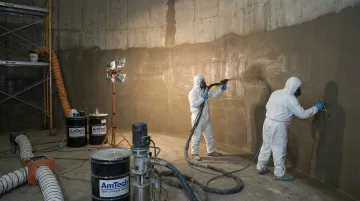
AmTech Tank Lining & Repair has been repairing and relining concrete tanks since the late 1960s. With an NLPA Special Inspector on staff, the company moves directly from NDT findings to compliant repair execution using proprietary systems:
- HydraStone Alkrete® cementitious lining — NSF/ANSI 61 compliant, with a 40-year track record in potable water and hot water storage applications
- DuraChem® 500 series 100% solids poly lining — Instant-cure, zero-VOC system with adhesion strength up to 1,965 PSI, designed for wastewater, chemical, and petroleum containment
AmTech's field crews perform ultrasonic testing to identify permeations and wall thinning, then execute repairs that meet NSF, ANSI, AWWA, API, and NLPA compliance requirements. The company serves water, wastewater, chemical, and petroleum tanks across all 50 states, Canada, and the Caribbean.
Frequently Asked Questions
How often do water tanks need to be inspected?
NFPA 25 requires fire protection tank interiors to be inspected every 5 years for concrete tanks, while exteriors require quarterly inspection. AWWA Manual M42 recommends potable water tanks be drained and inspected at least once every 3 years. Frequency should increase for older tanks or those showing signs of deterioration.
How do professionals inspect water tanks?
Professionals combine visual inspection with NDT methods such as GPR, Impact-Echo, Rebound Hammer testing, and ultrasonic thickness gauging. Interior access follows OSHA 29 CFR 1910.146 confined space entry protocols, which cover atmospheric testing, ventilation, and fall protection.
What is the life expectancy of a concrete water tank?
Concrete tanks were historically designed for 30 to 50 years, but service life modeling demonstrates that AWWA D110 Type I prestressed concrete tanks can achieve an estimated 100-year service life when properly maintained. Regular NDT-guided inspection and timely relining extend service life significantly beyond original design assumptions.
Can a crack in a concrete septic tank be repaired?
Yes — repairability depends on crack type, depth, and whether it's active or dormant. Smaller cracks are sealed with elastomeric caulk or epoxy injection. Wider or structural cracks need professional assessment first to determine whether reinforcement or section replacement is required.
What is one requirement for a tank tightness test to be valid?
AWWA D110 Section 5.12 requires the tank be filled with potable water to the overflow level and allowed to stand for at least 24 hours. The net liquid loss over the next 24 hours shall not exceed 0.05% of tank capacity, measured under stable temperature and environmental conditions.
How often should a concrete water tank be cleaned?
Most regulatory guidance recommends cleaning every 1–3 years depending on tank use, water quality, and jurisdiction. Coordinating cleaning with scheduled inspections lets crews assess tank condition while it's already dewatered, reducing total downtime.