What is NDT tank inspection and why is it important?
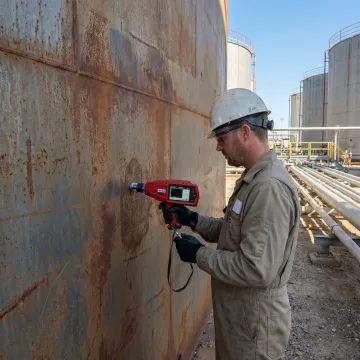
Non-destructive testing (NDT) tank inspection uses advanced methods like ultrasonic thickness testing to evaluate tank integrity without damaging the structure or requiring demolition. These inspections detect hidden corrosion, wall thinning, permeations, and structural defects that visual inspections miss. For Arizona facilities, NDT is critical because the state's extreme temperature swings, alkaline soil conditions, and mineral-heavy groundwater accelerate corrosion in underground and above-ground tanks. Early detection prevents catastrophic failures, environmental violations, and costly emergency repairs.
How does ultrasonic thickness testing work?
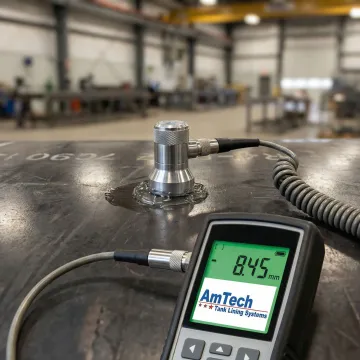
Ultrasonic thickness testing sends high-frequency sound waves through the tank wall material. The equipment measures how long it takes for the sound wave to travel through the metal and reflect back, calculating the remaining wall thickness with extreme precision—often to thousandths of an inch. Our NLPA-certified inspectors scan critical areas including tank bottoms, shell courses, nozzles, and weld seams, creating detailed thickness maps that identify corrosion patterns and predict remaining service life. This method works on steel, fiberglass, and concrete tanks without requiring surface penetration or structural alteration.
What types of tanks can be inspected with NDT methods?
AmTech's NDT inspection services cover all tank types and materials: above-ground petroleum storage tanks (crude oil, gasoline, diesel, jet fuel), underground fuel storage tanks (USTs), municipal potable water tanks, fire suppression water storage, wastewater and chemical processing tanks, industrial process tanks, thermal storage systems, and day tanks. We inspect steel, concrete, fiberglass (FRP), and composite laminate construction. Our methods are applicable to both pressurized and atmospheric tanks, single-wall and double-wall configurations, and tanks storing liquids ranging from water to aggressive chemicals.
How often should tanks be inspected in Arizona?
Inspection frequency depends on the tank type, stored product, and regulatory requirements. API Standard 653 requires external inspections of above-ground petroleum tanks every 5 years and internal inspections every 10 years, though intervals may be shortened based on corrosion rates. Arizona DEQ regulations mandate periodic testing for underground storage tanks. Municipal water tanks typically require inspection every 3-5 years. However, Arizona's harsh environmental conditions—intense UV exposure, extreme heat cycles exceeding 115°F, and corrosive alkaline soils—often justify more frequent inspections to catch accelerated degradation before failures occur.
What are the signs that a tank needs immediate NDT inspection?
Schedule an emergency inspection if you observe: unexplained product loss or inventory discrepancies, visible rust, corrosion, or pitting on external surfaces, moisture or product seepage around tank bases or nozzles, dented or deformed tank shells, failed cathodic protection systems on underground tanks, sudden changes in product quality (water contamination in fuel tanks, discolored potable water), monitoring system alarms indicating interstitial breaches in double-wall tanks, or regulatory notices requiring compliance verification. Additionally, tanks approaching their expected service life or those that haven't been inspected in 5+ years warrant proactive NDT assessment.
Can NDT inspections be performed while tanks are in service?
Many NDT inspection methods can be performed on in-service tanks, minimizing facility downtime and operational disruption. External ultrasonic thickness testing of above-ground tanks, permeation detection on underground tank walls (accessed via monitoring ports), and visual assessments of accessible surfaces typically don't require tank shutdown. However, comprehensive internal inspections following API 653 or NFPA 25 standards do require tanks to be emptied, cleaned, and degassed for crew safety and inspection accuracy. AmTech's field engineers evaluate each situation and recommend the most efficient inspection approach based on regulatory requirements and operational constraints.
What happens after the NDT inspection is completed?
AmTech provides a detailed inspection report documenting all findings, including ultrasonic thickness measurements with location-specific data, photographic evidence of visible corrosion or damage, corrosion rate calculations and remaining service life projections, comparison to previous inspection data (if available), compliance assessment against applicable API, NFPA, and DEQ standards, and specific recommendations for repairs, re-lining, or replacement. The report serves as documentation for regulatory compliance, insurance requirements, and capital planning. If immediate repairs are needed, our field crews can often perform corrective work on-site, including structural steel repairs, lining system installation, or emergency containment measures.
How much does NDT tank inspection cost in Arizona?
Inspection costs vary based on tank size, type, accessibility, stored product hazards, and the scope of testing required. A basic ultrasonic thickness survey of a small above-ground tank might cost a few hundred dollars, while comprehensive API 653 internal/external inspections of large petroleum storage tanks can cost several thousand dollars. Underground tank permeation testing and double-wall integrity assessments fall in between. AmTech provides free quotes based on your specific tank configuration and inspection needs. Keep in mind that proactive inspection is far less expensive than emergency repairs, environmental remediation, or regulatory fines resulting from undetected tank failures.