Introduction
Industrial and commercial pressure tanks are critical infrastructure across sectors — from municipal water systems and chemical processing to oil and gas and fire suppression. A failure doesn't just disrupt operations; it can trigger safety incidents, regulatory violations, and costly unplanned downtime. According to the National Board of Boiler and Pressure Vessel Inspectors, unfired pressure vessels were responsible for 64 fatalities and 289 injuries over a ten-year period, making them the deadliest equipment category tracked.
Pressure tank issues rarely happen without warning, but the signs are often misread or ignored until an emergency forces action. The same National Board data shows 83% of the 23,338 recorded accidents stemmed directly from human oversight — operator error, poor maintenance, and improper installation or repair. In industrial settings, delayed response compounds every one of those risks. A 2011 explosion of a 33-year-old hydropneumatic tank at a Redding, CA wastewater plant killed one worker and took the facility's treatment process offline.
This guide covers the key warning signs of a failing pressure tank, the root causes behind failures, a practical emergency response process, and how to decide between repair and full replacement.
What Is an Industrial Pressure Tank?
An industrial pressure tank is a pressurized vessel designed to store liquids — water, chemicals, fuel, and petroleum products — under controlled pressure. These tanks maintain system pressure between pump cycles and protect downstream equipment from pressure spikes and flow inconsistencies.
The tank uses compressed air or a bladder/diaphragm to maintain pressure, with a pressure switch controlling pump activation. Commercial and industrial variants are larger and held to stricter compliance standards than residential units:
- ASME (pressure vessel design and fabrication)
- API (petroleum storage and inspection)
- NSF (potable water contact safety)
These standards reflect the higher stakes involved — in critical industrial applications, a tank failure can mean unplanned downtime, contamination events, or cascading system damage.
Key Takeaways
- Warning signs include pump short-cycling, fluctuating pressure, visible corrosion, waterlogging, unusual pressure gauge readings, and exterior leaks
- Most tank failures stem from corrosion, bladder rupture, incorrect air charge, or faulty pressure switch components
- Emergency response means isolating the tank, diagnosing the root cause, and applying the correct fix
- Tanks with structural corrosion, ruptured internal linings, or repeated failure history typically warrant replacement over repair
- Surface-level corrosion is often repairable — professional lining systems can add decades of service life
Warning Signs Your Industrial Pressure Tank Is Failing
Most pressure tank emergencies are preceded by detectable warning signals. Recognizing them early can prevent catastrophic failure, protect downstream equipment, and avoid regulatory incidents.
Pump Short-Cycling
Short-cycling describes the pump turning on and off far more frequently than normal, caused by the tank losing its ability to store pressurized water (typically due to a ruptured bladder or lost air charge). In industrial settings, short-cycling accelerates pump wear and increases energy consumption.
When a healthy pressure tank operates, the pump should cycle on when pressure drops to the cut-in setting and cycle off when pressure reaches the cut-off setting. If your pump is cycling every few minutes instead of every 15-30 minutes, the tank has lost its pressure buffer.
Fluctuating or Inconsistent System Pressure
Erratic pressure readings — pressure that drops sharply after pump shutoff or surges unpredictably during operation — indicate the tank is no longer maintaining its air cushion. This leads to pressure instability throughout the connected system.
The downstream impact is predictable: pumps, valves, and process equipment rated for steady pressure will wear prematurely under these swings. Consistent pressure instability is a reliable indicator the tank requires immediate evaluation.
Visible Corrosion, Rust, or Tank Exterior Damage
Surface rust, pitting, pooling water at the base, or discoloration around fittings and welds are early indicators of structural tank degradation. In industrial environments, corrosion often progresses from the inside out, making exterior signs a lagging signal of deeper damage.
Check for:
- Rust stains or scale buildup on the tank exterior
- Pooling water or moisture around the tank base
- Discoloration or corrosion around weld seams and fittings
- Visible pitting or thinning of the tank shell
Water at the Air Valve or Waterlogging
The waterlogged tank test is simple: pressing the air valve should release only air. Water discharge from the air valve confirms the internal bladder has ruptured, meaning water has entirely displaced the air chamber. The tank is functionally compromised and cannot maintain pressure.
A waterlogged tank eliminates the pressure buffer the pump depends on, forcing it to run continuously to maintain system pressure. Without intervention, continuous operation will destroy the pump motor.
Unusual Noises, Water Hammer, or Pressure Gauge Irregularities
Banging or hammering sounds in connected piping indicate loss of the tank's shock-absorbing function. Clicking pressure switches cycling rapidly and pressure gauge readings that fail to stabilize all signal the tank is failing — the system needs to come offline for inspection.
Water hammer occurs when the tank can no longer cushion pressure surges, allowing shock waves to propagate through the piping system. Left unchecked, those shock waves damage pipe joints, valves, and connected equipment across the entire system.
Why Industrial Pressure Tanks Fail: Root Causes
Pressure tank failures follow predictable patterns. Knowing the root cause before attempting repair is what separates a permanent fix from one that fails again in 18 months.
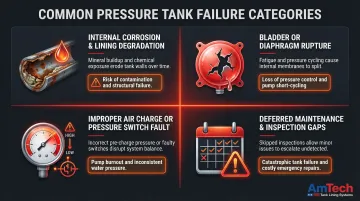
Four Primary Failure Categories
Internal corrosion and lining degradation — Chemical attack or water quality issues (high chloride, acidic pH, mineral content) erode the tank wall from the inside. Internal corrosion accounts for the majority of tank wall failures in water and chemical service. An EPA Chemical Safety Alert warns that pressure vessels can fail catastrophically from general wall thinning, localized pitting, or stress corrosion when maintenance is deferred.
Bladder or diaphragm rupture — Physical wear, sediment abrasion, or chemical incompatibility destroys the internal separator, eliminating the air-water barrier. Once the bladder ruptures, the tank must be replaced — relining is not an option.
Improper air charge or pressure switch misconfiguration — Incorrect pre-charge pressure or faulty switch settings push the tank outside its design parameters. According to the Florida Rural Water Association, pressure relief valve failure is likely responsible for more catastrophic tank failures than any other single cause.
Deferred maintenance and inspection gaps — Sediment accumulation, undetected micro-leaks, and missed wear indicators escalate into catastrophic failures when left unchecked.
Consequences of Ignoring Early Failure Signs
Ignoring warning signs leads to:
- Reduced system efficiency and increased energy costs
- Accelerated pump failure from continuous cycling
- Potential chemical or fuel release with regulatory and environmental consequences
- Costly emergency shutdowns
- Structural tank failure with catastrophic potential
The ACWA/JPIA reported an incident where a tank explosion forced the tank off its foundation and destroyed the perimeter block wall, causing tens of thousands of dollars in damages.
Emergency Response: How to Address a Pressure Tank Issue Step-by-Step
Responding to a pressure tank emergency without first diagnosing the root cause wastes time, risks compounding the damage, and often leads to repeat failures. In industrial settings especially, a structured approach separates a one-time fix from a recurring problem.
Step 1: Isolate and Depressurize the System
Immediately shut off power to the well pump or system pump. Close the isolation valves upstream and downstream of the tank. Open a drain valve or connected fixture to safely relieve built-up system pressure before any inspection or hands-on work.
In industrial settings with chemical or fuel storage, appropriate PPE and confined space protocols must be followed. A BSEE Safety Alert documents an incident where a worker suffered severe facial injuries when a fitting was removed from a pressurized water tank whose internal bladder retained 60 psi pre-charge pressure even though water lines were depressurized.
Step 2: Observe and Document Symptoms
Conduct a visual and auditory inspection:
- Note pressure gauge readings
- Listen for unusual sounds
- Look for leaks or corrosion at fittings and welds
- Tap the tank to detect waterlogging (hollow vs. solid sound)
- Check the air valve for water discharge
- Document when the issue first appeared and what operating conditions preceded it
Step 3: Confirm the Root Cause Category
Based on observations, classify the failure into one of four categories:
- Mechanical — bladder rupture, valve failure
- Structural — corrosion, wall thinning
- Configuration — incorrect air charge, pressure switch fault
- Operational — oversized demand, water quality issues
Skipping this step leads to repeat failures. Replace a faulty pressure switch without addressing the waterlogged tank driving it, and the new switch fails just as fast.
Step 4: Apply the Correct Fix Based on Root Cause
Match the repair method to the confirmed root cause:
- Incorrect air charge: Drain the tank, recharge the air valve to 2 PSI below the pump cut-in setting, and test system behavior.
- Faulty pressure switch: Inspect contacts for burning or corrosion, check the sensing tube for blockage, then clean or replace the switch. Electrical work in industrial environments requires a qualified technician.
- Bladder rupture or waterlogging: Bladder failure cannot be patched — the tank must be replaced. Do not attempt continued operation.
- Corrosion or internal lining failure: Assess wall damage extent. Surface-level corrosion may be addressable with a protective lining system — AmTech's DuraChem® 500 series and HydraStone® cementitious linings can restore structural integrity and extend service life without full replacement. Advanced wall thinning or structural compromise requires tank replacement.
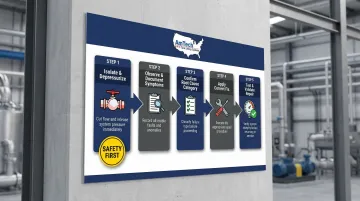
Step 5: Test and Validate the Repair
Once the repair is complete, restore system pressure gradually. Monitor the pressure gauge for stabilization within the expected cut-in/cut-off range. Observe pump cycle frequency to confirm short-cycling has stopped. Check all connection points for leaks. Document post-repair readings to establish a new performance baseline.
Fix vs. Replace: Making the Right Call
In industrial settings, the fix vs. replace decision comes down to the nature of the damage, the tank's age and service history, and the total cost of risk. A repair that leaves structural vulnerability in place often costs more in the long run than outright replacement.
When Repair Is Appropriate
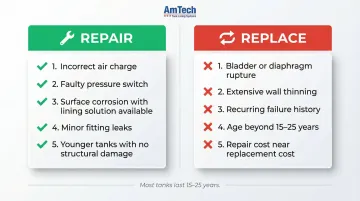
Repair is the right choice for:
- Incorrect air charge or pressure switch fault with no structural damage
- Minor leaks at fittings or connections on a relatively young tank
- Surface-level corrosion where a lining application can seal oxidation and stop further deterioration
AmTech's inspection data shows that 98% of double-walled tanks are sufficiently sound to be returned to full-term useful life expectancy after repair and lining, rather than requiring complete replacement.
When Replacement Is the Right Choice
Replacement is warranted for:
- Bladder or diaphragm rupture (non-repairable)
- Extensive internal corrosion with confirmed wall thinning (structural compromise)
- Tanks that have exceeded their expected service life and have a history of recurring failures
- Cases where the cost of repair approaches or exceeds replacement cost
Most pressure tanks last 15–25 years, depending on application, fluid quality, and maintenance history. Tanks handling chemicals or high-mineral-content fluids typically degrade faster. When replacing, upsizing the tank reduces pump cycling frequency and extends the new system's service life.
Preventive Maintenance to Avoid Future Pressure Tank Failures
Proactive maintenance costs far less than emergency repairs, pump replacements, or the downtime that follows an unplanned system failure.
Annual Inspection Schedule
Conduct regular inspections including:
- Pressure gauge and switch calibration checks
- Air charge verification
- Visual inspection for corrosion or exterior damage
- Bladder/diaphragm integrity testing
Tanks in chemical, fuel, or high-mineral water service may require more frequent inspection. The Florida Rural Water Association recommends checking pressure relief valves at least annually and replacing them every five years.
Protective Tank Lining as Long-Term Corrosion Defense
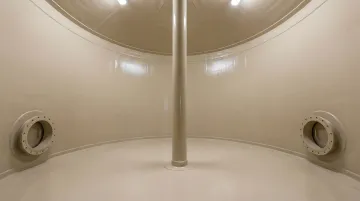
Applying a field-applied internal lining system is one of the most cost-effective ways to prevent corrosion-driven failure and extend tank service life by decades. Systems compliant with NSF, API, and ANSI standards create a seamless barrier between the stored product and the tank wall.
AmTech offers two proven systems for this application:
- DuraChem® 500 series — up to 1,965 PSI adhesion strength; 10+ year service life
- HydraStone Alkrete® — cementitious lining with a 40-year track record in hot and cold water tank applications
Operational Controls
Day-to-day operational discipline prevents the slow-burn failures that inspections alone won't catch:
- Maintain correct air pre-charge pressure per system design specs
- Verify pressure switch settings against original specifications
- Address water quality issues — high chloride content and acidic pH accelerate internal corrosion
- Log pump cycle frequency over time as a baseline indicator of tank health
Conclusion
Pressure tank failures in industrial and commercial applications are predictable and largely preventable. Most emergencies are preceded by identifiable warning signs that reward early action. Correct diagnosis before any repair attempt is what separates a lasting fix from a repeat failure.
Knowing when to repair versus replace, and when to bring in qualified professionals, protects more than the tank itself. Sound decisions here safeguard the entire system, operational continuity, and your facility's regulatory standing.
The consequences of failure run deeper than physical damage:
- Safety exposure: Pressure vessel failures can injure personnel and damage surrounding equipment
- Operational downtime: Unplanned shutdowns cost significantly more than scheduled maintenance
- Regulatory penalties: OSHA has issued fines exceeding $87 million for violations tied to pressure vessels and process safety management
When warning signs appear, early professional assessment is the lowest-cost option available. Emergency repair contractors with pressure vessel experience can diagnose the root cause, recommend the right repair method, and restore operations faster than most facility teams can manage independently.
Frequently Asked Questions
What are the signs of a pressure tank going bad?
Common indicators include pump short-cycling, fluctuating or dropping system pressure, banging or water hammer sounds in pipes, visible corrosion or pooling at the tank base, and water discharging from the air valve when only air should be present.
Can a waterlogged pressure tank be fixed?
No. A waterlogged tank — where the internal bladder has ruptured — cannot be repaired and must be replaced. Without a functioning pressure buffer, continued operation puts the pump at serious risk of premature failure.
How much does it cost to replace a pressure tank?
Residential pressure tank replacement typically runs $300–$1,900 depending on tank size and installation. Industrial replacement costs vary significantly based on tank size, fluid type, materials, and whether corrosion remediation or relining is also required.
What is the average lifespan of a water pressure tank?
Most pressure tanks last 15–25 years. Lifespan depends on water or fluid quality, maintenance frequency, operating pressure, and whether a protective internal lining is in place — tanks with professionally applied linings often push well past the 25-year mark.
When should you repair vs. replace an industrial pressure tank?
Repair is appropriate for fixable issues like incorrect air charge, pressure switch faults, or surface corrosion that can be resolved with a protective lining. Replacement is warranted when there is bladder failure, structural wall damage from advanced corrosion, or a history of recurring failures on an aging tank.