Introduction
Fuel storage tanks—whether aboveground, underground, or transport vessels—operate under constant pressure changes that remain invisible until something goes wrong. A plastic bag taped over a vent during maintenance can generate 60,000 pounds of crushing force on a single tank panel during pump-out, collapsing steel walls like a crushed soda can. Venting is not an optional accessory—it's a fundamental engineering requirement that prevents tank collapse, fuel spills, fires, and regulatory violations.
Understanding why that happens—and how to prevent it—starts with venting fundamentals. This guide covers the physics of tank breathing, normal vs. emergency vent design, regulatory standards (API 2000, NFPA 30, EPA, OSHA), and what failure looks like in practice.
Whether you manage underground storage tanks at a fuel dispensing facility or oversee aboveground petroleum storage at an industrial site, this knowledge is essential for protecting infrastructure, personnel, and compliance.
TLDR:
- Fuel tanks require bidirectional pressure relief to prevent vacuum collapse during pump-out and overpressure rupture during thermal expansion
- Atmospheric pressure exerts 14.7 PSI across tank surfaces—creating massive aggregate forces that collapse improperly vented tanks
- Normal vents handle daily thermal breathing; emergency vents protect against fire exposure requiring exponentially higher flow rates
- API 2000, NFPA 30, and EPA regulations mandate specific vent sizing and vapor recovery systems by tank type and throughput
- Blocked vents—from insects, ice, or maintenance covers—cause catastrophic failures requiring structural inspection and interior relining
What Is Fuel Tank Venting and Why Every Storage Tank Needs It
The Core Physics: Pressure Equilibrium
As fuel is pumped out of a tank, a vacuum forms unless air can enter to replace the lost volume. As fuel warms and vapors expand, pressure builds unless excess vapor can escape. Without bidirectional pressure relief, tanks face destructive forces from both directions.
According to API Manual of Petroleum Measurement Standards Chapter 11.1, gasoline has a volumetric thermal expansion coefficient of approximately 0.00069 per °F. A 10,000-gallon aboveground storage tank warming by 30°F during a summer day will expand by over 200 gallons. That vapor volume must escape, or internal pressure will climb to destructive levels.
The Vacuum Collapse Risk
Atmospheric pressure exerts approximately 14.7 PSI on the exterior of every tank wall at sea level. When internal pressure drops significantly below that threshold, the tank walls are forced inward by the pressure differential.
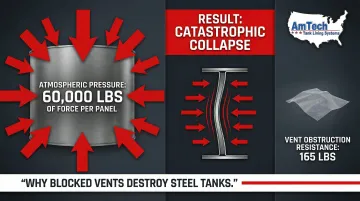
AIChE Beacon investigations documented that atmospheric pressure on a single panel of a collapsed storage tank generated approximately 60,000 pounds of force — while the plastic sheet blocking the vent resisted only 165 pounds before failure.
Documented collapse incidents include:
- A tank that imploded when material was pumped out after someone covered the atmospheric vent with a plastic sheet during maintenance
- A storage tank whose vent was plugged with wax buildup, collapsing during routine product withdrawal
- A fertilizer tote that buckled when a nest of bees blocked the vent opening
Even tanks with heavy steel walls are vulnerable. Atmospheric pressure acts uniformly on the entire outer surface area, creating an enormous aggregate force.
The Steel Tank Institute (STI) conducted in-situ testing on a 64-inch diameter buried steel tank, which withstood 16.5 inches of Mercury vacuum without buckling. That result depended entirely on properly compacted backfill providing structural support. Theoretical calculations for an unsupported tank predict buckling at just 1.3 to 6.0 PSI vacuum.
The Overpressure Risk
If vapors cannot escape, internal pressure builds to the point of deformation, seal failure, or rupture. In fuel storage, that means a direct fire and explosion hazard. The risk is highest in warm climates or sun-exposed aboveground tanks, where solar heating accelerates vapor generation.
The U.S. Chemical Safety Board (CSB) investigated a 5,200-gallon polyethylene tank rupture caused by overpressure, and a separate refinery incident where an explosion in the vapor space generated enough pressure to separate the tank's floor-to-shell joint.
In both cases, inadequate pressure relief contributed to catastrophic failure.
Engineered Relief, Not Open Holes
Effective venting requires engineered pressure/vacuum relief set to open at specific thresholds — not just an uncapped hole. Vents must activate at predetermined pressures to prevent structural damage, then reseal during normal conditions to minimize vapor emissions and satisfy EPA requirements.
How Fuel Tank Venting Systems Work: Key Components Explained
Pressure/Vacuum (P/V) Vent Valves
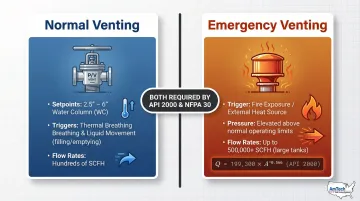
P/V vent valves (also called conservation vents) remain sealed under normal pressure ranges and only open when internal pressure or vacuum exceeds set thresholds. These thresholds are typically measured in inches of water column (WC) for atmospheric storage tanks.
Typical P/V vent setpoints range from 2.5" to 6" WC for pressure and -6" to -10" WC for vacuum. This design minimizes vapor emissions while providing pressure relief when needed. Manufacturer data shows that properly functioning P/V vents maintain leak rates below 0.05 cubic feet per hour (CFH) at 2" WC, keeping fugitive emissions strictly controlled.
P/V vents are the primary normal-venting device on most aboveground fuel storage tanks and are available in a range of pressure/vacuum settings depending on tank design and fluid stored. The valves use weighted pallets or spring-loaded mechanisms that lift when pressure differential exceeds the setpoint, allowing vapor to escape or air to enter.
Emergency Vents
Emergency vents open at higher pressure levels than P/V vents, designed specifically to handle abnormal conditions such as fire exposure. External fire causes rapid vapor generation well beyond normal operating pressures. For a 20,000-gallon tank, that can exceed 500,000 standard cubic feet per hour (SCFH).
Per API 2000 and NFPA 30, emergency vents are sized based on the tank's wetted surface area and the heat input from fire exposure. For wetted surface areas between 200 and 1,000 square feet, the required heat input (Q) is calculated as:
Q = 199,300 × A^0.566 (in BTU/hr)
This exponential relationship means emergency vent capacity requirements increase dramatically with tank size. Depending on tank design, emergency vents may use weighted pallets, spring-loaded mechanisms, or frangible roof-to-shell attachments that separate under extreme pressure.
Rollover Valves and Vent Line Routing
Rollover (or anti-spill) valves prevent fuel from flowing out through vent lines if the tank is tipped, overfilled, or subjected to sudden movement. These valves are critical for mobile fuel tanks and underground storage tanks at retail dispensing facilities.
Vent line routing is equally important. Even small errors in installation can block airflow entirely:
- Route vent lines higher than the highest point of the tank, including the fill neck
- Eliminate dips or low points where condensation or fuel can pool
- Inspect for liquid accumulation regularly — even a small blockage turns a functional vent into a sealed system
Vapor Recovery and Carbon Canisters
Proper venting controls pressure and liquid hazards, but vapor emissions require a separate strategy. In regulated applications, particularly underground storage tanks at fuel retail locations, vapors displaced during filling must be captured rather than released to atmosphere. Vapor recovery systems use activated carbon canisters that adsorb fuel vapors during tank filling operations.
The carbon beds are regenerated using high vacuum and purge air stripping, which removes the adsorbed gasoline vapor and restores the carbon's capacity. The recovered product is returned to the storage tank, reducing VOC releases at the source rather than treating them after the fact.
Vapor recovery requirements are driven by EPA Stage I and Stage II regulations and apply to tanks above certain throughput thresholds. This distinguishes compliant industrial fuel storage from simpler agricultural or private-use tanks that may not require vapor capture systems.
Normal Venting vs. Emergency Venting: Key Differences
Operational Triggers
Normal (thermal) venting handles routine pressure changes from temperature variation and day-to-day fuel movement. This includes:
- Liquid movement during filling and withdrawal operations
- Thermal breathing as ambient temperature changes throughout the day
- Barometric pressure fluctuations
Emergency venting is sized and set specifically for fire exposure scenarios that generate far greater vapor volumes in a shorter time frame. Both are required on aboveground storage tanks per NFPA 30 and API 2000.
Pressure Setpoints and Mechanisms
Normal vents are calibrated to very low thresholds—often expressed in ounces per square inch or inches of water column (typically 0.20 to 6" WC). These low setpoints ensure the vent opens before any structural stress develops in the tank wall.
Emergency vents open at higher pressures and may use different mechanisms:
- Weighted pallet vents that lift when pressure exceeds the weight of the pallet
- Spring-loaded relief valves calibrated to specific higher pressures
- Frangible disk or roof-to-shell seams designed to fail at predetermined pressures
The sizing calculations differ dramatically. According to API 2000, normal venting capacity is the sum of requirements for liquid movement and thermal effects. Emergency venting capacity is determined by heat input from fire exposure, calculated from the tank's wetted surface area.
The Consequence of Getting This Wrong
A tank sized only for normal venting may pass routine inspection but still rupture during a fire event. Regulatory standards address this gap directly. Normal P/V vents cannot handle the surge in vapor generation under fire exposure conditions, which is why dedicated emergency relief devices are mandatory for most petroleum storage applications.
Regulatory Standards Governing Fuel Tank Venting
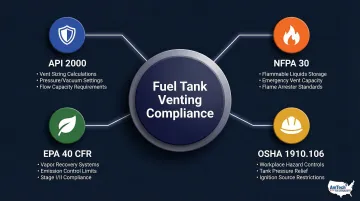
API 2000: Venting Atmospheric and Low-Pressure Storage Tanks
API Standard 2000 (7th Edition, March 2014) is the primary engineering standard governing vent sizing and selection for aboveground petroleum storage tanks. It prescribes methods for calculating required venting capacity for both normal operations and emergency fire conditions based on:
- Tank capacity and configuration
- Fluid vapor pressure and volatility
- Maximum fill and withdrawal rates
- Wetted surface area during fire exposure
- Geographic location and climate factors
The standard covers atmospheric and refrigerated storage tanks operating at pressures from full vacuum through 15 PSI gauge, with guidance spanning vent device selection, installation, and maintenance.
NFPA 30: Flammable and Combustible Liquids Code
NFPA 30 mandates that aboveground tanks storing Class I, II, or IIIA liquids must be equipped with vents designed and sized to prevent vacuum or pressure exceeding the tank's design limits. Section 21.4.3.3 requires that normal vents be sized in accordance with API Standard 2000 or another approved standard, or be at least as large as the largest filling or withdrawal connection (minimum 1.25 inches nominal inside diameter).
EPA Vapor Recovery Regulations
Underground storage tanks (USTs) and high-throughput aboveground tanks at fuel dispensing facilities are subject to EPA regulations requiring vapor recovery systems during filling operations to reduce VOC emissions.
- 40 CFR Part 280 — Technical standards and corrective action requirements for underground storage tanks
- 40 CFR Part 63 Subpart CCCCCC (NESHAP) — Requires installation and operation of vapor balance systems on gasoline storage tanks at dispensing facilities
These regulations mandate that vapors displaced during tank filling be captured and controlled through carbon adsorption or other approved methods, rather than vented directly to atmosphere.
OSHA 29 CFR 1910.106: Flammable Liquids Storage
OSHA regulations require that atmospheric storage tanks be adequately vented to prevent the development of vacuum or pressure sufficient to distort the roof or exceed the design pressure. Normal vents must be sized in accordance with API Standard 2000 or another accepted standard.
Improper venting creates fire and explosion hazards that fall under OSHA's flammable liquids and process safety management standards. Additionally, vent inspection access on top of tanks creates OSHA compliance challenges around fall protection and confined space entry—making remote or accessible vent designs an operational consideration.
Related API Standards
Beyond the primary standards above, these API documents inform tank design and installation decisions that directly affect venting requirements:
- API 650 (13th Edition, 2020) — Design and construction of welded steel aboveground storage tanks for pressures approximating atmospheric
- API 620 (12th Edition, 2013) — Design and construction of large, welded, low-pressure storage tanks (up to 15 PSI)
- API RP 1615 (6th Edition, 2011) — Installation of underground petroleum storage systems
AmTech Tank Lining & Repair holds API compliance certifications and NFPA membership, supporting work on fuel storage tanks where these standards govern design, repair, and inspection requirements.
What Happens When Fuel Tank Venting Fails
Vacuum-Related Failure
When a vent is blocked or absent and fuel is pumped out, the resulting vacuum can deform or fully collapse tank walls. Even tanks with heavy steel walls are vulnerable because atmospheric pressure (14.7 PSI) acts uniformly on the entire outer surface area, creating an enormous aggregate force.
The AIChE Beacon documented a case where a tank collapsed because material was pumped out after someone covered the atmospheric vent with a plastic sheet during maintenance. The total force from atmospheric pressure on each panel was about 60,000 pounds, while the force on the plastic sheet was only 165 pounds—not enough to break the obstruction, leading to catastrophic collapse.
Common causes of vacuum collapse include:
- Temporary weather covers or plastic bags left on vents after maintenance
- Insect nests or spider webs blocking vent openings
- Ice formation in cold climates sealing vent passages
- Wax or sludge buildup internally blocking vent lines
Overpressure-Related Failure
When vapors cannot escape, pressure builds until seals fail, fittings blow, or the tank wall deforms outward. In fuel storage contexts, this also creates a vapor release that dramatically elevates fire and explosion risk.
The CSB investigated an incident where a refinery tank explosion in the vapor space generated sufficient pressure to separate the tank's floor-to-shell joint. The investigation noted that the tank's conversion to a different service invalidated its original design, which did not include an emergency pressure relief system adequate for the new operating conditions.
Secondary Damage and Repair Requirements
Whether from vacuum collapse or overpressure rupture, structural deformation can compromise far more than the tank wall itself:
- The tank's internal lining (if present), exposing bare steel to corrosive fuel contact
- Weld integrity at seams and joints, creating leak paths
- Coating systems and corrosion protection layers
- The tank's structural certification and regulatory compliance status
Tanks that have experienced pressure events often need professional structural inspection and interior relining before they can safely return to service. That work typically includes ultrasonic testing, structural steel repair, surface preparation, and application of compatible lining systems — services AmTech Tank Lining & Repair has performed on petroleum and fuel tanks across all 50 states using systems like DuraChem® 500 series polyurea linings and Armor Shield® tank linings.
Fuel Tank Vent Inspection and Maintenance Best Practices
What a Proper Vent Inspection Includes
Comprehensive vent inspection should be integrated into annual or biannual tank inspection protocols and include:
- Inspect vent housings, screens, and mounting hardware for corrosion, impact damage, or physical deterioration
- Check all vent openings for debris, dirt, insect nests, ice, or other obstructions
- Verify that pressure and vacuum pallets move freely and seat properly when released
- Confirm vent lines maintain proper slope with no dips, kinks, or blockages where liquid can accumulate
STI SP001 (7th Edition, 2024) and PEI RP1200 (2024) mandate regular visual and functional inspections, as industry data shows vents frequently fail due to preventable maintenance oversights.
Common Causes of Vent Blockage
Vent blockages most commonly result from:
- Insect nests and spider webs in unprotected vent openings, particularly during warm months
- Ice formation in cold climates, sealing vent passages or locking pallet mechanisms in place
- Debris accumulation from nearby operations — dust, leaves, and construction materials
- Paint or sealant inadvertently applied over vent openings during tank maintenance or repainting
- Temporary covers — plastic bags, tape, or weather caps — left in place after maintenance
Each of these can turn a working vent into a sealed obstruction within hours or days, creating immediate collapse or overpressure risk during the next fill or withdrawal operation.
Functional Verification Procedures
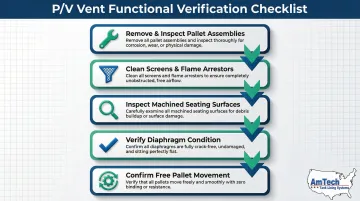
Maintenance procedures for P/V vents involve:
- Remove pressure and vacuum pallet assemblies and inspect for corrosion, warping, or damage
- Clean protective screens and flame arrestors to ensure unobstructed airflow
- Clean and inspect machined seating surfaces for debris, corrosion, or damage that prevents proper sealing
- Verify diaphragms (if present) are clean, flat, smooth, and free of cracks or deterioration
- Confirm pallets move freely upward without binding or sticking
Post-Failure Tank Assessment
Vent condition should be assessed alongside overall tank integrity. A tank that has operated with a compromised vent — even temporarily — should be evaluated for internal corrosion, lining degradation, or structural deformation before returning to full service. This is especially critical for:
- Older tanks with marginal structural margins
- Tanks storing corrosive fuel blends (E10, E15, E85, biodiesel)
- Tanks that have experienced multiple pressure events
- Tanks with existing coating or lining systems that may have been compromised
If any of these conditions apply, a post-event structural assessment should precede returning the tank to service. AmTech Tank Lining & Repair performs these evaluations using ultrasonic thickness testing, leak and permeation detection, and structural assessment — and can determine whether interior relining or structural repair is needed following a venting failure.
Frequently Asked Questions
Why are fuel tanks vented to the atmosphere?
Venting allows air to enter as fuel is withdrawn — preventing vacuum collapse — and lets expanding vapors escape as temperatures rise, preventing overpressure rupture. Without it, tanks face structural failure from both conditions.
Why are gas cans not vented anymore?
EPA regulations finalized in 2007 (effective 2009) required portable fuel containers to cut evaporative emissions. Modern gas cans use sealed designs with automatic pressure-equalizing spouts instead of passive vents, which were the primary source of those emissions.
What are the venting requirements for atmospheric storage tanks?
Atmospheric storage tanks must be equipped with vents sized to handle both normal thermal breathing and emergency fire conditions, per API 2000 and NFPA 30. Vent capacity is calculated based on tank volume, fluid vapor pressure, maximum fill/withdrawal rates, and heat input during fire exposure. Vents must prevent tank pressure from exceeding design limits in both normal and emergency scenarios.
What is the API code for storage tanks?
API 650 governs welded steel aboveground storage tanks, API 620 covers low-pressure tanks (up to 15 PSI), and API 2000 addresses venting requirements for atmospheric and low-pressure tanks. Underground storage tanks fall under separate EPA regulations and the API 1615/1632 series.
What is API 2000 used for?
API 2000 (Venting Atmospheric and Low-Pressure Storage Tanks) provides the engineering methodology for sizing and selecting vents on aboveground petroleum storage tanks. It covers normal (thermal) venting calculations, emergency (fire exposure) venting requirements, and guidance on vent device selection and installation for tanks operating from full vacuum through 15 PSI.