Introduction
Foundation settlement in aboveground storage tanks (ASTs) is one of the most structurally significant integrity threats facing tank operators today. A 2024 industry study found that over 40% of ASTs in service for more than 20 years show measurable foundation deformation, yet many operators lack a clear understanding of when settlement crosses the threshold from "normal" to "actionable."
API 653 storage tank settlement calculation is the standardized engineering process used to determine whether foundation-induced deformation falls within safe, code-defined limits and what corrective action is required when it does not. This guide is written for tank inspectors, integrity engineers, and facility operators in oil and gas, petrochemical, water/wastewater, and industrial sectors where AST integrity is a compliance requirement and an operational safety concern.
Understanding settlement limits isn't just about passing inspection — a missed threshold can mean shell distortion, weld failures, or a release event.
The specific mechanics of how API 653 Annex B calculations work are rarely broken down in practical terms. This guide covers the settlement types the standard addresses, how each calculation is performed, and how to interpret results against the acceptance criteria.
Key Takeaways
- API 653 Annex B evaluates four settlement types: uniform tilt, differential shell settlement, edge settlement, and localized bottom settlement
- Each uses a different calculation method with acceptance thresholds tied to tank diameter and geometry
- Tanks passing screening continue service; those failing require API 579 Fitness-For-Service analysis or repair
- Survey points must be spaced ≤31.42 feet apart using an even number of locations
- Remove uniform tilt from measurements before evaluating out-of-plane shell deformation
- Settlement beyond limits triggers mandatory NDE, foundation repair, or bottom plate relining
What Is API 653 Storage Tank Settlement Calculation?
API 653 storage tank settlement calculation is the structured engineering evaluation that determines whether the magnitude and pattern of foundation settlement in a flat-bottom AST fall within acceptable limits for continued safe operation. This process is governed by API 653 Annex B.
The process converts topographic elevation measurements into a clear verdict—acceptable, monitor, or repair—by comparing actual deformation against code-defined limits based on tank size, weld geometry, and settlement type.
How This Differs from General Inspection
Unlike routine corrosion or thickness assessments, settlement evaluation specifically addresses foundation-driven geometric distortion. This damage can:
- Compromise the shell-to-bottom corner joint
- Induce shell buckling under internal pressure
- Damage floating roof travel and sealing systems
- Create localized stress concentrations at welds
None of these failure modes show up in thickness readings. Settlement evaluation applies to ASTs originally built under API 650 and maintained under API 653. It is typically triggered by:
- Scheduled internal inspections (typically every 10 years)
- After seismic events or flooding
- When visual distortion is observed during routine walkarounds
- When floating roof binding or operational issues suggest deformation
Types of Tank Settlement That API 653 Annex B Evaluates
Uniform Settlement
The entire tank base descends evenly, producing no significant internal stress. This is the least structurally concerning type but can damage external piping connections and must still be documented. API 653 does not set a hard rejection limit for uniform settlement but requires monitoring of attached appurtenances.
Rigid Body Tilt (Planar Tilt)
One side of the tank settles more than the other, creating an inclination. Contrary to common industry belief, API 653 Annex B does not specify a strict 1:120 limit for planar tilt, explicitly stating that uniform and rigid tilt do not induce stresses in the tank structure.
However, the commonly referenced 1:120 limit (8.3 mm/m or 1 in/10 ft) between diametrically opposite shell points is widely used as a serviceability threshold. If no structural damage is evident and the tank is in service, it may continue under monitoring. Correction to verticality is mandatory if the tank is to be relocated or reconstructed per API 650 Chapter 10.
Differential Shell Settlement
The most structurally significant global mode, characterized by non-uniform elevation variation around the tank circumference. This creates out-of-plane shell distortions that can cause:
- Shell buckling under internal pressure
- Floating roof operational problems
- Weld fatigue at the shell-to-bottom junction
Two screening methods are available under API 653 Annex B:
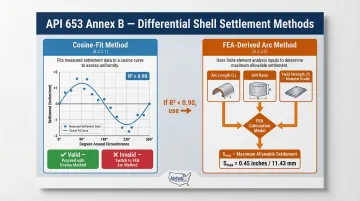
- Cosine-Fit Method (B.3.2.1): Fits an optimal cosine curve to measured data to represent a rigid tilt plane. Valid only when the statistical coefficient of determination R² ≥ 0.90; if this threshold is not met, the method cannot be used.
- FEA-Derived Arc Method (B.3.2.2): Calculates maximum permissible out-of-plane settlement (Smax) using settlement arcs, tank diameter-to-height ratio, and material yield strength. This method removes dependence on rigid tilt planes and is mandatory when the cosine fit fails.
Bottom Edge Settlement
A localized depression that forms at the tank perimeter where the shell meets the bottom. This occurs when the foundation shoulder erodes or is insufficiently extended beyond the tank shell, imposing higher secondary stress at the corner joint and nearby bottom welds.
Allowable limits depend on weld orientation at the measured location, using two curves from API 653 Annex B:
- Bew curve: For areas with lap welds parallel to the shell (±20°) — more conservative
- Be curve: For areas with no welds, butt welds, or lap welds perpendicular to the shell (±20°) — less conservative
The calculation requires measuring the settlement displacement (B) over the settled radius (R).
Mandatory NDE Trigger: When edge settlement exceeds 75% of the allowable limit AND is greater than 2 inches (50.8 mm), magnetic particle (MT) or liquid penetrant (PT) examination of shell-to-bottom and bottom welds is required.
Localized Bottom Settlement (Internal/Bulge)
Localized bottom settlement covers isolated depressions or dome-shaped deformations in the tank floor away from the shell. API 653 Annex B.3.3 evaluates these by comparing measured settlement B against an allowable limit Bb based on:
- Radius R of the settled zone
- Weld type (single-pass or double-pass lap welds)
For single-pass lap-welded joints, the permissible settlement is calculated as Bb = 0.37R. Where dishing or irregular out-of-plane distortion is present across multiple zones, 3D scanning provides the measurement resolution needed to apply these limits accurately.
How the API 653 Settlement Calculation Process Works
The end-to-end process follows four defined phases: collect field survey data, remove uniform tilt from the readings, quantify the settlement pattern, and compare results against the Annex B acceptance thresholds for the identified settlement type. Each step builds directly on the last — skipping or shortcutting any phase compromises the validity of the final evaluation.
Step 1: Conduct the Settlement Survey
Measurement Requirements per API 653 Section 12.5.2 and Annex B:
- Survey points are placed at equal intervals around the tank shell
- Maximum spacing: 31.42 feet (9.576 m)
- Always use an even number of points
- The highest elevation point is designated as Point 1 for cosine-fit accuracy
- Internal radial measurements are added if localized or dishing-type bottom settlement is suspected
The minimum number of survey points (N) is calculated as N = D/10 (where D is diameter in feet), rounded to the next higher even whole number. API 653 Figures B-1 and B-2 provide point quantity guidance as a function of tank diameter.
With survey points recorded, the raw data is ready for mathematical processing. Before out-of-plane deformation can be assessed, the uniform settlement and rigid body tilt components embedded in the readings must be isolated and removed.
Step 2: Remove Uniform Tilt and Fit the Data
Cosine Curve Fitting Method (B.3.2.1): This method fits an optimal cosine curve to the elevation data to mathematically separate tilt from true out-of-plane deformation. An R² ≥ 0.90 is required for the result to be considered valid. When the threshold isn't met, the settlement pattern is too irregular for this approach and an alternate method is needed.
Arc-Based Method (B.3.2.2): When the cosine fit fails, this method identifies settlement arcs between minimum elevation readings and calculates maximum permissible out-of-plane settlement (Smax) as a function of:
- Arc length (Sarc)
- Diameter-to-height ratio (D/H)
- Shell material yield strength (Y)
The method was developed through a large-scale parametric analysis of over 3,700 finite element runs and applies a 3.0% plastic strain criterion as the failure threshold.
Once the settlement type and magnitude are quantified, the fitted data feeds directly into the acceptance evaluation.
Step 3: Apply the Appropriate Acceptance Criterion
Compare measured values against the specific Annex B limit for the settlement type identified:
For differential shell settlement: Compare computed out-of-plane deviation against Smax from B.3.2.2 (capped at 101.6 mm / 4 in.)
For edge settlement: Plot measured B and R against the allowable settlement curves (Bew or Be) from API 653 Annex B.3.4. When edge settlement exceeds 50.8 mm (2 in.) and is greater than 75% of the allowable, MT or PT examination of the corner weld is required.
For internal bottom/bulge settlement: Compare B against the allowable Bb from B.3.3
If any criterion is exceeded, the tank requires evaluation under API 579 or must be taken offline for repair before returning to service.
Acceptability Criteria and What Happens When Limits Are Exceeded
Key Numerical Thresholds
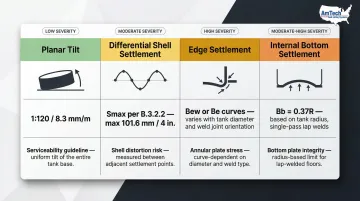
| Settlement Type | Acceptance Limit | Notes |
|---|---|---|
| Planar Tilt | 1:120 (8.3 mm/m) | Serviceability guideline; not a structural stress limit |
| Differential Shell Settlement | Smax per B.3.2.2 | Maximum 101.6 mm (4 in.) |
| Edge Settlement | Bew or Be curves | Varies with tank diameter and weld orientation |
| Internal Bottom Settlement | Bb = 0.37R | For single-pass lap welds |
Three-Level Response Framework
- Within Limits: Continue operation with a documented monitoring schedule
- Between Limits and NDE Threshold: Continued operation requires MT or PT examination of the corner joint and weld areas
- Limits Exceeded: The tank must undergo API 579 Fitness-For-Service evaluation or be taken out of service for physical correction
API 579 Escalation
When settlement exceeds Annex B limits but no visible structural failure is present, API 579-1/ASME FFS-1 can be used to justify continued operation:
| FFS Level | Method | Application |
|---|---|---|
| Level 1 | Simplified calculations | Conservative screening |
| Level 2 | Elastic stress modeling | Complex geometries |
| Level 3 | Finite element analysis (FEA) | Quantifies actual stress and equivalent plastic strain |
The B.3.2.2 screening limits were themselves derived from a parametric study of over 3,700 FEA runs — meaning a tank that fails the simplified check may still pass a more rigorous Level 3 evaluation before corrective action is required.
Corrective Actions When Repair Is Required
When a tank fails FFS evaluation — or when settlement has already caused bottom plate distortion, accelerated corrosion, or coating disbondment — physical remediation becomes necessary. Corrective actions typically include:
- Hydraulic jack lifting for tilt correction
- Foundation shoulder extension or compaction for edge settlement
- Bottom plate repair or replacement for localized damage
Bottom repair work almost always requires relining before the tank returns to service. AmTech Tank Lining & Repair provides API-compliant tank bottom relining using DuraChem® 500 and HydraStone® Alkrete® systems, with engineer-led field crews available across all 50 US states, Canada, and the Caribbean.
Common Misconceptions and Key Factors Affecting Accuracy
Most Common Misconceptions
"Uniform settlement is the same as differential settlement": This leads operators to under-inspect tanks that appear to have "settled evenly" when shell distortion or localized bottom depressions are actually present. Uniform settlement does not induce structural stress; differential settlement does.
"A tank that looks level doesn't need a settlement survey": Out-of-plane deformation at tolerances relevant to API 653 limits — often less than 4 inches over 100+ feet of circumference — is not visually detectable. Instrumented elevation surveys are mandatory.
Key Factors Affecting Calculation Accuracy
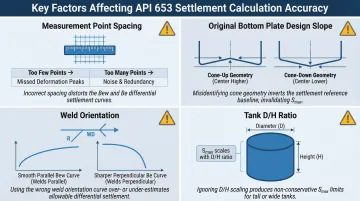
Four variables consistently drive calculation errors in field practice:
- Measurement point spacing — Too few points underdetect settlement arcs and inflate R² values; too many introduce noise and measurement error.
- Original bottom plate design slope — Cone-up vs. cone-down geometry must be subtracted from raw data before edge settlement is quantified. Measuring from a horizontal baseline produces significant errors.
- Weld orientation relative to settlement direction — Parallel vs. perpendicular bottom welds have different allowable curves (Bew vs. Be). Misidentifying orientation leads to incorrect acceptance decisions.
- Tank D/H ratio — Diameter-to-height ratio directly scales permissible Smax in the FEA-derived method. Higher D/H tanks are more sensitive to out-of-plane deformation.
When API 653 Annex B Methods Are Not Sufficient
Complex settlement patterns: The cosine-fit method (B.3.2.1) only applies when settlement follows a simple tilted plane. Twisting patterns or settlement concentrated near flush clean-out nozzles fall outside its scope. In those cases, a Level 3 API 579 FEA assessment is required regardless of whether calculated limits are met.
Progressive settlement: Tanks on saturated clay strata or unstable foundations experiencing repeated or progressive settlement require geotechnical reassessment, not just re-inspection.
Frequently Asked Questions
How is tank bottom settlement evaluated?
Tank bottom settlement is evaluated using API 653 Annex B methods, which involve taking topographic elevation measurements at equidistant points around the tank perimeter and bottom, classifying the settlement type (edge, differential, localized, or tilt), and comparing measured deformation against code-defined acceptance limits tied to tank diameter, weld geometry, and settlement radius.
What is the passing score for API 653?
The API 653 Authorized Inspector Certification Exam is scored on a pass/fail basis, and the exact passing score is not publicly published by API. The exam includes both open-book and closed-book portions covering inspection, calculations, welding, NDE, and repair per the API 653 Body of Knowledge.
What is the difference between uniform settlement and differential settlement in API 653?
Uniform settlement occurs when the entire tank base descends evenly with no internal distortion, while differential settlement refers to non-uniform deformation—either as tilt (one side lower than the other) or as out-of-plane shell or bottom distortion. Only differential settlement generates the structural stresses that API 653 Annex B is designed to evaluate and limit.
What are the acceptable settlement limits per API 653 Annex B?
API 653 Annex B defines limits by settlement type:
- Tilt: Must not exceed 1:120 (8.3 mm/m)
- Differential shell settlement: Must not exceed Smax per B.3.2.2 (maximum 101.6 mm / 4 in.)
- Edge settlement: Must fall within allowable curves in Annex B.3.4 based on tank diameter and weld orientation
- Localized bottom settlement: Must not exceed Bb per B.3.3, a function of settled radius R and weld type
When should API 579 be used instead of API 653 for settlement evaluation?
Use API 579-1/ASME FFS-1 when Annex B screening methods are insufficient or inapplicable:
- Settlement exceeds Annex B limits but no visible structural failure is present
- The settlement pattern is complex (twisting, near nozzles) and falls outside Annex B scope
- A detailed stress and strain analysis is needed to justify continued operation in place of re-leveling or repair
How many settlement survey points are required for an API 653 inspection?
The number of survey points is determined per API 653 Section 12.5.2 and Annex B Figures B-1 and B-2 as a function of tank diameter. An even number of points is required, and the maximum spacing between adjacent points must not exceed 31.42 feet (9.576 m) around the tank circumference.