Introduction
If you've ever inspected a hot water storage tank—whether in a mechanical room, on a rooftop, or at an industrial facility—you've likely noticed the distinctive silver or metallic finish. This isn't a cosmetic choice or industry tradition. The silver coating is a deliberate engineering decision rooted in thermodynamics, corrosion science, and decades of industry experience.
The silver paint serves three critical functions:
- Reflects radiant heat back toward the tank to minimize thermal loss
- Creates a moisture-resistant barrier that shields steel from corrosion
- Provides UV protection that extends coating lifespan
This guide explains the science behind the silver finish, clarifies the difference between exterior coatings and interior linings, and outlines when a failing coating needs professional attention.
Key Takeaways
- Silver coatings have low thermal emissivity (0.27–0.67), radiating far less heat than white or dark paints and keeping stored water hot longer
- Aluminum-pigmented paints form a dense, overlapping barrier that blocks moisture and oxygen from reaching steel surfaces
- UV-reflective properties prevent chalking and delamination on outdoor tank surfaces
- Exterior silver coatings and interior linings do different jobs: one controls heat loss, the other prevents corrosion and contamination
- Visible coating failures—rust bleed-through, blistering, or flaking—require urgent professional inspection and re-coating
The Real Reasons Hot Water Storage Tanks Are Painted Silver
Aluminum-pigmented coatings have dominated hot water storage tank specifications for decades — and for good reason. Each property below reflects a documented performance advantage, not an aesthetic preference.
Low Thermal Emissivity Reduces Heat Loss
The primary functional reason is thermal performance. Silver coatings—typically formulated with aluminum flake pigments—have low thermal emissivity, meaning they radiate far less heat outward from the tank surface compared to standard paints.
| Coating Type | Emissivity Range | Heat Radiation |
|---|---|---|
| Aluminum paint | 0.27–0.67 | Low |
| White or black paint | 0.90+ | High |
A lower emissivity surface releases less radiant heat per unit area, so heating systems cycle less frequently to maintain set temperatures — directly reducing energy consumption.
Corrosion Protection Through Lamellar Barrier Structure
Beyond thermal performance, silver coatings provide superior corrosion resistance. Aluminum-pigmented epoxy or polyurethane coatings use lamellar (leafing) aluminum flakes that align parallel to the steel substrate during application, creating a dense, overlapping moisture barrier. This physical structure blocks the water-oxygen interaction that causes rust formation, extending the service life of outdoor and semi-exposed tanks.
UV Reflection Extends Coating Lifespan
Metallic coatings reflect UV radiation rather than absorbing it, reducing photodegradation of the coating material itself. This UV protection is particularly important for outdoor tanks, where prolonged sun exposure accelerates coating breakdown and chalking in non-reflective paints.
Visual Inspection Advantage
The same reflective surface that resists UV also makes routine inspections more straightforward. Rust staining, pitting, blistering, and coating failures stand out clearly against a consistent metallic background — critical for maintenance schedules and compliance checks.
Industry Standards and Engineering Consensus
The silver standard isn't arbitrary. The American Water Works Association (AWWA) D102 standard, "Coating Steel Water-Storage Tanks," explicitly specifies aluminum finishes for exterior protection. For example, Outside Coating System (OCS) No. 1-B requires that intermediate and finish coats be nonleafing aluminum alkyd.
When exterior coatings degrade — from UV exposure, moisture intrusion, or mechanical damage — the steel substrate underneath becomes vulnerable fast. Specifying AWWA-compliant aluminum finishes isn't just about aesthetics; it's the first line of defense against corrosion that can compromise structural integrity and trigger costly repairs or regulatory non-compliance.
In summary, silver coatings earn their place on hot water storage tanks by delivering:
- Lower heat loss through reduced thermal emissivity
- Corrosion resistance via lamellar aluminum barrier structures
- Extended coating life from UV reflectivity
- Easier defect detection during inspections
- Compliance with AWWA D102 exterior coating specifications
The Science of Heat Reflection: Why Silver Works
Every surface emits (radiates) heat at a rate determined by its thermal emissivity value—a number between 0 (no emission) and 1 (maximum emission). Silver and aluminum coatings have exceptionally low emissivity, meaning they release far less radiant heat per unit area than dark or matte surfaces.
Thermal Emissivity Comparison
| Surface Material | Thermal Emissivity | Solar Absorptance |
|---|---|---|
| Aluminum paint | 0.27 - 0.67 | N/A |
| White paint (acrylic) | 0.90 | 0.26 |
| Black paint (flat) | 0.97 | 0.98 |
| Polished aluminum | 0.039 - 0.057 | N/A |
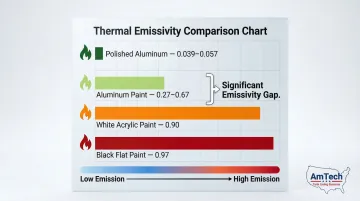
A hot water tank coated with aluminum paint emits less than half the thermal radiation of a white-painted tank and dramatically less than a black-painted tank. This difference compounds over time: the heating element runs less frequently, energy consumption drops, and standby heat loss decreases.
Contrast with High-Emissivity Surfaces
A dark or matte-painted tank radiates stored heat outward continuously. In cold weather or uninsulated environments, this forces the heating system to work harder and consume more energy to maintain the set water temperature. Black and dark blue tanks are particularly problematic, with emissivity values near 0.97—meaning they release nearly all absorbed heat as thermal radiation.
Two Heat Reflection Mechanisms
Silver coatings work through two distinct mechanisms:
- Reflecting incoming solar radiation away from the tank exterior (relevant for outdoor tanks)
- Minimizing outward thermal emission from the tank surface itself (relevant for all tanks, indoors and outdoors)
Aluminum Pigment Infrared Reflectivity
Many silver tank coatings use aluminum flake pigments, which are effective at reflecting infrared radiation in the 8–14 micron range, where the majority of thermal energy from hot water tanks is emitted. Leafing aluminum pastes use surface-treated aluminum flakes that float to the coating surface during application, aligning parallel to the substrate to form a highly reflective metallic layer.
This structure is measured using ASTM E408 ("Standard Test Methods for Total Normal Emittance of Surfaces Using Inspection-Meter Techniques"), which allows engineers and procurement teams to verify a coating's actual emissivity performance before specifying it for a project.
Interior Lining vs. Exterior Silver Coating: Two Different Jobs
A critical distinction often confuses tank owners: the silver exterior paint and the interior lining are separate systems with entirely different purposes.
Exterior paint is about thermal performance and environmental protection—minimizing heat loss, blocking UV degradation, and preventing external corrosion.
Interior lining is about corrosion resistance, structural integrity, and water quality safety—protecting the steel substrate from hot water and oxygen while ensuring no contaminants leach into stored water.
Common Interior Lining Materials
Interior linings for hot water storage tanks include:
- 100% solids epoxy coatings for chemical resistance and strong substrate adhesion
- High-temperature polyurethane linings for flexibility across wide temperature ranges
- Calcium aluminate cementitious systems (such as HydraStone Alkrete®) rated to 900°F
- Glass-fused enamel coatings for residential and light commercial applications
- Reinforced fiberglass composite linings where aggressive chemical exposure is a factor
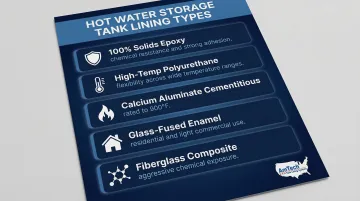
Each is selected based on water chemistry, temperature range, and chemical exposure.
NSF/ANSI 61 Compliance for Potable Water
Interior linings in contact with potable hot water must comply with NSF/ANSI 61 ("Drinking Water System Components – Health Effects"). This standard evaluates the health effects of materials and chemical contaminants imparted to drinking water.
Products intended for "Commercial hot" applications are tested at 82 ± 2 °C (180 ± 4 °F), with strict extractable limits for solvents like xylene and toluene. To meet these strict requirements, the industry relies heavily on 100% solids epoxies and polyurethanes.
Interior Lining Failure is the More Serious Concern
When the interior coating fails, bare steel is exposed to hot water and oxygen, accelerating corrosion from the inside out. In potable water tanks, this also introduces rust and contaminants into the water supply—a direct threat to water quality and structural integrity.
Case studies document that water-soluble salts left on the steel substrate can create an osmotic cell, driving water through the coating and causing "osmotic blistering" and underfilm corrosion.
Critical takeaway: A tank can look pristine on the outside (silver coat intact) while suffering severe interior lining failure. Regular internal inspections are essential and should not be skipped just because the exterior appears fine.
Silver vs. Other Colors: How Tank Color Affects Performance
Color choice directly impacts both heat gain (from solar radiation) and heat loss (through emissive radiation).
Here's how the main options compare:
| Color | Solar Absorptance | Thermal Emissivity | Best For |
|---|---|---|---|
| White | ~0.26 (low) | ~0.90 (high) | Cold water storage |
| Dark/Black | 0.90–0.98 (high) | 0.90–0.97 (high) | Solar thermal collectors only |
| Metallic Silver | ~0.25–0.35 (low) | ~0.05–0.15 (low) | Hot water storage |
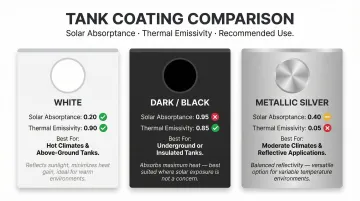
White Paint: Good for Cold Water, Not Hot Water
White paints excel at reflecting solar energy (low solar absorptance of ~0.26), making them ideal for cold water storage where the goal is to prevent solar heating. However, white paint has high thermal emissivity (~0.90), meaning it rapidly radiates the tank's internal heat into the ambient air. For hot water storage, this is counterproductive—you want to retain heat, not radiate it away.
Dark Colors: Worst Option for Hot Water Storage
Black and dark-colored tanks have both high solar absorptance (up to 0.98) and high thermal emissivity (0.90–0.97). While they absorb solar heat during the day, they suffer massive radiative heat loss at night or in cold weather. Dark tanks can also cause dangerous overheating in outdoor settings.
Exception: Solar thermal collector tanks intentionally use dark absorptive surfaces to maximize solar heat gain.
Insulated Indoor Tanks: Color Matters Less, But Still Matters
For insulated indoor hot water tanks, insulation reduces but doesn't eliminate the color effect. For outdoor or semi-exposed tanks, the silver coating reduces standby heat loss across the tank's operating life — an advantage that adds up in energy costs over time.
The The Solar Reflectance Index (SRI) combines solar reflectance and thermal emittance into a single performance score. Metallic silver coatings typically score between 35 and 68 on this index — balanced enough to reflect solar gain while keeping emissivity low enough to prevent standby heat loss.
When Does a Hot Water Tank's Coating Need Replacing?
Exterior coatings don't last forever. Recognizing the warning signs of coating failure allows you to intervene before minor deterioration becomes a major structural problem.
Key Warning Signs
- Chalking or powdering: The paint surface becomes dusty and loses its sheen
- Visible rust staining or bleed-through: Orange or brown discoloration indicates corrosion beneath the coating
- Widespread blistering or peeling: Coating lifts away from the substrate in bubbles or sheets
- Loss of reflective metallic sheen: The surface becomes dull and matte
- Exposed bare metal: Any visible bare steel should be treated as urgent
Recommended Inspection Frequency
Authoritative maintenance guidelines, such as those from the U.S. Bureau of Reclamation, recommend that exterior inspection surveys for structures in atmospheric service exposure be conducted every 3 to 5 years. Hot water storage tank exteriors should be professionally inspected and re-coated every 5–10 years depending on environment, coating type, and tank usage.
Surface Preparation Standards Before Re-Coating
Before recoating, the steel substrate must be properly prepared to ensure adhesion. The Society for Protective Coatings (SSPC) and NACE (now AMPP) define blast-cleaning grades:
- SSPC-SP 6 / NACE No. 3 (Commercial Blast Cleaning): Removes all visible oil, grease, dust, dirt, mill scale, rust, and coating, allowing stains or shadows to remain on up to 33% of each unit area
- SSPC-SP 10 / NACE No. 2 (Near-White Metal Blast Cleaning): A more stringent standard that limits random staining to no more than 5% of each unit area
Economics of Proactive Recoating
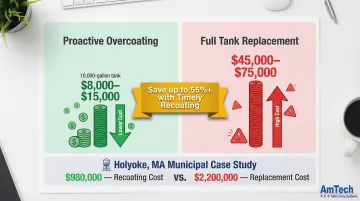
Proactive overcoating is significantly more cost-effective than full tank replacement. A municipal case study in Holyoke, MA demonstrated that utilizing a surface-tolerant overcoat system cost $980,000, saving over half the original $2.2 million estimate required for full containment and dry blasting to bare metal. Industry data indicates that professional coating systems for a 10,000-gallon commercial steel tank cost between $8,000 and $15,000, whereas full tank replacement costs between $45,000 and $75,000.
When those warning signs appear, AmTech Tank Lining & Repair provides tank inspection, ultrasonic thickness testing, structural steel repair, surface preparation to SSPC standards, and application of proprietary coating and lining systems — including DuraChem® 500 series poly linings, HydraStone® cementitious systems, and Armor Shield® epoxy systems — for both interior and exterior protection. All work is performed by engineer-led field crews and backed by the BLUE CHECK warranty program.
Frequently Asked Questions
Why are hot water tanks painted silver?
Silver coatings have low thermal emissivity (0.27–0.67), meaning they radiate far less heat outward than white or dark paints. This helps the tank retain stored hot water more efficiently while also providing corrosion and UV protection.
Does the silver paint on a hot water tank actually improve energy efficiency?
Yes. Low-emissivity silver coatings reduce radiant heat loss from the tank surface, which means the heating element runs less frequently to maintain water temperature. Exposed or outdoor installations see the greatest gains.
What type of paint or coating is used on hot water storage tanks?
Exterior coatings are typically epoxy or polyurethane-based with aluminum or metallic pigments for reflectivity. Interior linings are separate systems (epoxy, cementitious, enamel, or polyurethane) selected for chemical compatibility and water contact safety.
Does the color of a water tank affect the temperature of the water inside?
Color affects both heat gain (from solar radiation in outdoor tanks) and heat loss (through emissive radiation). Silver minimizes both unwanted solar gain and thermal emission loss for hot water applications.
How often should hot water storage tanks be repainted or recoated?
Exterior coatings typically require inspection every 3–5 years and recoating every 5–10 years depending on environmental exposure and coating type. Interior linings should be inspected on a similar schedule by a certified inspector.
Can you repaint a hot water storage tank yourself?
Commercial and industrial hot water storage tanks require professional surface preparation — typically abrasive blasting to SSPC-SP 6 or SSPC-SP 10 standards — before any coating is applied. Skipping this step compromises adhesion and voids most coating warranties. Field crews with NSF-compliant systems and code-compliance experience, like AmTech's engineer-led teams, handle this work from surface prep through final application.