Introduction
Stainless steel hot water tanks represent significant capital investments for industrial, commercial, and municipal facilities. When a 5,000-gallon storage tank begins showing signs of deterioration, facility managers face a decision that can run into six figures: replace it entirely, or reline and restore it for decades more of service.
Unlike glass-lined residential units that fail predictably after 8–12 years, commercial stainless steel tanks can deliver 30+ years of service. Water chemistry, operating conditions, and maintenance history determine whether you reach that ceiling—or fall well short of it.
This article covers:
- How long stainless steel hot water tanks typically last
- What shortens or extends that lifespan
- Warning signs that a tank is approaching failure
- How professional tank relining can maximize your investment
Key Takeaways
- Stainless steel hot water tanks last 30–50+ years with proper maintenance, versus 8–12 years for glass-lined or galvanized alternatives
- High chloride water content is the single biggest threat, causing stress corrosion cracking at temperatures above 140°F
- Annual inspections, sediment flushing, and water chemistry control prevent premature failure
- Professional tank relining with NSF-compliant systems extends service life by 15–25+ years — often at a fraction of full replacement cost
How Long Do Stainless Steel Hot Water Tanks Last?
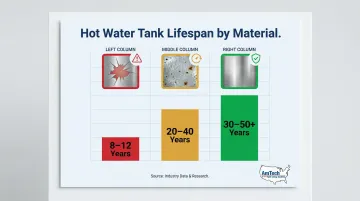
Stainless steel hot water tanks typically deliver 30 to 50+ years of service under normal operating conditions with proactive maintenance. That significantly outpaces other common materials:
| Tank Material | Typical Lifespan |
|---|---|
| Glass-lined steel | 8–12 years |
| Galvanized steel | 20–40 years |
| Stainless steel | 30–50+ years |
The gap between residential-scale water heaters and large commercial or industrial storage tanks matters here. Industrial tanks face higher throughput, greater temperature cycling, and more aggressive water chemistry. A 500-gallon DHW tank serving a hotel operates under very different stress than a 50,000-gallon municipal thermal storage system.
Grade is the deciding factor. Type 304 stainless steel is common in water applications, but Type 316 adds approximately 2% molybdenum — a meaningful difference in chloride-heavy environments. Per BSSA guidelines on stainless steel in water service, Type 304/304L should be limited to water with 50 ppm chlorides or less in hot water service. Type 316/316L handles up to 250 ppm.
The lifespan estimate assumes the tank's protective interior remains intact. Stainless steel relies on a passive oxide layer for corrosion resistance. Once this layer or any applied protective coating is compromised, corrosion can accelerate dramatically and shorten expected life from decades to months.
Field data supports these benchmarks. According to the Kennedy Tank quality comparison guide, commercial stainless steel tanks in non-corrosive environments routinely exceed 50 years of service, while glass-fused-to-steel tanks show a reference service life of 40 years based on documented performance.
What Factors Most Affect the Lifespan of a Stainless Steel Hot Water Tank?
Water Chemistry Dominates All Other Variables
High chloride concentrations cause chloride-induced stress corrosion cracking (SCC): a failure mode unique to stainless steel that can be sudden rather than gradual. SCC requires three conditions: a susceptible alloy, tensile stress, and a corrosive environment. Failures have been documented in bulk environments with as little as 10 ppm chlorides when concentrating mechanisms—such as evaporation at wet/dry interfaces—allow chlorides to reach hundreds of ppm locally.
The risk escalates exponentially at elevated temperatures. When stainless steels are fully immersed, chloride SCC is rare below 140°F (60°C), but temperatures above this threshold dramatically increase failure risk. For hot water applications, Type 304 and 316 are not recommended above 140°F in chloride-bearing waters.
Operating Temperature Creates Multiple Threats
Higher water temperatures accelerate corrosion in chloride-rich environments while increasing scale and sediment buildup rates. Repeated thermal cycling places stress on welds and seams, which are the most vulnerable points in any tank. In chloride-prone water supplies, temperatures below 140°F are worth maintaining — this single variable has an outsized effect on how quickly SCC and scale-related damage progress.
Microbiologically Influenced Corrosion (MIC)
Mineral scale and biofilm harbor bacteria that produce localized corrosive byproducts on stainless steel surfaces. Studies show biofilms can induce severe pitting, with pit depths under biofilm reaching 9.8 µm after just 14 days, 6.7 times deeper than in bacteria-free water. MIC thrives under stagnant conditions where untreated water stands, allowing chlorides to concentrate and biofilms to establish.
Installation Quality and System Design
Even premium 316 stainless steel fails prematurely when installation introduces stress points or corrosive microenvironments. Common installation-related failure causes include:
- Improperly supported tanks that create mechanical stress on welds and seams
- Dissimilar metal connections that trigger galvanic corrosion at contact points
- Poor drainage design that allows water to pool and concentrate chlorides
- Inadequate pressure regulation that accelerates fatigue at joints
Maintenance Frequency Determines Longevity
Tanks receiving annual inspections, regular flushing, and early-stage corrosion monitoring last significantly longer than neglected units. Massachusetts DEP guidelines and similar municipal standards require thorough interior and exterior structural inspections every 3–5 years by qualified personnel.
Warning Signs Your Stainless Steel Hot Water Tank Is Failing
Visible Corrosion Indicators
Surface rust staining around welds, joints, or fittings signals crevice corrosion—often the first visible sign of deterioration. Discolored or metallic-tasting hot water indicates corrosion byproducts entering the water supply. Visible pitting on accessible interior surfaces during inspection reveals localized corrosion that will spread.
Stress corrosion cracking (SCC) is another indicator to watch for. According to AMPP's corrosion basics resource, chloride-induced SCC fractures display a characteristic multi-branched "lightning bolt" transgranular (through-grain) crack pattern. Once initiated, these cracks propagate rapidly.
Performance Degradation Signals
Watch for these operational changes:
- Reduced hot water output or temperature inconsistency
- Unusual noises—rumbling, popping, or banging indicating heavy sediment buildup
- Unexplained spikes in energy consumption suggesting heating elements work harder against scale insulation
- Longer recovery times after high-demand periods
Structural Failure Warning Signs
These symptoms demand immediate professional evaluation:
- Moisture accumulation or water pooling at the tank base
- Visible bulging or deformation of tank walls
- T&P (temperature and pressure) relief valve discharge
A dripping or discharging T&P valve indicates that system water pressure is too high or that thermal expansion is occurring in a closed system. As noted in Smith Water Products' maintenance guide, the T&P valve is an emergency relief device—not intended for constant duty. Frequent discharge requires immediate correction, typically by installing a properly sized thermal expansion tank.
How to Extend the Life of Your Stainless Steel Hot Water Tank
Annual Flushing and Sediment Removal
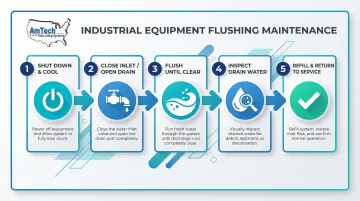
Scheduled tank flushing prevents scale buildup that insulates heating elements and creates under-deposit corrosion sites. In high-hardness water areas, flushing may need to occur quarterly rather than annually.
Follow these steps each time you flush:
- Shut down the tank and allow water to cool
- Close inlet valves and open drain valves
- Flush until discharge runs clear
- Inspect drain water for excessive sediment or discoloration
- Close drains, refill, and return to service
Routine Inspection and Anode Rod Checks
Even though stainless steel tanks don't always rely on sacrificial anode rods the way glass-lined tanks do, many commercial hot water systems include them as an added corrosion barrier. Inspecting anode rods and replacing them every 3–5 years contributes to system longevity by providing cathodic protection.
Water Treatment and Chemistry Control
Softening high-hardness water, controlling pH between 6.5–8.5, and managing chloride levels through filtration or treatment systems directly extends tank life. Chloride thresholds vary by alloy:
| Stainless Steel Grade | Max Chloride Level (Hot Water Service) |
|---|---|
| Type 304 | Below 50 ppm |
| Type 316 | Below 250 ppm |
Professional Interior Tank Lining as Proactive Protection
Applying a protective interior lining creates a barrier between the tank's steel substrate and the water, reducing corrosion risk. NSF-compliant systems—such as epoxy, cementitious, or polymer-based coatings—can extend tank life by decades.
AmTech Tank Lining & Repair's NSF/ANSI 61-certified systems include the DuraChem 500 series and HydraStone Alkrete. The HydraStone Alkrete cementitious lining is engineered for hot water environments, handling temperatures up to 900°F and resisting softened water chemistry. With a 40-year track record in hot water service, Alkrete has become a factory-installed choice for DHW tank manufacturers across the industry.
Professional relining is far less disruptive and costly than full tank replacement, typically completed within 30 hours with the tank returned to service immediately after cure.
Repair or Reline? When Full Replacement Isn't Your Only Option
The Replace-vs.-Repair Decision Framework
If a stainless steel tank is under 15 years old with localized corrosion but intact structural integrity, repair and relining is almost always more cost-effective than replacement. If the tank exceeds 25 years with widespread pitting, cracked welds, or deformation, replacement may be unavoidable.
Industry practice suggests that if repair costs exceed 50% of replacement cost, replacement should be considered. However, this threshold rarely applies to large commercial tanks where replacement involves significant capital expenditure, extended downtime, and complex removal logistics.
What Professional Tank Relining Entails
The relining process includes:
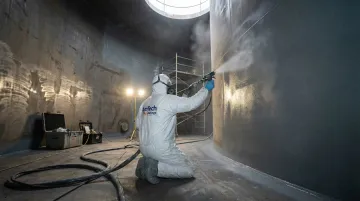
- Surface preparation — Abrasive blasting to SSPC-SP5 White Metal, SSPC-SP6 Commercial Blast, or SSPC-SP10 Near-White Blast standards removes all corrosion and contamination
- Application — Certified interior lining system applied at specified thickness
- Cure — Controlled cure process with environmental monitoring
- Quality inspection — Verification of uniform coverage, proper adhesion, and complete protection
A professionally relined stainless steel hot water tank can deliver an additional 15–25+ years of service life. AmTech has been relining commercial and industrial water tanks since the late 1960s, using ANSI/NSF-compliant coating systems across municipal, industrial, and commercial applications nationwide.
Cost and Operational Benefits
Compared to full replacement, tank relining offers three immediate operational advantages:
- Minimizes facility downtime during restoration
- Avoids procurement and installation costs of a new tank
- Eliminates the complexity of removing and disposing of large industrial vessels
A municipal water storage tank rehabilitation case study documented cost savings of $1.25 million compared to full replacement. When structural integrity remains sound, refurbishment outperforms new construction on both economic and environmental measures.
For commercial facilities, avoiding 2–4 weeks of hot water system downtime during replacement prevents revenue loss and operational disruption that far exceeds the direct cost of the tank itself.
Frequently Asked Questions
What is the life expectancy of a stainless steel water tank?
Stainless steel hot water tanks typically last 30–50+ years depending on water quality, maintenance practices, and operating conditions. This significantly exceeds glass-lined tanks (8–12 years) and galvanized steel alternatives (20–40 years).
Are stainless steel hot water tanks worth it?
Yes. In commercial and industrial applications, stainless steel tanks deliver a lower cost-per-year-of-service than glass-lined or galvanized alternatives once corrosion resistance, hygiene properties, and service life are factored in.
What causes a stainless steel hot water tank to fail prematurely?
Chloride-induced stress corrosion cracking is the leading cause, particularly at temperatures above 140°F. Aggressive water chemistry, microbial corrosion under biofilms, neglected maintenance, and improper installation with dissimilar metal connections all accelerate failure.
How do I know when my stainless steel hot water tank needs to be replaced?
Widespread pitting, cracked welds, structural deformation, persistent leaks, or a tank exceeding 25 years with no lining restoration are key indicators that replacement may be necessary. However, professional inspection with ultrasonic thickness testing should inform this decision rather than age alone.
Can a stainless steel hot water tank be relined instead of replaced?
Yes. Professional tank relining is a proven alternative to replacement for tanks with intact structure but deteriorating interiors. A properly applied NSF-compliant lining system can restore serviceability and add 15–25+ years of additional service life.
How often should a stainless steel hot water tank be inspected?
Annual professional inspections are recommended for commercial and industrial tanks. Facilities with aggressive water chemistry or high-demand usage should inspect every 6 months to catch corrosion in its early stages.