Introduction
Industrial facilities managers, municipal engineers, and commercial property directors face the same recurring infrastructure question: glass-lined or stainless steel hot water tanks? The answer drives maintenance budgets, operational downtime, and long-term asset value. Choose wrong, and you're looking at premature failure, emergency replacements, and capital overruns across multiple fiscal cycles.
Both tank types dominate municipal, commercial, and industrial applications, but neither is universally superior. The right choice depends on your water chemistry (TDS, chlorides, pH), operating temperatures, maintenance capacity, budget structure, and compliance requirements. A hotel in a hard water region faces entirely different constraints than a pharmaceutical plant running strict CIP protocols. The tank that works for one can fail catastrophically in the other.
This guide breaks down how each tank type is built, where each performs best, and when professional relining is the smarter alternative to replacement.
Glass-Lined vs. Stainless Steel Hot Water Tanks: Quick Comparison
The right tank type depends on your budget constraints, water chemistry, maintenance capacity, and expected service life. Here's how the two options compare across the five factors that matter most for industrial and commercial facilities.
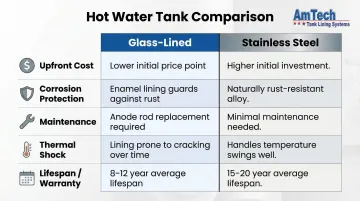
| Factor | Glass-Lined | Stainless Steel |
|---|---|---|
| Upfront Cost | Lower — carbon steel substrate with enamel coating | 30–50% higher — premium alloy and precision fabrication |
| Corrosion Protection | Excellent when intact; depends on active anode rod replacement | Self-healing chromium oxide layer; no coatings or anodes required |
| Maintenance | Anode rod inspection every 2 years; lining monitoring for cracks/spalling | Weld seam inspection and passivation checks only |
| Thermal Shock | Vulnerable — glass/steel expansion mismatch can cause stress fractures above ~140°C differential | Not a concern — homogeneous alloy structure eliminates differential expansion |
| Warranty / Lifespan | 5–6 years typical; TCO climbs if maintenance lapses | 10–15 years typical; lifespans exceeding 20 years in well-managed facilities |
Corrosion Protection: A Closer Look
Glass-lined tanks use a borosilicate glass surface that resists acids, alkalis, and mineral scaling — but only while the lining stays intact. Protection relies on a sacrificial anode rod that draws corrosive elements through electrochemical reaction. Once that anode is consumed and not replaced, the exposed steel corrodes fast.
Stainless steel works differently. The minimum 10.5% chromium content forms a passive oxide film that re-forms on its own if scratched or damaged — no external protection mechanism required.
Maintenance: What Each Tank Actually Demands
Glass-lined tanks require more active management:
- Anode rod inspection every 2 years (per Bradford White guidelines), more frequently in softened water or high-TDS environments
- Visual inspection or holiday testing to catch cracks, spalling, or thermal shock damage before failure
Stainless steel maintenance is limited to weld seam checks using ultrasonic or liquid penetrant methods, plus periodic passivation verification. No anode rods to track, no coating condition to monitor.
What is a Glass-Lined Hot Water Tank?
A glass-lined tank is a carbon steel vessel with a layer of borosilicate glass fused to the interior at 800–900°C. This creates a chemically inert, non-porous surface barrier between stored water and the steel shell. The process—called vitreous enameling—transforms powdered glass into a smooth, hard coating that bonds molecularly to the steel substrate.
The sacrificial anode rod (usually magnesium or aluminum) is critical to glass-lined tank longevity. It attracts corrosive elements through electrochemical reaction, protecting exposed steel where the lining may be imperfect. Anode rods must be inspected every 2 years and replaced when consumed—if neglected, exposed steel corrodes rapidly once the anode is exhausted.
Key operational advantages:
- Glass surface resists most acids, alkalis, and mineral scaling
- Performs well in hard water conditions (high TDS) where mineral deposits accelerate corrosion
- Lower upfront cost than stainless steel for large-volume storage
- Ideal for environments where TDS does not exceed 350 ppm and hardness stays between 5–25 grains per gallon
Key vulnerabilities:
- Lining can crack or chip under mechanical impact or thermal shock
- Once breached, localized rust on underlying steel accelerates sharply
- Repairs require professional relining or re-firing at manufacturing facilities
- Water chemistry outside manufacturer specifications voids warranties
These vulnerabilities shape how manufacturers engineer specialized variants. Solar-rated glass-lined tanks use thicker enamel layers to withstand higher sustained temperatures, while high-TDS environments call for "hard water" aluminum anodes in place of standard magnesium.
Use Cases of Glass-Lined Hot Water Tanks
Glass-lined tanks dominate applications where hard water chemistry, large storage volumes, and cost-sensitive budgets converge:
- Stores municipal potable water under AWWA D103 and ISO 28765 standards — glass-fused-to-steel tanks are a proven choice for drinking water infrastructure
- Serves high-volume domestic hot water demand in hotels, hospitals, and multi-unit residential complexes
- Handles industrial laundry and food service operations where hard water is the norm and corrosion resistance must scale with throughput
- Suits chemical process storage where inertness matters and the stored medium maintains stable temperature and pressure
What is a Stainless Steel Hot Water Tank?
Stainless steel tanks are homogeneous alloy vessels—typically 304 or 316L grade—where corrosion resistance is inherent throughout the entire material, not dependent on a coating. The chromium content (minimum 10.5%) forms a self-repairing passive oxide layer that re-forms if the surface is scratched or damaged.
Two grades cover most commercial and industrial applications:
- 304 stainless — standard for potable water and general commercial use; contains 18% chromium and 8% nickel
- 316L stainless — contains 2–3% molybdenum, which increases resistance to pitting and crevice corrosion in chloride environments
- 316L's "L" designation — indicates low carbon content, reducing chromium carbide formation during welding and preventing intergranular corrosion
Facilities with high-chloride water, marine environments, or chloride concentrations exceeding 200 ppm should always specify 316L to avoid premature pitting at weld seams.
Those material properties translate into a low-maintenance operational profile:
- No anode rods required
- No coating to inspect or maintain
- Excellent thermal shock tolerance
- Superior mechanical strength under pressure variations
- Smooth non-porous surface supports clean-in-place (CIP) sanitation protocols with surface roughness ≤ 0.8 µm per 3-A Sanitary Standards
Key limitation: Stainless steel tanks are only as strong as their weld seams. Poor water quality (high TDS, excessive chlorides) or improper alloy selection can cause pitting or stress corrosion cracking at welds over time. Repairs require skilled welding followed by pickling and passivation to restore the protective oxide layer.
Use Cases of Stainless Steel Hot Water Tanks
Those same properties—corrosion resistance, smooth surfaces, and no reactive coatings—make stainless steel the default specification in industries where hygiene and regulatory compliance drive purchasing decisions:
- Food and beverage processing — FDA 21 CFR 211.65 mandates non-reactive, non-absorptive surfaces for equipment contacting consumable products
- Pharmaceutical manufacturing — strict clean-in-place (CIP) sanitation protocols and contamination control
- Breweries and dairy operations — applications requiring frequent high-temperature cleaning cycles
- Institutional kitchens and hospitals — infection-control requirements and hygiene compliance
- Any facility where CIP sanitation, variable water quality, or regulatory cleanliness standards are mandatory
Glass-Lined vs. Stainless Steel: Which is Better for Your Facility?
The right tank material comes down to your specific operating conditions — water chemistry, maintenance capacity, regulatory requirements, and total cost horizon. Here's how to read those factors clearly.
Choose glass-lined when:
- Your facility operates in a hard water region (high TDS, mineral content)
- Budget favors lower upfront CAPEX over long-term OPEX
- Maintenance teams can support anode inspections on a regular schedule (every 2 years)
- Stored liquid is stable in temperature and pressure — such as large-volume domestic hot water in hotels, municipal systems, or commercial buildings
- Water chemistry stays within manufacturer limits (TDS ≤ 350 ppm, pH 6.0–8.0, chlorides ≤ 100 ppm)
Choose stainless steel when:
- Facility handles variable water quality or elevated chloride content (>100 ppm; use 316L above 200 ppm)
- Hygiene and cleanability are regulatory requirements (food, beverage, pharma)
- Maintenance resources are limited or stretched thin
- Temperature swings are frequent or unpredictable
- Goal is minimizing long-term operational intervention
- Marine environments or saline water exposure is present
Decision Clarity Checklist
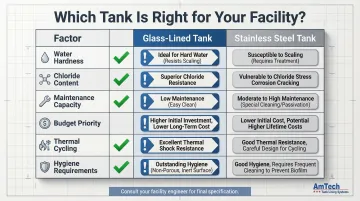
| Factor | Glass-Lined | Stainless Steel |
|---|---|---|
| Water hardness | High (>15 grains/gallon) | Low to moderate |
| Chloride content | <100 ppm | >100 ppm (use 316L) |
| Maintenance capacity | Regular anode inspection possible | Limited maintenance resources |
| Budget priority | Lower CAPEX | Lower TCO |
| Thermal cycling | Stable temperatures | Frequent temperature swings |
| Hygiene requirements | Standard potable water | CIP/food-grade compliance |
Whichever tank type your facility runs, the lining system protecting that interior surface is what determines long-term performance — and that's where proper inspection and restoration planning matters most.
When Tank Linings Fail: The Case for Professional Relining
Both glass-lined and steel tanks eventually experience internal degradation. Glass linings crack, spall (chip away), or wear thin over years of thermal cycling and water contact. Unlined or inadequately protected steel tanks corrode from the inside out. In large commercial or industrial tanks, full replacement is costly and disruptive—often exceeding $50,000 to $200,000 depending on capacity and site access.
Professional tank relining offers a practical alternative. Advanced coating systems—including 100% solids epoxy, cementitious calcium aluminate, and polymer linings—restore deteriorated interiors to meet NSF/ANSI 61 and potable water compliance standards. The City of Holyoke saved over $1.2 million by using a two-coat overcoat system instead of full dry blasting and replacement for municipal water storage tanks—extending service life by decades at a fraction of replacement cost.
AmTech Tank Lining & Repair brings 55+ years of experience relining industrial, municipal, and commercial tanks across all 50 US states, Canada, and the Caribbean. Proprietary systems include:
- HydraStone Alkrete® — NSF/ANSI 61-compliant cementitious lining for hot water tanks, handling temperatures up to 900°F with complete resistance to softened water chemistry
- DuraChem® 500 series — 100% solids polyurethane and polyurea linings providing up to 1,965 PSI adhesion strength for potable water and fire suppression applications
- Armor Shield® systems — UL-listed tank linings for petroleum, chemical, and industrial storage
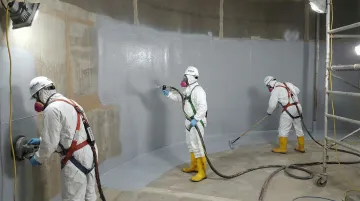
The decision trigger is early detection. Facilities that catch lining failure through routine inspection—holiday testing for glass-lined tanks, ultrasonic testing for steel tanks—can act before structural corrosion sets in, keeping relining viable and cost-effective.
That timing also determines who can do the work. AmTech's field crews perform all work in-house using engineer-led teams, ensuring consistent quality and adherence to SSPC, NACE, and ASTM surface preparation standards.
Conclusion
Glass-lined tanks offer a cost-effective, corrosion-resistant solution well-suited to hard water environments and budget-conscious CAPEX cycles. Stainless steel tanks deliver lower long-term maintenance burden, superior thermal and mechanical resilience, and compliance-grade cleanability for hygiene-critical operations. Neither is the universal winner. The right choice depends on your specific conditions:
- Water chemistry and mineral content
- Operating temperatures and pressure ranges
- In-house maintenance capacity
- CAPEX vs. OPEX budget structure
- Facility-specific compliance requirements
Whichever material you install, long-term performance depends on proactive inspection and maintenance. Internal degradation is inevitable over a tank's lifespan. When it occurs, AmTech's field-applied relining services offer a proven path to extend service life significantly — protecting your capital investment, avoiding the operational disruption of full tank replacement, and delivering decades of additional service well below the cost of replacement.
Frequently Asked Questions
Do glass-lined water heaters last longer?
Glass-lined tanks can last decades when the lining remains intact and anode rods are maintained on schedule. However, stainless steel tanks typically carry longer warranties (10–15 years vs. 5–6 years) and require less maintenance to achieve their full service life. Longevity for either type depends heavily on water quality and maintenance discipline.
What is the best material for insulating a hot water tank?
Insulation refers to the external foam or fiberglass jacket, which is separate from the tank material itself. Both glass-lined and stainless steel tanks can be paired with equivalent insulation performance. Tank material selection should be driven by corrosion resistance, application needs, and water chemistry—not insulation performance.
Which water heaters do plumbers recommend?
Plumber recommendations vary by application and water quality. Glass-lined tanks are common in hard water areas for their protective lining and lower upfront cost; stainless steel suits facilities prioritizing minimal maintenance and long-term durability. For commercial and industrial systems, consult a facilities engineer or tank specialist rather than relying on residential plumbing advice.
Can a glass-lined hot water tank be repaired if the lining chips or cracks?
Minor chips can sometimes be patched with approved repair materials, but significant lining damage typically requires professional relining or refiring at a manufacturing facility. In large industrial tanks, professional on-site relining using NSF/ANSI 61-compliant polymer or cementitious coatings is often the most cost-effective repair path.
What are the maintenance requirements for glass-lined vs. stainless steel tanks?
Glass-lined tanks require anode rod replacement every 2–5 years plus periodic lining checks via visual inspection or holiday testing. Stainless steel tanks need far less routine maintenance: periodic inspection of weld seams and surface condition, with no anode rods required.
Which tank type performs better in hard water conditions?
Glass-lined tanks perform better in hard water because the inert glass surface blocks mineral-driven corrosion of the steel substrate. Stainless steel handles moderate hardness, but high TDS or chloride levels can attack weld seams and may void manufacturer warranties if water chemistry exceeds specified limits.