
TL;DR
- National average repair cost: $615, with a typical range of $228 to $1,016
- Water heater type (tank vs. tankless, gas vs. electric) and problem severity are the biggest cost drivers
- Minor part replacements cost far less than structural failures like tank leaks, which usually require full unit replacement
- Accurate budgeting requires understanding all cost components, not just the part price
- The 50% Rule: if repair costs exceed 50% of a new unit's price, replacement is usually the smarter choice
How Much Does Water Heater Repair Cost?
There is no single flat price for water heater repair. Costs depend on what failed, how complex the fix is, and who does the work. A common mistake is focusing only on the part cost and ignoring labor or service fees, which often make up the majority of the bill.
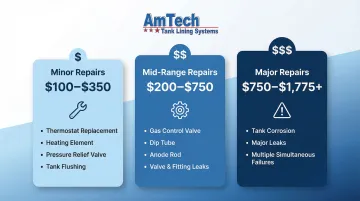
Here's how costs break down across three tiers:
Minor Repairs: $100 – $350
Minor repairs include thermostat or heating element replacements, pressure relief valve swaps, and basic tank flushing. This tier covers parts and labor for straightforward jobs. It's best suited for units under 8 years old with a single, clearly diagnosed issue.
Common minor repairs:
- Thermostat replacement
- Heating element replacement
- Pressure relief valve swap
- Basic tank flushing or sediment removal
Standard / Mid-Range Repairs: $200 – $750
More involved repairs fall into this tier, including gas control valve replacement, dip tube replacement, anode rod replacement, or minor leak fixes at valves and fittings. This range suits units in reasonable condition where a single larger component has failed.
Common mid-range repairs:
- Gas control valve replacement
- Dip tube replacement
- Anode rod replacement
- Non-tank leak repairs at valves or fittings
Major Repairs or Complex Issues: $750 – $1,775+
Severe or complex scenarios — including tank-related corrosion, significant leaks, or multiple component failures — fall into this category. At this level, homeowners should carefully weigh repair against full replacement, as costs can approach or exceed the price of a new unit.
Common major repairs:
- Tank corrosion treatment or patching
- Major leak diagnosis and repair
- Multiple simultaneous component failures
All three tiers include parts and labor. Note that diagnostic fees ($75–$250) are typically billed separately, and permit costs ($25–$300) or additional plumbing work may add to the total.
Key Factors That Affect Water Heater Repair Cost
Pricing depends on a combination of technical, logistical, and situational factors. No two repair jobs are identical, even for the "same" symptom.
Type of Water Heater: Tank vs. Tankless, Gas vs. Electric
Storage-tank and tankless systems use fundamentally different components, so repair paths, part costs, and labor complexity vary considerably. Here's how costs break down by type:
- Tankless systems: $100–$1,300 to repair; specialized parts and complex diagnostics drive higher costs. Routine descaling and flushing runs $150–$400 per service.
- Gas units: Higher repair costs due to safety-critical components — gas valves, thermocouples, and pilot/ignition assemblies.
- Electric storage tanks: Least expensive to repair; common issues include tripped breakers, faulty heating elements, and bad thermostats.
Nature and Severity of the Problem
The specific failed component is one of the strongest cost drivers. Replacing a thermostat is far less disruptive than replacing a gas control valve or addressing internal corrosion. Vague symptoms (e.g., "not heating well") often require a paid diagnostic visit before repair costs are confirmed. A single symptom can have several possible root causes that carry very different price tags.
Labor, Accessibility, and Geographic Location
Labor makes up a significant portion of most repair bills. Licensed plumbers typically charge $45 to $200 per hour, with high-cost metros like San Francisco ($100–$200/hour) and New York City ($150–$250/hour) running substantially higher than rural areas ($45–$75/hour).
Units installed in tight, hard-to-reach spaces—crawl spaces, cramped utility closets—increase the time and therefore cost of any repair. Accessibility surcharges are common when technicians must navigate difficult installation locations.
Age, Warranty Status, and Overall Unit Condition
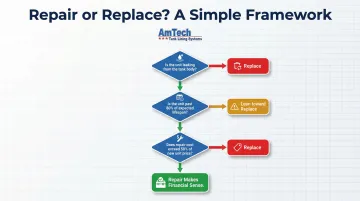
An older unit—especially one nearing or past its typical lifespan—shifts the repair-vs-replace decision. Once a unit hits 80% of its expected lifespan, repair costs often exceed the value of the remaining service life.
Expected lifespans:
- Storage tank water heaters: 8 to 12 years
- Tankless water heaters: 15 to 20+ years
Manufacturer warranties typically cover parts for 2–10 years and can offset costs if still valid. However, warranties may be voided by improper maintenance, unlicensed repairs, or use of non-approved parts. Check warranty documentation before authorizing any repair.
Full Cost Breakdown: What You're Actually Paying For
Full Cost Breakdown: What You're Actually Paying For
The invoice for a water heater repair is usually made up of several distinct cost categories. Knowing what each category covers helps you spot inflated quotes and avoid being caught off guard when the bill arrives.
Parts and Components — One-Time Cost
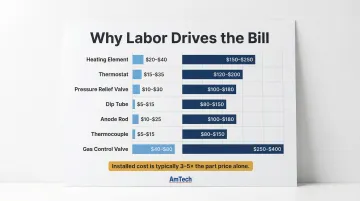
The part itself is often the smallest line item. While many parts are inexpensive on their own, the labor to access, replace, and test them adds considerably to the total.
Here's how parts-only prices compare to installed costs:
| Component | Parts-Only Price | Installed Cost |
|---|---|---|
| Heating Element (Electric) | $15 – $60 | $150 – $350 |
| Thermostat (Electric) | $20 – $400 | $100 – $300 |
| Pressure Relief Valve | ~$20 | $150 – $350 |
| Dip Tube | ~$25 | $150 – $400 |
| Anode Rod | $25 – $75 | $200 – $500 |
| Thermocouple (Gas) | Low cost | $150 – $350 |
| Gas Control Valve | $70 – $200 | $250 – $750 |
Labor and Service Call Fees — One-Time Cost
Most plumbers charge a diagnostic or service call fee of $100 to $250 before any work begins. After that, labor is billed either hourly or as a flat rate per job. Some plumbers credit this fee toward the final repair total — but that policy varies, so ask upfront.
Hidden and Additional Costs — Periodic or Situational
Costs that can surprise homeowners include:
- Accessibility surcharges for hard-to-reach units
- Flue or vent pipe replacements on gas units
- Expansion tank replacement if due
- Tank flushing as a maintenance add-on during the repair visit
These are legitimate line items but should be itemized on any quote.
Maintenance and Preventative Servicing — Recurring
Annual professional maintenance—including flushing, anode rod inspection, and valve testing—costs $100 to $250 and is significantly less than emergency repairs. For most tank-style units, consistent annual service adds 3–5 years of serviceable life — a straightforward return on a modest recurring cost.
Repair vs. Replace: How to Make the Right Call
When Repair Is the Right Choice
Repair makes financial sense when:
- The unit is relatively young (under 6–8 years old for tanks, under 10 years for tankless)
- The problem is isolated and clearly diagnosed
- Repair cost is well below the cost of a new unit and installation (typically under 50% of replacement cost)
- Warranty coverage is still valid
When Replacement Is the Better Value
Replacement generally delivers better long-term value when:
- The tank itself is leaking or corroding internally
- The unit is at or past its expected lifespan and has had multiple recent repairs
- Repair costs approach 50% or more of a new unit's installed cost
The 50% Rule: If repair costs exceed 50% of the cost of a new, equivalent unit, replacement is the recommended financial choice. A new unit also brings improved energy efficiency and a fresh warranty.
New unit installed costs for reference:
- Tank water heater: $882 to $1,814 (average $1,337)
- Tankless water heater: $1,400 to $3,900
Commercial and Industrial Hot Water Storage Tanks
For commercial or industrial facilities managing large-capacity hot water storage tanks, internal corrosion does not always mean full replacement. Professional tank relining and repair services, such as those offered by AmTech Tank Lining & Repair, can restore a tank's structural integrity and extend its service life by decades at a fraction of full replacement cost.
AmTech's HydraStone Alkrete® cementitious lining system (with a 40-year track record) is designed for domestic hot water (DHW) tanks, boiler feed tanks, and thermal storage tanks. Key specifications include:
- Withstands temperatures up to 900°F
- Fully resistant to softened water chemistry that accelerates corrosion in unlined steel tanks
- Compatible with periodic re-maintenance to maximize service life
With relining, facilities can gain decades of additional use and save tens of thousands of dollars in avoided capital expenditures.
Decision Framework Checklist
Consider these factors when deciding:
- Age of unit (compare to expected lifespan)
- Nature of the problem (replaceable component vs. tank failure)
- Cost of repair vs. replacement (apply the 50% Rule)
- Recent repair history (multiple failures suggest replacement)
What Most People Get Wrong When Budgeting for Water Heater Repairs
Focusing Only on the Parts Price
The part itself—a $20 thermostat or $50 anode rod—can create a false impression of a cheap repair. Once labor, diagnostic fees, and any additional work are added, the final bill is often 3–5× the part cost alone.
Example: A homeowner sees a $25 dip tube online and assumes a $50 repair. The actual bill totals $300: $25 for the part, $150 for labor, $100 for the service call, and $25 for tank flushing performed during the visit.
Hiring Based on Price Alone
Unlicensed or inexperienced plumbers may offer lower quotes but can cut corners, misdiagnose problems, or perform repairs that void the manufacturer warranty. Before hiring, confirm:
- Licensed and insured in your state
- Offers a written warranty on labor
- Has verifiable reviews or references
A higher quote from a qualified contractor typically delivers better value and fewer callbacks.
Delaying Minor Issues Until They Become Major Ones
Symptoms like inconsistent temperatures, minor noises, or small drips are often early warnings of fixable problems. Ignoring them typically results in larger component failures, water damage, or full replacement scenarios that cost far more — in some cases $1,000+ more than catching the issue early would have.
Conclusion
Water heater repair costs range from $228 to over $1,775, and the gap between those numbers comes down to a handful of variables:
- Unit type: Tankless and heat pump systems cost significantly more to service than standard tank units
- Failed component: Heating elements run $150–$300; heat exchangers can push past $1,000
- Labor complexity: Confined spaces, permit requirements, and same-day calls all add to the bill
- Unit age: Repairs on systems older than 10–12 years often make less financial sense than replacement
When repair costs approach 50% of the replacement price — or the unit is nearing end of life — replacement is typically the stronger investment. For complex or commercial-scale systems, a professional assessment before committing to repairs can prevent costly surprises down the line.
Frequently Asked Questions
How much does it cost to repair a leaking hot water tank?
Repair costs for a leaking water heater depend heavily on the source of the leak. Minor valve or fitting leaks can be fixed for $150 to $600, while a leaking tank body typically signals internal corrosion and usually means replacement rather than repair, with total costs ranging from $882 to $1,814 for a new tank.
How many years does a hot water heater typically last?
Conventional tank water heaters typically last 8 to 12 years, while tankless units last 15 to 20+ years. Regular maintenance—including annual flushing, anode rod inspection, and valve testing—can extend a unit's usable life toward the upper end of that range.
Is it worth it to repair a hot water heater?
Repair makes sense for units under 6–8 years old with a single, clearly diagnosed problem. For aging units with multiple recent repairs or tank-level failures, apply the 50% Rule: if repair costs exceed half the replacement price, replace it.
Can a leaking water tank be fixed?
External leaks at valves, fittings, and connections are often fixable at moderate cost ($150 to $600). Internal tank leaks caused by corrosion are rarely repairable long-term and typically require replacement. A licensed plumber can determine leak type on-site, usually within the initial diagnostic visit.
Is a leaking water tank an emergency?
Yes — shut off the water supply immediately. For gas units, set the thermostat to "vacation/pilot" mode or close the gas valve. Call a licensed plumber the same day; even slow leaks can cause structural water damage within hours.
Will home insurance cover a leaking hot water tank?
Homeowners insurance typically does not cover the repair or replacement of the water heater itself, since that is considered a maintenance issue. However, policies may cover resulting water damage to the home structure if the leak was sudden and accidental. Document the damage with dated photos before any cleanup — insurers typically require proof that the leak was sudden, not the result of long-term neglect.