How often should fire water tanks be inspected?
NFPA 25 requires annual internal inspections for fire water storage tanks, with more frequent inspections (quarterly or semi-annually) recommended for tanks with known corrosion issues, older lining systems, or those storing water in aggressive conditions. Comprehensive ultrasonic thickness testing should be performed every 3-5 years to map wall integrity and detect hidden corrosion beneath coatings. AmTech provides both routine annual inspections and detailed engineering assessments that document tank condition, identify repair priorities, and establish baseline data for future comparison—helping Reno facilities maintain regulatory compliance and plan capital budgets effectively.
What does a fire water tank inspection include?
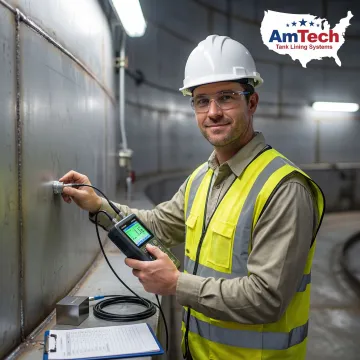
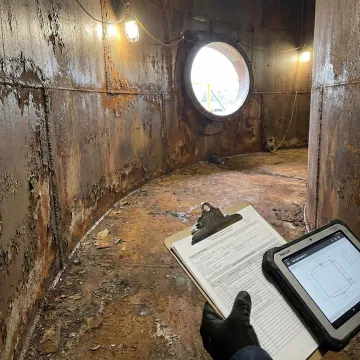
AmTech's comprehensive inspection includes visual assessment of interior and exterior surfaces, ultrasonic thickness testing to map wall and bottom plate integrity, coating condition evaluation to identify blistering or delamination, structural component inspection (welds, nozzles, manways, ladders), water quality testing for contamination or microbiological growth, and documentation of sediment accumulation. Our engineer-led crews provide detailed written reports with photographic evidence, thickness mapping diagrams, prioritized repair recommendations, and cost estimates. Reports are formatted to meet NFPA 25, API 653, and insurance carrier requirements, giving Reno facility managers the documentation needed for regulatory compliance and informed decision-making.
What causes fire water tank lining failures?
Common lining failure mechanisms include chemical degradation from water treatment additives (chlorine, biocides, pH adjusters), osmotic blistering caused by water permeation through pinholes in the coating, adhesion loss due to poor surface preparation during original installation, thermal cycling stress from temperature fluctuations, and mechanical damage from sediment abrasion or maintenance activities. Stagnant water conditions promote microbiological growth that accelerates coating breakdown. AmTech's inspection identifies the root cause of lining deterioration and recommends appropriate repair strategies—from localized patching to complete re-lining with advanced systems like HydraStone® Alkrete® that resist aggressive water chemistry and provide decades of protection.
Can you inspect tanks without draining them?
While comprehensive interior inspection requires draining and entry, AmTech offers preliminary assessment services using external ultrasonic thickness testing, acoustic emission monitoring, and visual inspection of accessible exterior components. This non-invasive approach can identify gross wall thinning, active leaks, and structural issues without operational disruption. However, for detailed coating condition assessment, interior corrosion mapping, and compliance documentation required by NFPA 25, tank draining and confined space entry is necessary. AmTech coordinates with facility operations to minimize downtime, often scheduling inspections during planned maintenance windows or low-demand periods. Our efficient inspection protocols typically allow tanks to be returned to service within 2-4 days.
What happens if your inspection finds major problems?
AmTech's inspection reports include clear, prioritized recommendations categorized by urgency: immediate safety concerns requiring emergency repair, compliance issues that must be addressed within regulatory timeframes, and preventive maintenance items that can be scheduled proactively. Our field engineers provide cost estimates for recommended repairs and can mobilize specialized crews immediately for emergency situations. Unlike inspection-only firms, AmTech offers complete repair capabilities including steel welding, structural modification, proprietary lining systems (HydraStone®, DuraChem® 500 series), and fiberglass reconstruction—meaning one contractor handles assessment through restoration. We help Reno facility managers develop phased repair strategies that balance budget constraints, operational needs, and regulatory compliance requirements.
Do you provide reports for insurance and fire marshal review?
Yes, AmTech's inspection reports are specifically formatted to meet requirements from insurance carriers, fire marshals, and regulatory authorities. Reports include comprehensive photographic documentation, ultrasonic thickness mapping diagrams, coating condition grading based on SSPC standards, structural component assessment, and engineer-signed recommendations. We document compliance status against NFPA 25, API 653, and applicable local fire codes. Reports clearly identify deficiencies, recommended corrective actions, and estimated timelines for completion. Our documentation has been successfully submitted to insurance underwriters, fire department plan reviewers, and environmental regulators across all 50 states. Reno facility managers receive both detailed technical reports and executive summaries suitable for presentation to management and regulatory authorities.
How long does a fire water tank inspection take?
Inspection duration depends on tank size, configuration, and accessibility. For typical 20,000-50,000 gallon fire water tanks, AmTech's field crews complete interior inspection, ultrasonic thickness testing, and documentation within 1-2 days after draining and ventilation. Larger tanks (100,000+ gallons) or tanks with complex internal structures may require 3-4 days. Preliminary external assessment can often be completed in 4-6 hours without draining. AmTech coordinates closely with facility operations to schedule inspections during planned maintenance windows or low fire risk periods. We provide detailed project timelines during the quotation phase, including time estimates for draining, inspection, cleaning, and return-to-service—helping Reno facilities plan for minimal disruption to fire suppression capabilities.
What certifications do your inspectors hold?
AmTech's inspection crews are led by field engineers who hold NLPA Special Inspector certification, OSHA 10/30 training, confined space entry certification, and API 653 tank inspection training. Our technicians are trained in ultrasonic thickness testing (UT), magnetic particle inspection (MPI), and other non-destructive testing methods. All crews maintain current safety certifications including first aid, fall protection, and hazardous material awareness. AmTech is a Thomas Verified company and maintains compliance with ANSI, NSF, NLPA, and API standards. Our inspection protocols are developed by engineers with decades of specialized experience in fire water tank assessment, ensuring every inspection meets or exceeds industry best practices and regulatory requirements applicable to Reno and Nevada facilities.