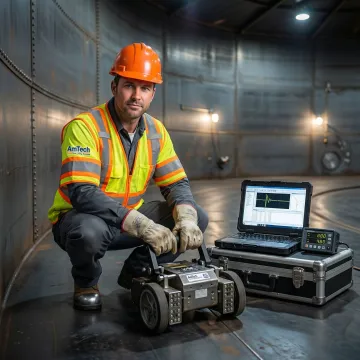
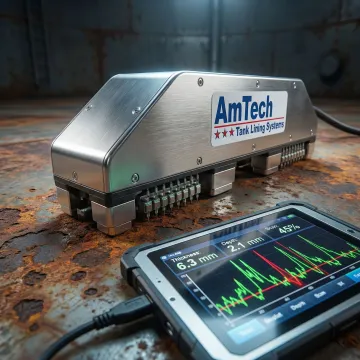
Magnetic Flux Leakage (MFL) scanning is a non-destructive testing method that detects corrosion, pitting, and metal loss in steel tank floors. The technique uses a magnetic field and sensors to identify areas where the steel has thinned or deteriorated. MFL equipment is moved across the tank bottom surface, and variations in the magnetic field indicate defects. This produces detailed maps showing corrosion severity and location, allowing inspectors to assess tank integrity without removing the tank from service or disturbing protective coatings.
The MFL method magnetizes a section of the tank floor using powerful magnets. As the scanner passes over the surface, sensors measure the magnetic flux leaking from the steel. Healthy steel maintains a consistent magnetic field, but areas with corrosion, pitting, or wall thinning disrupt the field, causing detectable flux leakage. The sensors record these variations, which are analyzed to determine the extent and depth of metal loss. This provides quantitative data on tank condition and helps engineers decide whether repairs, monitoring, or replacement are needed.
How often should tank floor MFL inspections be performed?
API Standard 653 recommends internal inspections at intervals determined by corrosion rates, stored product type, and previous inspection findings—typically every 5 to 10 years. High-risk tanks storing corrosive substances, those with known corrosion issues, or tanks nearing end-of-life may require more frequent MFL inspections every 3 to 5 years. Facilities subject to EPA Spill Prevention, Control, and Countermeasure (SPCC) regulations or state environmental mandates may have specific inspection frequency requirements. AmTech's inspectors help determine the appropriate inspection interval based on your tank's age, service history, and operating conditions.
Can MFL inspection be done on in-service tanks?
MFL inspection typically requires the tank to be taken out of service, emptied, cleaned, and made safe for entry. The interior must be accessible and free of product, sludge, and explosive vapors before inspection crews can enter. However, ultrasonic thickness testing can sometimes be performed on the exterior underside of elevated or supported tanks without full decommissioning. AmTech's field engineers assess your specific tank configuration and operational constraints to recommend the most practical inspection approach that minimizes downtime while ensuring thorough evaluation and crew safety.
What types of defects can MFL scanning detect?
MFL scanning detects general corrosion (uniform wall thinning), pitting corrosion (localized deep pits), underside corrosion from soil contact or moisture exposure, internal corrosion from stored product or water bottoms, and weld seam defects. It can also identify areas where previous repairs are failing or where coating disbondment has allowed corrosion to progress. The technology provides both surface and subsurface defect detection, revealing issues not visible during visual inspections. This comprehensive assessment informs repair planning and helps prevent unexpected failures.
What happens after defects are found during MFL inspection?
AmTech's field engineers analyze the MFL data and produce a detailed inspection report mapping all detected defects, their locations, severity, and remaining wall thickness. Based on API 653 criteria, they classify areas as acceptable, requiring monitoring, or requiring immediate repair. The report includes repair recommendations—such as steel plate replacement, welding, or full floor pan installation—with cost estimates and timeline projections. Because AmTech provides both inspection and repair services, the transition from assessment to remediation is seamless, minimizing facility downtime and eliminating the need to coordinate between multiple contractors.
How much does an MFL tank floor inspection cost?
Inspection costs depend on tank size, configuration, accessibility, geographic location, and the extent of testing required. A typical MFL floor scan for a mid-sized above-ground storage tank ranges from several thousand to tens of thousands of dollars. While this may seem significant, it is far less expensive than emergency repairs, environmental remediation, or catastrophic tank failure. AmTech provides detailed project quotes after assessing your specific tank and operational requirements. Early detection through MFL inspection often saves facilities tens of thousands by enabling planned repairs before failures occur.
Are MFL inspections required by regulation?
API Standard 653 requires periodic internal inspections for above-ground atmospheric storage tanks, and MFL scanning is a widely accepted method for meeting this requirement. EPA regulations under SPCC, state environmental agencies, and local fire codes may mandate tank integrity assessments at specific intervals. Facilities storing hazardous materials, petroleum products, or regulated chemicals are typically subject to these requirements. AmTech's NLPA Special Inspectors are familiar with federal, state, and industry standards, and ensure all inspection work meets applicable regulatory requirements while providing documentation needed for compliance audits.