Introduction
Many facility operators assume that installing a double-walled tank automatically satisfies secondary containment requirements. That assumption can be costly and legally risky. A double-walled tank can serve as secondary containment—but only when it meets specific regulatory criteria that vary by jurisdiction and stored substance.
Which framework governs your facility—EPA SPCC (40 CFR Part 112), RCRA hazardous waste rules (40 CFR 264), or OSHA construction standards—determines whether your double-walled tank qualifies. Tank construction and installed equipment matter just as much as the regulation itself.
This article breaks down each scenario for environmental compliance officers, facility managers, engineers, and operators in oil and gas, chemical processing, manufacturing, and other industries that store regulated liquids in bulk tanks.
TLDR
- Double-walled tanks can qualify as secondary containment under EPA SPCC rules—but only if they meet five specific construction and operational requirements
- Under 40 CFR 264 (hazardous waste), the double wall must be integral with 24-hour leak detection; external containment may still apply
- OSHA confirms that double walls alone don't satisfy collision damage protection requirements
- Non-compliance carries civil penalties up to $68,445 per day per violation
- Most double-walled tanks (98%) can be restored to full compliance through professional inspection and relining
What Is a Double-Walled Tank and How Does It Work?
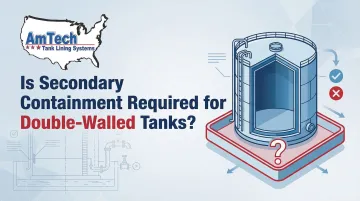
A double-walled tank uses a tank-within-a-tank design: the inner tank holds the stored substance while the outer tank (or shell) provides a containment layer. The space between these two walls—called the interstitial or annular space—serves as a monitoring zone where leak detection sensors or inspection ports can give early warning of primary tank failure.
Not all double-walled tanks are created equal. A true double-walled tank features a monitored interstitial space equipped with leak sensors, inspection ports, or testing capability. Simpler double-wall designs without this monitoring infrastructure are often treated differently under regulations and may not qualify as secondary containment at all.
That distinction matters because the regulatory definition of secondary containment is tied to performance, not just design. In regulatory terms, secondary containment is any backup system designed to capture releases from the primary container before they reach soil, groundwater, or surface water. Common forms include:
- Concrete dikes and earthen berms
- Containment basins and vault systems
- Double-walled tanks (when properly constructed and monitored)
The Key Regulations That Govern Secondary Containment for Double-Walled Tanks
Three main regulatory frameworks govern whether your double-walled tank needs additional secondary containment:
- EPA SPCC rule (40 CFR Part 112) for oil storage
- EPA RCRA regulations (40 CFR 264.193) for hazardous waste tanks
- OSHA standard 29 CFR 1926.152 for flammable liquid storage at construction sites
Each framework sets different standards for when a double wall is "enough."
EPA SPCC Rule (40 CFR Part 112)
Under the SPCC rule, a double-walled tank can qualify as "equivalent" secondary containment, eliminating the need for a separate dike or berm—but this status is conditional, not automatic.
The five SPCC equivalency requirements:
- Shop fabricated construction — built in a controlled factory environment, not assembled on-site
- UL-listed steel inner tank — the primary containment must meet Underwriters Laboratories standards
- Outer tank built to national standards — per API, STI, or equivalent industry specifications
- Overfill prevention measures — must include both an alarm and either an automatic flow restrictor/shutoff device or alternative secondary containment sized to the most likely discharge volume
- Constant monitoring of all product transfers — someone must be physically present to watch liquid levels during every fill operation
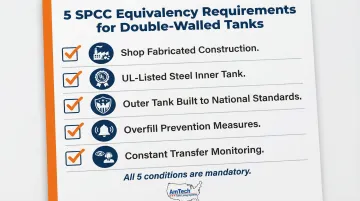
All five conditions are mandatory. Miss even one, and the tank loses its SPCC equivalency status.
40 CFR 264.193 (RCRA Hazardous Waste Tanks)
For hazardous waste storage, the requirements are even stricter. The regulation mandates:
- Integral structure design — the outer shell must completely envelop the inner tank so any release is contained by the outer shell
- Corrosion protection — both the interior of the primary tank and the exterior of the outer shell must be protected from corrosion
- 24-hour leak detection — a built-in continuous system must detect releases within 24 hours
One frequently overlooked compliance failure involves drain outlet fittings.
Critical failure point: Drain outlet fittings that penetrate both walls are a common compliance violation. If these fittings let leaks bypass the outer shell instead of being captured in the interstitial space, the tank fails the integral containment requirement—regardless of how sound the tank body is.
OSHA §1926.152(e)(4)
Double walls alone do NOT satisfy OSHA's collision damage protection requirements for fuel dispensing tanks. Additional physical protection is still required, scaled to the collision risk at your specific site:
- Low-risk locations: Visual warning markers or boundary demarcation
- High-risk locations: Substantial barriers such as bollards or concrete barricades
When Can a Double-Walled Tank Serve as Its Own Secondary Containment?
Under EPA SPCC rules, a qualifying double-walled tank is treated as if it already has a dike or berm around it. This "equivalency" status offers real practical advantages: no space-consuming berms, simpler facility layout, and lower construction costs.
Overfill Prevention Requirements
The SPCC rule requires an overfill alarm that activates before the tank reaches capacity, plus either:
- An automatic flow restrictor or shutoff device, OR
- Alternative active/passive secondary containment sized to the most likely discharge volume during a transfer event
EPA's example calculation method:
Scenario: Truck loading at 150 gallons per minute, with a ruptured hose connection as the failure mode. If your crew can safely close the shutoff valve in 15 seconds:
[(150 gal/min) × (1 min/60 sec) × (15 sec)] = 37.5 gallons minimum containment capacity
That calculation assumes clean transfer conditions. If your double-walled tank has fittings, a manway, or piping connections located below the liquid level, those penetrations may require additional containment regardless of the tank's double-wall status. NFPA 30 paragraph 22.11 requires all piping connections to be made above the normal maximum liquid level to avoid this problem.
Tank Size Thresholds and Applicability
SPCC rules apply to facilities with aggregate aboveground oil storage capacity exceeding 1,320 gallons (counting only containers of 55 gallons or larger). However, applicability also depends on whether your facility "could reasonably be expected to discharge oil" into navigable waters or adjoining shorelines.
State and Local Regulations
Many jurisdictions impose stricter requirements than federal rules. For example, Florida and Pennsylvania mandate 110% containment capacity, while federal SPCC rules require only "entire capacity plus sufficient freeboard." The stricter standard always governs — consult a licensed professional engineer (PE) familiar with local requirements before finalizing your containment plan.
Compliance Pitfalls That Can Invalidate Double-Walled Tank Containment
Double-walled tanks can still fail regulatory requirements—not because of the tank itself, but because of how it's installed, documented, and maintained. These are the most common compliance gaps that auditors find.
Fitting Failure: The Weakest Link
The most likely release point in a double-walled tank isn't the tank wall—it's the outlet fitting where the wall is penetrated.
If the fitting design allows a leak to escape the outer shell rather than be captured in the interstitial space, the tank fails 40 CFR 264.193(i) integral containment requirements, even if the tank body is structurally sound.
Inspection Failures Under SPCC
SPCC §112.8(c)(6) requires regular integrity testing and frequent visual inspections of the outer tank and interstitial space. Inspect the interstitial space using:
- Fish-eye ports
- Leak sensors
- Screw-in inspection plugs (on older tanks)
One of the most frequent audit findings: inspection forms that document only the primary tank. Both the outer tank and interstitial space must be documented to demonstrate compliance.
Documentation gaps here often surface the same vulnerability found in overfill prevention programs—the equipment exists, but the paper trail doesn't.
Lack of Overfill Prevention Documentation
Having the physical equipment (alarm, shutoff) isn't enough. Operators must document that they've tested these systems and confirmed they're functional, and that all product transfers are "constantly monitored" as required by SPCC rules. Missing documentation = non-compliance, even if the equipment works perfectly.
Non-Compliant Tank Construction
Not all commercially available double-walled tanks meet SPCC equivalency requirements out of the box. Tanks can be UL-listed and still fall short of the specific construction standards your SPCC Plan requires. When purchasing new tanks, require the manufacturer to provide documentation covering:
- Construction methods and materials
- UL listing status
- Compliance with API/STI standards
- Overfill prevention accessories
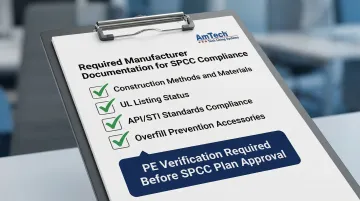
Your Professional Engineer (PE) must verify compliance before sealing your SPCC Plan.
How to Keep Your Double-Walled Tank Compliant Over Time
Regulatory compliance for a double-walled tank is not a one-time certification—it's an ongoing obligation. The interstitial space and outer shell must be periodically inspected for corrosion, moisture intrusion, and structural deterioration. Any repairs trigger additional integrity testing requirements under SPCC and RCRA rules.
A less visible risk is lining degradation: corrosion or coating failure on the inner tank's interior or the outer shell's exterior can compromise containment integrity even when the tank looks intact from the outside. Catching these failures early — before they trigger a violation or spill — requires inspection beyond what a visual walkthrough can catch.
AmTech Tank Lining & Repair uses ultrasonic testing to detect pinholes, wall thinning, and minute permeations that standard visual inspection misses. With NLPA Special Inspector credentials and 55+ years of field experience, they produce inspection documentation suitable for SPCC Plan and RCRA compliance files.
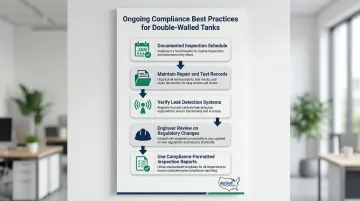
Best practices for ongoing compliance:
- Establish a documented inspection schedule based on tank age, contents, and regulatory requirements
- Maintain records of all repairs and integrity tests
- Verify leak detection systems are functional before each inspection period
- Work with a qualified engineer to review compliance whenever regulations change or tank contents/operational parameters are modified
- Use inspection services that generate documentation formatted for SPCC Plan or RCRA compliance files
Frequently Asked Questions
Is secondary containment required for double-walled tanks?
It depends on the regulatory framework. Under EPA SPCC, a qualifying double-walled tank can serve as its own secondary containment if it meets five specific construction and operational requirements. Under 40 CFR 264 (hazardous waste), the double wall itself is a form of secondary containment but must meet integral design and 24-hour leak detection criteria. Under OSHA, additional physical collision protection is still required.
What is the SPCC rule for secondary containment?
The EPA SPCC rule (40 CFR Part 112) requires secondary containment for aboveground oil storage at facilities with aggregate capacity exceeding 1,320 gallons. A qualifying double-walled tank satisfies this requirement if it meets all five criteria: shop fabrication, UL-listed inner tank, nationally accepted outer tank standards, overfill prevention, and constant transfer monitoring.
What is the 110% secondary containment rule?
The 110% rule requires that a secondary containment structure hold at least 110% of the volume of the largest single tank it surrounds, ensuring that even complete primary tank failure won't result in an uncontained release. This is primarily a state-level requirement (Florida, Pennsylvania, and others)—federal SPCC rules require "entire capacity plus sufficient freeboard" without specifying 110%.
What counts as secondary containment?
Secondary containment is any system that captures a release from the primary container before it reaches the environment. Common forms include concrete dikes, earthen berms, containment basins, vault systems, and qualifying double-walled tanks, each subject to design and capacity standards under the applicable regulation.
What size tank needs secondary containment?
Under EPA SPCC rules, facilities with aggregate aboveground oil storage exceeding 1,320 gallons (containers of 55 gallons or larger only) must provide secondary containment. State regulations often set lower thresholds, and the substance stored and proximity to navigable waters can also trigger requirements.
What is the purpose of the secondary tank in a double-walled tank?
The outer tank (secondary tank) serves as the containment wall, capturing any release from the inner primary tank in the interstitial space and preventing it from reaching surrounding soil, groundwater, or stormwater. The interstitial space also provides a monitoring zone where leak detection sensors or inspection ports give early warning of primary tank failure.