What types of industrial tanks can AmTech paint and coat?
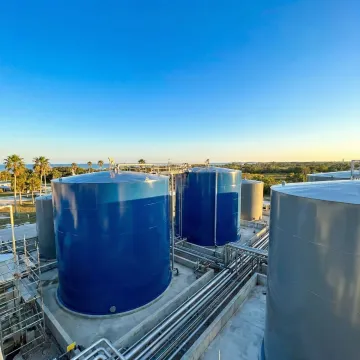
AmTech provides coating services for all industrial tank types and materials including steel above-ground storage tanks (ASTs), underground storage tanks (USTs), concrete tanks, fiberglass tanks, FRP composite tanks, and laminate tanks. We coat petroleum storage tanks (crude oil, diesel, gasoline, jet fuel), chemical process tanks, water storage tanks (potable and fire suppression), wastewater treatment tanks, hot water tanks up to 900°F, and specialized industrial process vessels. Our coating systems are engineered for both interior lining and exterior protective coating applications across all storage capacities.
How does AmTech's tank coating process differ from standard industrial painting?
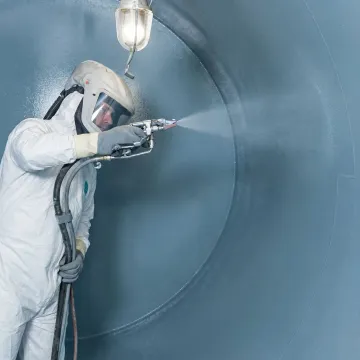
AmTech specializes in advanced tank lining and coating systems that go far beyond conventional industrial paint. Our proprietary DuraChem 500 series polylinings are 100% solids systems that cure instantly on contact, creating seamless monolithic barriers with no seams or joints. Unlike traditional multi-coat epoxy or urethane systems requiring days of cure time between coats, DuraChem allows same-day or next-day return to service. Our cementitious HydraStone Alkrete system forms a permanent crystalline bond with concrete substrates and withstands temperatures up to 900°F—capabilities standard paint cannot achieve. All surface preparation follows strict SSPC, NACE, and ASTM specifications with verified surface profiles.
What surface preparation methods does AmTech use for tank painting projects?
AmTech's engineer-trained crews perform comprehensive surface preparation tailored to each tank's substrate and service conditions. Methods include dry abrasive blasting (sandblasting) to SSPC-SP5 White Metal or SSPC-SP10 Near-White standards, wet abrasive blasting for dust control in occupied facilities, hydroblasting for removing loose coatings and scale, and manual power tool cleaning for localized repairs. We select blast media based on substrate—harder media like garnet or aluminum oxide for heavy steel corrosion, softer media like walnut shells for fiberglass. All surface profiles are measured and verified using replica tape or digital gauges before coating application proceeds.
How long does an industrial tank painting project typically take?
Project duration varies based on tank size, coating system, and extent of surface preparation required. AmTech's instant-cure DuraChem polylining systems dramatically reduce timeline—many tanks return to service within 24-48 hours after coating application versus 7-14 days for traditional epoxy systems requiring extended cure times between coats. A typical 10,000-gallon AST with moderate surface preparation may take 3-5 days total including prep, coating, and inspection. Larger petroleum storage tanks (50,000+ gallons) with extensive steel repairs may require 2-3 weeks. Emergency repairs are expedited—our mobile crews can often restore failed coatings within 24-72 hours to minimize facility downtime.
What certifications and standards does AmTech follow for tank coating work?
AmTech maintains compliance with all major industry standards and regulatory requirements. Our coating systems and application methods meet SSPC (Society for Protective Coatings), NACE (National Association of Corrosion Engineers), ASTM (American Society for Testing and Materials), API Standard 653 (Tank Inspection, Repair, Alteration, and Reconstruction), ANSI, NSF (for potable water contact), NLPA (National Leak Prevention Association), NFPA (National Fire Protection Association), UL listing for specific systems, and EPA underground storage tank regulations. Our crews hold OSHA 10 and OSHA 30 certifications. Project Engineer Greg Comeau is an NLPA Special Inspector with advanced training in tank inspection and lining system specifications.
Can AmTech coat tanks while they're in service, or do they need to be emptied?
Most interior tank lining and coating projects require the tank to be emptied, cleaned, and properly ventilated before work begins—this is essential for crew safety, proper surface preparation, and coating adhesion. However, AmTech can often perform exterior tank painting while tanks remain in service, minimizing operational disruption. For critical storage systems that cannot be taken offline, we can coordinate phased work schedules or work with redundant tank systems to maintain continuous operations. Our instant-cure DuraChem coating systems significantly reduce out-of-service time compared to traditional multi-coat systems, and emergency repair services can sometimes implement temporary solutions that allow partial operations during restoration.
What warranty does AmTech provide on industrial tank coating projects?
AmTech backs all tank coating projects with our industry-leading Blue Check warranty program—recognized as the best warranty program in the tank lining business. Specific warranty terms vary based on coating system, tank application, and service conditions, but our proprietary DuraChem polylinings and HydraStone Alkrete cementitious systems carry comprehensive coverage against coating failure, delamination, and premature degradation when properly maintained. The Blue Check program includes post-installation inspection protocols and ongoing technical support. Detailed warranty documentation is provided for each project specifying coverage terms, maintenance requirements, and claim procedures. Our 55+ years of proven field performance demonstrates the long-term reliability of our coating systems.
Does AmTech provide emergency tank coating repair services in Southwest Florida?
Yes, AmTech maintains emergency response capabilities throughout Southwest Florida for unexpected coating failures, leaks, and corrosion breakthroughs. When facilities experience sudden lining failures, structural cracks, or regulatory shutdown orders, our mobile crews deploy with proprietary repair materials including instant-cure DuraChem polylinings, HydraStone cementitious systems, fiberglass repair laminates, PLS 755 Tank Tape for temporary sealing, and welding equipment for structural repairs. Emergency services cover all tank types—steel, concrete, fiberglass—and all stored products including petroleum, chemicals, water, and wastewater. Response prioritizes rapid containment, integrity restoration, and return to service to minimize facility downtime and prevent environmental incidents.