What causes corrosion inside fire suppression water tanks?
Fire suppression tanks can corrode when unlined steel is exposed to stored water, dissolved oxygen, sediment, stagnant conditions, coating failure, or damaged welds and nozzles. Concrete tanks may experience cracking, water permeation, and rebar corrosion. Interior relining creates a protective barrier between the tank substrate and fire water, helping prevent leaks, wall loss, and premature replacement.
Can a corroded fire suppression tank be repaired instead of replaced?
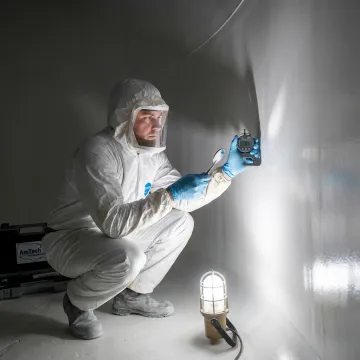
In many cases, yes. AmTech evaluates wall thickness, pitting, weld integrity, nozzles, floor condition, and existing lining failure before recommending repair. Corroded steel sections can often be patched or replaced, concrete defects can be sealed, and the interior can be relined. Repair and relining frequently save significant capital expense compared with full tank replacement.
What lining systems are used for fire suppression tank relining?
The specified lining depends on tank material, water chemistry, temperature, structural condition, and project requirements. AmTech uses proprietary systems including HydraStone Alkrete cementitious linings, DuraChem 500 series poly linings, Armor Shield coatings, and AT BiFlex systems. These are selected to create a continuous corrosion-resistant interior barrier for steel or concrete tanks.
How is the tank prepared before relining?
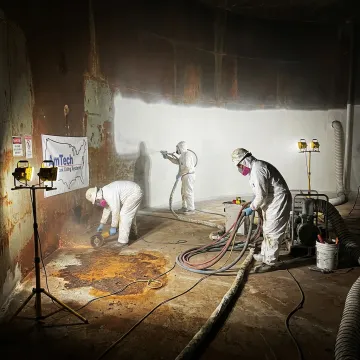
Preparation typically includes draining, inspection, cleaning, removal of loose material, and abrasive blasting or hydroblasting to remove rust, old coatings, scale, oxides, and contaminants. Crews verify surface profile, ambient conditions, dew point, and humidity before application. Proper preparation is critical because lining adhesion and long-term performance depend on a clean, correctly profiled substrate.
Do you provide emergency fire suppression tank repairs?
Yes. AmTech provides emergency tank repair services for active leaks, corrosion breakthrough, lining delamination, nozzle failures, structural cracks, and shutdown-related integrity issues. Crews can mobilize with temporary sealing materials, welding equipment, and proprietary repair systems to stabilize the tank, restore integrity, and reduce facility downtime whenever possible.
How long does interior relining take?
Project duration depends on tank size, access, corrosion severity, preparation requirements, structural repairs, and the lining system specified. Some rapid-cure systems can reduce downtime compared with traditional multi-coat lining methods, while structural steel or concrete repairs may add time. AmTech assesses conditions first, then plans work to return the tank to service efficiently and safely.
Can you repair both steel and concrete fire suppression tanks?
Yes. AmTech repairs and relines steel and concrete tanks. Steel work may include abrasive blasting, welding, nozzle repair, plate replacement, and protective lining. Concrete work may include crack repair, joint sealing, crystalline waterproofing, and compatible interior lining. Materials are selected on-site to match the tank’s construction, condition, and service requirements.
What standards and credentials support AmTech’s work?
AmTech’s work is supported by engineer-led crews, an NLPA Special Inspector, NFPA membership, API-compliant practices, ANSI and NSF compliance where applicable, OSHA 10 and OSHA 30 training, and UL listed systems. Surface preparation and coating practices are performed to recognized industry expectations, including SSPC, NACE, and ASTM specifications when required.