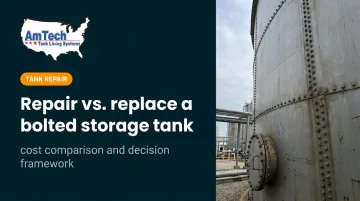
The choice isn't always obvious. Unlike welded or fiberglass tanks, bolted steel tanks offer repair options that don't exist elsewhere: panel-level swaps, full internal relining, and targeted bolt and gasket work. That middle ground makes the repair-vs.-replace question genuinely nuanced.
This guide walks through a straight cost comparison, the structural and compliance factors that drive the decision, and a practical five-factor framework operators can use to evaluate their specific situation.
Key Takeaways
- Relining a bolted tank sidesteps the biggest replacement cost drivers: fabrication, foundation work, crane erection, and steel lead times
- Full replacement projects can run to 57 weeks of steel procurement lead time alone, per a 2023 EPA waiver filing for a glass-coated bolted standpipe
- Bolted tanks offer a third path — individual panel replacement — unavailable with welded or FRP construction
- Five factors drive the decision: structural integrity, steel condition, contents compatibility, remaining design life, and regulatory compliance
- A qualified tank integrity assessment is the essential first step — not an optional one
Repair vs. Replace: Quick Comparison
| Factor | Repair / Reline | Full Replacement |
|---|---|---|
| Upfront Cost | Avoids fabrication, foundation, crane, and erection costs | Includes new tank, demolition, foundation, freight, piping adaptation, commissioning, and permitting |
| Downtime | Days to a few weeks; work can be staged by section | Long lead capital project — procurement alone can exceed 57 weeks |
| Service Life Added | Significant extension for structurally sound tanks; relining may need repeating before shell reaches end of life | Full design life reset — typically 30–40+ years with proper maintenance |
| Best Suited For | Tanks with sound steel panels, localized or surface corrosion, deteriorated linings | Severe structural damage, capacity shortfalls, non-compliant design, or multiple prior reline cycles |
A note on costs: No authoritative public database provides verified per-gallon or per-square-foot cost ranges for bolted steel tank relining or replacement. Published bid data from municipal projects varies widely based on tank size, contents, condition, and regional labor markets. The most reliable number for your situation comes from a project-specific estimate by a qualified contractor following an integrity assessment.
What Repairing a Bolted Storage Tank Involves
"Repair" covers more ground than most operators realize. For bolted steel tanks, there are three distinct intervention levels:
- Localized repairs — bolt, gasket, and seal replacement; patching isolated corrosion spots or small panel defects
- Internal relining — applying a new protective coating or liner system over the full tank interior after the original surface has failed
- Partial panel replacement — swapping out individual corroded or compromised panels, a structural option unique to bolted construction
The Internal Relining Process
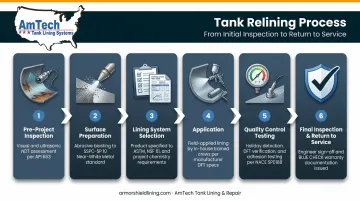
Every professional relining job follows the same sequence:
- Pre-project inspection — visual assessment plus ultrasonic thickness testing to confirm the steel is a sound substrate
- Surface preparation — abrasive blasting to SSPC-SP 10 / Near-White Metal Blast Cleaning standard, removing all existing coatings, rust, and mill scale
- Lining system selection — matched to contents, service temperature, and applicable standards (NSF/ANSI 61 for potable water, NFPA 22 for fire protection, API 653 where applicable)
- Application — by qualified, trained applicators following manufacturer and specification requirements
- Quality control — dry film thickness verification per SSPC-PA 2 and holiday/pinhole testing per NACE SP0188
- Final inspection and return to service
Lining Systems and Contents Compatibility
The right lining system depends entirely on what the tank stores. AmTech Tank Lining & Repair deploys several proprietary systems, each engineered for a specific set of service conditions:
- DuraChem® 500 series — 100% solids poly systems engineered for chemical and industrial applications where aggressive stored media demand high chemical resistance
- HydraStone® Alkrete — a calcium aluminate cementitious system suited to potable water and corrosive environments; AmTech holds the exclusive U.S. license and is North America's largest field installer of this system
- Armor Shield® tank linings — UL-listed systems covering a wide range of industrial storage applications, including fire suppression and general process water
For potable water tanks, all lining and sealing materials must comply with NSF/ANSI 61. For fire protection storage, NFPA 22 governs design and maintenance requirements.
One standard distinction worth noting: ANSI/AWWA D103 covers factory-coated bolted carbon steel water tanks — not AWWA D102, which explicitly excludes bolted tank coating systems.
What Makes a Tank a Strong Repair Candidate
A tank is a strong reline candidate when:
- Steel panels pass ultrasonic thickness testing — wall thickness remains above minimum structural thresholds
- Corrosion is surface-level or limited to the lining layer, not through-wall
- The existing lining has failed but the steel beneath it is intact
- The tank's design configuration can meet current regulatory requirements with a lining upgrade
One practical advantage bolted construction offers: relining work can be staged by section, allowing a facility to keep one tank partially operational while another section is being prepared and coated. No crane, no demolition, no extended site shutdown — and that directly affects the cost side of the repair-vs.-replace equation.
When Full Tank Replacement Makes Sense
Relining is not always the answer. There are specific conditions where the steel can't be saved and replacement is the only defensible path.
Structural Red Flags That Disqualify Repair
These findings during inspection typically eliminate relining as an option:
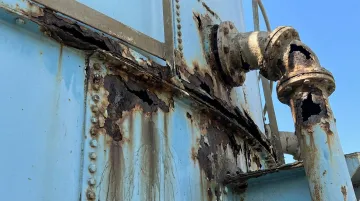
- Through-wall pitting or perforation of steel panels — a lining cannot bridge structural voids
- Severe panel warping or buckling that compromises the tank's geometry and bolt connections
- Irreparable bolt-hole elongation that prevents panels from maintaining a sealed joint
- Wall thickness below minimum structural thresholds — under API 653, inspectors calculate minimum acceptable thickness for continued service; panels that fall below that threshold under API 653 sections 4.3.3.1 and 4.3.4.1 require removal, not coating
Note: API 653 applies where tanks were built to API 650 or API 12C. For AWWA D103 bolted water tanks, a qualified inspector uses the applicable D103 standard to evaluate structural fitness.
Capacity and Compliance Triggers
Structural failure isn't the only trigger. Consider full replacement when:
- Current tank volume no longer meets operational demand and expansion isn't practical
- The existing design lacks required features — adequate overflow protection, proper access hatches, venting — that can't be retrofitted to comply with updated standards
- The stored contents have changed and no compatible lining system exists for the new media
The Hybrid Option: Partial Panel Replacement
Bolted construction creates a middle path that welded tanks don't offer. When only a minority of panels have failed structurally, those individual panels can be replaced while the rest of the tank shell is relined. This hybrid approach makes economic sense when:
- Fewer than roughly 20–30% of panels are structurally compromised
- The replacement panels restore full structural integrity
- The remaining shell passes thickness testing
When the number of failed panels grows, the cost and complexity of hybrid repair converges toward full replacement — and at that point, the economics tip the other way.
The Long-Term Ownership Case for Replacement
Replacement can win on total cost alone, even when the steel is still serviceable. That case strengthens when a tank:
- Has already been relined once or twice
- Is approaching or past 30 years of service
- Requires frequent maintenance interventions between formal reline cycles
- Carries growing liability or insurance exposure due to age
In that situation, the compounding cost of repeated rehabilitation often exceeds the capital cost of a new tank — one that delivers a clean 30–40 year service horizon with no deferred maintenance inherited from the old structure.
The True Cost Comparison: Repair vs. Replacement
What Relining Costs Include
A complete relining project scope typically covers:
- Pre-project inspection and integrity assessment fees
- Mobilization and demobilization
- Surface preparation — abrasive blasting labor, equipment, containment, and disposal
- Lining system materials (varies by system type, tank size, and DFT requirements)
- Application labor
- Quality control testing (DFT checks, holiday/pinhole testing)
- Downtime and lost production cost (often the most significant variable)
- Post-project warranty coverage
What Full Replacement Costs Include
Replacement is a substantially larger scope bundle, and public project records confirm this consistently.
A 2023 EPA waiver request for a 200,000-gallon glass-coated bolted steel standpipe replacement included new tank fabrication and erection, a concrete foundation, a geodesic dome roof, cathodic protection, and a tank mixer — with a cited 57-week U.S. steel procurement lead time. A separate municipal bolted tank replacement project ran 600 calendar days to substantial completion.
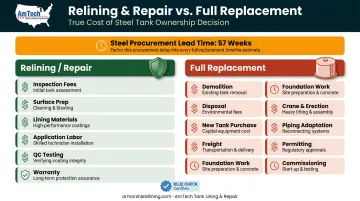
Full replacement cost components:
- Demolition and removal of the existing tank
- Disposal costs (including hazardous material handling if applicable)
- New tank purchase and freight delivery
- Site preparation and foundation work
- Installation labor and crane work
- Piping and instrumentation adaptation
- Commissioning and functional testing
- Regulatory re-permitting
Hidden Costs That Are Frequently Underestimated
Replacement budgets routinely undercount:
- Procurement and construction timelines that stretch months, not weeks
- Temporary storage rental costs while the permanent tank sits out of service
- Recommissioning labor to reconnect and re-calibrate instrumentation, piping, and control systems
- New permit applications and fees triggered by the replacement itself
Relining avoids nearly all of these. The tank shell stays in place, connections remain intact, and most projects recommission in weeks rather than the months a full replacement demands.
The 30-Year Cost Perspective
Even when relining needs to be repeated once over a 30-year horizon, the combined cost of two reline cycles often compares favorably to a single full replacement today — particularly when the value of deferring that capital expenditure is factored in. STI/SPFA confirms that coatings and linings for steel water storage tanks deliver extended service life and reduced lifecycle costs. For most facilities, that math points clearly toward repair first.
How to Decide: A Practical Decision Framework
Work through these five factors before committing to either path.
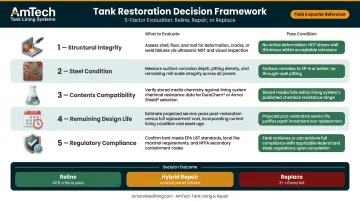
The Five-Factor Assessment Checklist
| Factor | What to Evaluate | Pass Condition |
|---|---|---|
| 1. Structural integrity | Visual panel inspection + ultrasonic thickness testing | Panels pass; wall thickness above minimum structural threshold |
| 2. Steel condition | Corrosion depth — surface/lining layer vs. through-wall | Corrosion limited to surface; no through-wall pitting or perforation |
| 3. Contents compatibility | Lining system options exist for stored media | At least one qualified lining system is compatible |
| 4. Remaining design life | Age and condition relative to design life | At least 10–15 years of useful service life remaining in the steel |
| 5. Regulatory compliance | Existing design vs. current API, NFPA, NSF/ANSI requirements | Tank configuration can meet current standards with a lining upgrade |
Decision Rules of Thumb
- Reline if the tank passes all five criteria
- Consider hybrid panel replacement + relining if only isolated panels fail structural criteria while the majority pass
- Replace if two or more criteria fail, if the tank has already been relined twice, or if operational capacity no longer meets demand
These rules hold in most cases — but the right call depends on actual inspection data, not estimates.
Start With a Professional Inspection — Every Time
The checklist above is only as good as the inspection data feeding it. A qualified tank integrity assessor — whether API 653 certified or operating under NLPA standards — can perform ultrasonic thickness testing, structural evaluation, and lining condition assessment.
That means actual wall measurements, corrosion depth readings, and a documented condition report that tells you exactly what you're working with before any budget commitment.
AmTech's assessment team, led by Greg Comeau (NLPA Special Inspector, CS Project Engineer), provides pre-project tank integrity evaluations across all 50 states, Canada, and the Caribbean. Call 888-839-0373 or reach Greg directly at 603-315-8839 to schedule an evaluation.
Conclusion
For most bolted steel storage tanks showing signs of wear, relining or targeted repair is the more practical choice. It avoids the bulk of replacement costs, gets facilities back online faster, and can add significant service life to a structurally sound tank.
Replacement is the right answer when the steel itself is compromised, when capacity demands have outgrown the existing tank, or when cumulative rehabilitation costs have closed the gap with new-build pricing.
The key is not to guess. A qualified integrity assessment gives operators the objective data (wall thickness readings, corrosion mapping, compliance status) needed to make that call with confidence. AmTech's field engineers perform ultrasonic testing and structural evaluations on bolted steel tanks across all 50 states — giving operators a clear picture before any budget commitment is made.
Frequently Asked Questions
Is it better to repair or replace a tank?
Repair or relining is generally the better choice when structural steel is still sound, as it avoids the major cost drivers of replacement and returns the tank to service faster. Replacement is warranted when structural integrity is compromised, capacity is insufficient, or the tank cannot meet current compliance standards through a lining upgrade alone.
How much does it cost to reline a water tank?
Relining costs vary based on tank size, lining material, surface condition, and regional labor rates, with no universal per-gallon benchmark for bolted steel tanks. Costs are project-specific and depend on surface preparation scope and the lining system selected. An on-site assessment is the only reliable way to generate an accurate estimate.
What is tank relining?
Tank relining is the process of applying a new protective coating or liner to a tank's interior after the original surface has deteriorated. It restores corrosion protection and chemical resistance without removing the tank structure, though abrasive blasting is required to prepare the steel before any lining system is applied.
How long does a tank liner last?
Liner lifespan depends on the lining material, stored contents, and operating conditions. High-quality systems in benign or low-corrosivity service can last 25–30+ years. Tanks storing aggressive chemicals may require relining every 10–15 years. Manufacturer warranties and post-application quality control testing help confirm expected performance.
What are the signs that a bolted storage tank needs repair?
Common indicators include visible corrosion at bolt connections or interior surfaces, leaks at panel joints or gaskets, blistering or delaminating lining, and steel thinning flagged during ultrasonic inspection. Elevated bacteria counts in potable water storage are also a warning sign. Any of these findings should prompt a formal integrity assessment.
Can all bolted storage tanks be relined?
Most bolted steel tanks in structurally sound condition can be relined, but suitability depends on interior access (minimum manway dimensions for safe worker entry), the condition of the steel panels, and compatibility of available lining systems with the tank's stored contents. A professional inspection determines eligibility before any relining scope is committed.