The answer isn't obvious — and choosing wrong is expensive. A coating applied over compromised seams will fail prematurely. A reline specified for a tank that only needed a maintenance coat wastes capital budget. Getting this right requires understanding what each option actually delivers, where each one falls short, and which tank conditions make one clearly superior to the other.
Bolted tanks are structurally different from welded tanks. Their panel-and-bolt construction creates dozens of seam lines, gasket interfaces, and bolt head points — all of which behave differently under protective coatings than smooth welded plate. As STI/SPFA notes, bolted steel tanks rely on gasket materials and sealants at seams to maintain watertightness, making those joints the first inspection priority before any protection decision.
This guide walks through both options side by side — costs, service life, compliance, and the five factors that should drive your final call.
Key Takeaways
- Coating is a thin-film corrosion barrier best suited for structurally intact tanks with early-stage surface deterioration
- Relining creates a monolithic membrane that encapsulates seams, bolt heads, and penetrations — the structural weak points standard coatings leave exposed
- High-quality lining systems can deliver service life approaching 30 years; standard coatings typically require re-application every 5–10 years
- For potable water, fuel, or chemical service, NSF/ANSI 61, API, or NFPA-compliant lining systems are required
- Annualize your bids before deciding — the lowest upfront cost is rarely the lowest lifecycle cost
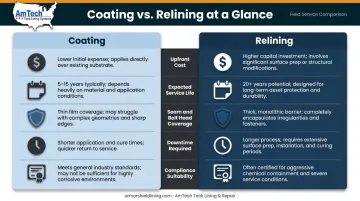
Coating vs. Relining: Quick Comparison
| Factor | Coating | Relining |
|---|---|---|
| Upfront Cost | Lower; specification-driven — varies by tank size, blast standard, and DFT | Higher per project; better lifecycle value spread over its service life |
| Expected Service Life | Typically 5–10 years under normal service conditions | High-quality systems approaching 15–30 years |
| Seam/Bolt Head Coverage | Inconsistent; thin films bridge but don't encapsulate joint lines | Monolithic coverage seals seams, bolt heads, and penetrations completely |
| Downtime Required | Shorter; return-to-service as fast as 48 hours depending on chemistry and temperature | Longer due to full surface prep and cure; still far shorter than tank replacement |
| Compliance Suitability | Some systems carry NSF/ANSI 61 or API listings; verify per stored contents | More commonly certified for potable water, fuel, chemical service; mandatory in regulated environments |
A critical note on cost: No authoritative per-square-foot price range for bolted tank interior work exists in the public domain. Costs are entirely specification-driven — a 2021 public RFB for a 200,000-gallon bolted steel alum sludge tank called for SSPC-SP10 blast cleaning, a 3.0-mil surface profile, and 18–20 mil polyamine epoxy with 3-year workmanship and 5-year manufacturer warranties. It published no price.
Every line item below shifts the final number:
- Tank size and interior access conditions
- Blast grade required (SSPC-SP6 vs. SP10 vs. SP5)
- Lining thickness and DFT specification
- Seam and bolt head treatment method
- Cure schedule and environmental controls
Get itemized bids on identical specifications before comparing quotes.
What Is a Bolted Tank Coating?
A bolted tank coating is a protective film — typically epoxy polyamide, novolac epoxy, polyurethane, or glass-flake reinforced epoxy — applied to the interior steel surface to form a barrier between the metal substrate and stored contents.
These are thin-film systems, measured in mils, that depend entirely on substrate adhesion.
Their effectiveness starts with surface preparation: AMPP's surface preparation standards require Near-White Metal Blast Cleaning (SSPC-SP 10) or White Metal Blast Cleaning (SSPC-SP 5) before any quality lining application. Skip the prep, and the coating fails — regardless of material quality.
Common Coating Types for Bolted Tanks
| Type | Key Properties | Best For |
|---|---|---|
| Epoxy polyamide | High-build, good adhesion, water immersion resistant | General water storage, moderate chemical exposure |
| Novolac epoxy | 100% solids, superior chemical resistance, higher temperature tolerance | Aggressive chemical, fuel, and wastewater service |
| Polyurethane/elastomeric | Flexible, impact resistant, NSF/ANSI 61 available | Water tanks with thermal cycling or ice exposure |
| Glass-flake reinforced | Applied 15–50 mils, temperature resistance up to 260°F | Aggressive chemical and thermal service environments |
Where Coatings Make Sense
Coating is the right call when:
- Tank seams are intact and gaskets are holding
- Corrosion is surface-level with minimal pitting
- Stored contents are lower-risk (ambient water, dry products)
- A scheduled maintenance cycle is needed before deterioration advances
- Budget constraints require extending service life by 5–10 years before a larger capital decision
Industry segments where coating-only maintenance is common include municipal water towers with intact interiors, fire suppression tanks in early maintenance cycles, and agricultural storage with limited chemical exposure. When those conditions no longer hold — active seam leaks, deep pitting, or aggressive chemical service — coating alone stops being the answer.
What Is Bolted Tank Relining?
Relining is a full interior protection system — a high-build, monolithic membrane applied across the entire tank interior, including seams, bolt heads, floor-to-wall transitions, and all penetrations. Unlike a coating, a reline is engineered to be the primary corrosion protection layer for the tank's remaining service life.
A reline rebuilds the protection system from the ground up — at thicknesses that bridge joint gaps, encapsulate hardware, and resist aggressive chemistry that thin-film coatings can't withstand.
Relining Material Categories
- 100% solids epoxy — applies at 16–40 mils DFT; suitable for non-potable water, crude oil, petroleum, and wastewater immersion with 48-hour return-to-service (Tnemec Series 322 is a common example)
- Polyurea/polyurethane elastomeric — 2mm+ build, ANSI/NSF 61 compliant, rated from -40°F to 248°F; 72-hour immersion window before service return
- Cementitious linings — NSF/ANSI 61 certified for potable hot and cold water; the HydraStone Alkrete system (AmTech holds the exclusive U.S. license) carries a 40+ year track record in DHW and municipal water applications
- Fiberglass-reinforced systems — used when severe pitting or structural cracking requires mechanical reinforcement beyond what spray-applied membranes can provide
- Plural-component spray systems — enable rapid cure and high-build application in a single mobilization; require specialized equipment and contractor qualification
At the high-build poly end of this spectrum, AmTech's DuraChem 500 series applies at 80–125 mils with adhesion strength up to 1,965 PSI. The DuraChem 580 PW formulation is NSF/ANSI 61 compliant for potable water; the DK2 polyurea variant handles constant-immersion diesel, kerosene, and #2 oil service.
Why Bolted Tanks Specifically Benefit from Relining
Standard coatings applied to bolted tank interiors routinely fail at seam lines and bolt heads. Thin films bridge joint gaps without fully sealing them, and thermal cycling causes differential movement at those joints — cracking or delaminating the coating from the edges inward. A monolithic reline encapsulates the entire bolt head and seam assembly under a continuous membrane, eliminating that failure point entirely.
Where Relining Is the Correct Choice
Reline when:
- Seam leaks or gasket failures are active or suspected
- Interior corrosion is widespread or pitting exceeds surface-level depth
- The tank is being repurposed for a new stored product
- NSF/ANSI 61, API, or NFPA compliance certification is required
- The goal is a full additional service cycle of 15 years or more
Standard relining environments: municipal potable water systems, fire suppression storage, petroleum and fuel terminals, wastewater treatment facilities, and chemical processing plants.
Coating vs. Relining: Which Is Right for Your Tank?
Five factors drive this decision. Work through each one before committing to either option.
1. Tank Condition
This is the primary driver. Inspect seams, gaskets, bolt lines, floor-to-wall transitions, and existing coating condition first.
- Intact seams, surface-level corrosion, sound gaskets → Coating is defensible; provides a cost-effective 5–10 year extension
- Active seam leaks, advanced bolt corrosion, delamination → Relining is mandatory; recoating over compromised seams will fail prematurely
2. Lifecycle Cost vs. Upfront Budget
The annualized cost math often surprises facilities managers. A coating applied at lower cost but requiring re-application every 5–7 years can cost more over 20 years than a single quality reline.
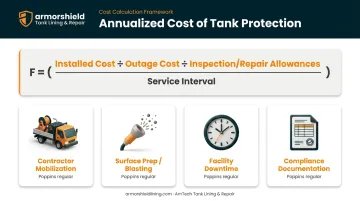
Run this calculation for both options before deciding on upfront price alone:
(Installed cost + outage cost + inspection/repair allowances) ÷ expected service interval
Each cycle of coating renewal adds:
- Contractor mobilization and setup costs
- Full surface prep (abrasive blasting each time)
- Facility downtime and lost production
- Inspection and compliance documentation fees
3. Stored Contents and Compliance
The applicable standard depends on what your tank stores:
- Potable water: NSF/ANSI 61 governs all barrier materials in contact with drinking water, including coatings, gaskets, and adhesives
- Petroleum storage: API 12B and API 653 provide the relevant framework
- Fire suppression: NFPA 22 governs design and maintenance requirements
One common point of confusion: AWWA D102 covers coating and recoating steel potable water tanks, but bolted steel tanks are explicitly excluded from D102 scope. They fall under ANSI/AWWA D103.
In regulated service environments, the coating-vs-reline question often isn't economic. A non-compliant coating on a potable water tank creates direct regulatory and liability exposure.
4. Downtime Tolerance
Return-to-service timelines vary significantly by system:
- Fast-setting polyurea: foot traffic in 1–4 hours, immersion after 72 hours
- Standard epoxy: 48 hours at 75°F, up to 7 days at 50°F
- Rapid-reacting AWWA systems: disinfection-ready within 4–24 hours
Temperature has a larger impact on project timeline than most facility managers anticipate. A relining project scheduled in cold weather will take two to three times longer to cure than the same project in summer.
5. Situational Recommendations
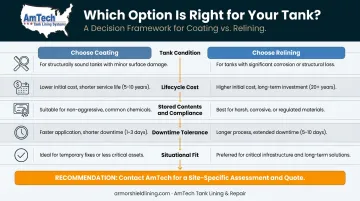
Once you've assessed condition, lifecycle cost, compliance requirements, and downtime tolerance, the decision usually becomes clear. Here's where each option fits:
Choose coating if:
- Tank is structurally sound with intact seams
- Corrosion is early-stage and surface-level
- Stored contents are low-risk
- A shorter-term maintenance solution fits the budget cycle
Choose relining if:
- Seam or gasket failures are present
- Corrosion is widespread or pitting is significant
- Stored contents require compliance certification
- The tank needs a full additional service cycle of 15+ years
When a Recoat Inquiry Becomes a Reline Project
A scenario AmTech encounters regularly: a municipal water authority or industrial facility contacts AmTech for an interior recoat on an aging bolted tank. From the outside, the tank looks like a maintenance candidate — some coating wear, a few areas of surface rust.
Then the NLPA inspection and ultrasonic testing happen.
The inspection reveals seam deterioration that isn't visible through standard observation. Common findings include:
- Bolt heads with active corrosion beneath the existing coating layer
- Gasket interfaces that have lost their seal
- Pitting at floor-to-wall transitions that makes re-adhesion of a thin-film coating unreliable
A second recoat over that substrate would fail within two to three years.
The recommendation shifts to a full interior reline. The facility then evaluates two recoat cycles plus repeat mobilization costs against a single reline with warranty coverage.
When annualized, the reline delivers lower cost per year of protection and eliminates the compliance risk of a failed coating inspection during the next regulatory review cycle.
Depending on the service environment, AmTech specifies either the DuraChem 500 series (for chemical, wastewater, or fuel service) or the HydraStone Alkrete cementitious system (for potable water and municipal applications). Both approaches extend tank service life by 15–25+ years and defer replacement at a fraction of new tank capital cost.
If your tank inspection is surfacing similar findings, AmTech's team of NLPA-certified inspectors can assess the interior condition and help determine whether coating or relining is the right investment. Contact AmTech for a consultation.
Conclusion
Neither coating nor relining is universally the right answer. Coating is a legitimate, cost-effective maintenance tool for tanks in early deterioration with structurally sound interiors. Relining is the more durable, comprehensive solution when seams are compromised, chemistry is aggressive, or compliance certification is required.
What separates good decisions from expensive ones is assessment quality. Facilities that skip proper inspection and choose the lower-cost option when their tank actually needs a full reline risk accelerated failure and unplanned outages. Emergency repair costs in those scenarios routinely exceed what a proper reline would have cost upfront.
Before choosing between coating and relining, get a qualified inspector on-site to assess structural integrity, seam condition, and chemical exposure history. AmTech's NLPA Special Inspector conducts ultrasonic testing and structural evaluations that take the guesswork out of that decision.
Frequently Asked Questions
What is the difference between a bolted tank coating and a lining?
A coating is a thin-film corrosion barrier (measured in mils) applied to the steel surface. A lining is a thicker, monolithic membrane that covers the entire interior — including seams, bolt heads, and penetrations — providing more comprehensive and durable long-term protection.
What is the purpose of a bolted tank lining?
A bolted tank lining creates a continuous protective barrier against corrosion, chemical attack, and seam leaks. It's particularly valuable for bolted tanks because the panel-and-bolt construction creates dozens of joint points that thin coatings can't fully seal — a monolithic lining encapsulates all of them.
How long does a bolted tank liner last?
High-quality relining systems (100% solids epoxy, polyurea, or cementitious) typically deliver 15–30 years of service life with proper installation and surface preparation. Standard protective coatings generally require re-application every 5–10 years.
How much does a bolted tank liner cost?
Costs vary by tank size, surface condition, lining material, DFT, and location. Relining costs more upfront than recoating, but the longer service life usually produces better lifecycle value. Contact AmTech at 888-839-0373 for project-specific pricing.
When should I reline instead of recoating my bolted tank?
Relining is the right choice when:
- Active seam or gasket leaks are present
- Widespread corrosion or pitting has developed
- The tank is being repurposed for a new stored product
- NSF/ANSI 61 or API compliance certification is required
- The goal is a full additional service cycle of 15+ years
Does relining a bolted tank require regulatory compliance certifications?
Yes. Potable water tanks require NSF/ANSI 61-certified systems; petroleum storage requires API-compliant materials; fire suppression tanks must meet NFPA 22. AmTech holds certifications across all three standards and specifies compliant systems based on your stored contents and jurisdiction.