Introduction
Biodiesel storage tanks serve as critical infrastructure for anyone storing, distributing, or using biodiesel fuel — yet this alternative fuel's unique chemical properties demand far more rigorous management than conventional diesel. Unlike petroleum diesel, biodiesel exhibits powerful solvent action that can loosen decades of accumulated tank deposits, a higher cloud point that causes gelling at temperatures other fuels easily handle, strong affinity for water that accelerates microbial growth, and heightened sensitivity to oxidation when exposed to heat, light, or incompatible metals.
Those chemical properties translate directly into operational risk when storage is mismanaged. Poor biodiesel tank management leads to:
- Fuel degradation that shortens shelf life
- Microbial contamination at the fuel-water interface
- Accelerated corrosion from incompatible materials
- Rapid filter clogging from suspended sediments
- Costly equipment downtime
- Regulatory non-compliance under EPA underground storage tank (UST) rules
Facilities transitioning from petroleum diesel to biodiesel blends — particularly B20 and above — face the greatest risk if existing tanks haven't been properly assessed and upgraded.
This guide covers what operators need to know: compatible tank materials, optimal storage conditions, maintenance types, early warning signs, and a practical schedule calibrated to blend ratio, climate, and tank type. Whether you're storing B5 blends or pure B100, protecting fuel quality starts with understanding how biodiesel behaves in storage.
Key Takeaways
- Biodiesel is far more chemically reactive than petroleum diesel: it absorbs water, degrades under heat and UV, and strips legacy tank deposits that clog filters within days of first use
- Use stainless steel, aluminum, or UL 1316-listed fiberglass — copper, brass, zinc, and uncoated mild steel degrade biodiesel without a compatible lining
- Monthly water sampling from tank bottoms is the minimum standard — water contamination drives 90% of biodiesel storage failures through microbial growth and corrosion
- Temperature control prevents gelling: maintain storage at 5–10°F above the fuel's cloud point, particularly for aboveground tanks storing B30 to B100
- Daily visual checks through annual professional inspections are required to protect fuel quality, prevent regulatory violations, and avoid costly tank failures
Key Requirements for Biodiesel Storage Tanks: Materials and Conditions
Before developing any maintenance plan, the tank itself must be verified as compatible with biodiesel. B20 blends and higher place significantly greater chemical demands on tank materials compared to conventional diesel, and using incompatible infrastructure accelerates both fuel degradation and equipment failure.
Compatible Tank Materials
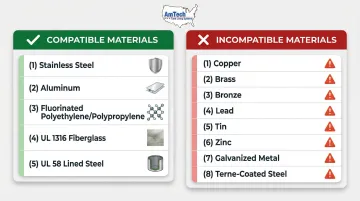
Recommended materials for safe biodiesel storage include:
- Stainless steel — excellent corrosion resistance across all blend ratios
- Aluminum — lightweight and compatible with biodiesel's chemical properties
- Fluorinated polyethylene and polypropylene — resistant to biodiesel's solvent action
- Fiberglass tanks listed under UL 1316 — tested with biodiesel-specific test fluids (B25a and B100a)
- Steel tanks listed under UL 58 — compatible compatible if properly cleaned and professionally lined before biodiesel use
Materials to strictly avoid: Copper, brass, bronze, lead, tin, and zinc catalyze oxidation reactions that rapidly degrade biodiesel quality. Copper accelerates biodiesel degradation significantly, causing chain scission of fatty acid methyl esters (FAME) and altering fuel composition. Galvanized metal and terne-coated sheet metal are incompatible at any blend level.
For existing tanks with incompatible interiors, professional biodiesel-compatible lining systems can convert them to safe storage without full replacement. AmTech Tank Lining & Repair offers in-place upgrade lining services for older fiberglass tanks storing biodiesel fuels, using custom-assembled glass, Kevlar, and carbon veils with service-specific polymer matrices. The Genesis Double Wall Retrofit System provides another option, converting single-wall USTs to fully compliant double-wall tanks while maintaining compatibility with biodiesel, petroleum fuels, and alcohol blends.
Temperature Management
Biodiesel's cloud point ranges from -1°C to 20°C (30°F to 68°F), depending on feedstock — substantially higher than petroleum diesel. At temperatures below the cloud point, wax crystals form and fuel begins to gel, restricting flow and clogging filters.
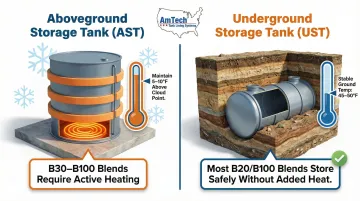
Storage temperature requirements: Maintain temperatures at least 2.5°C to 5°C (5°F to 10°F) above the fuel's specific cloud point. Aboveground storage tanks (ASTs) storing B30 to B100 generally require insulation and active heating systems to prevent gelling, particularly in cold climates. Slow agitation or tank mixers prevent crystals from accumulating on tank bottoms.
Underground storage tanks (USTs) benefit from natural soil insulation, with subsurface temperatures typically stable around 7°C to 10°C (45°F to 50°F). Most B100 and B20 blends can be stored underground in cold climates without additional heating, except for biodiesel from highly saturated feedstocks like tallow or palm oil that have cloud points above 15°C (60°F).
Excluding Water, Light, and Oxygen
Temperature control addresses physical gelling — but chemical contamination poses its own set of risks. Biodiesel absorbs moisture far more readily than petroleum diesel, and water contamination triggers multiple failure modes:
- Microbial growth at the fuel-water interface, creating biofilms and sludge
- Microbially influenced corrosion (MIC) that pits tank walls
- Filter icing in cold weather when entrained water freezes
- Rising acid numbers as water accelerates oxidation and hydrolysis
Keeping water out requires attention at multiple points:
- Top off tanks regularly to minimize condensation in the headspace
- Inspect fill caps and vapor caps for missing or damaged gaskets
- Install desiccant breather filters on vent pipes to reduce moisture ingress
ASTM D6751 and D7467 mandate maximum water and sediment limits of 0.050% by volume, measured via ASTM D2709.
Oxygen and light exposure accelerate oxidation, forming peroxides, gums, and sediments that raise acid numbers and degrade fuel quality. Tanks should be opaque and sealed to block UV light.
Aboveground tanks should be painted white or light-colored to minimize heat absorption — elevated temperatures speed up oxidation reactions. Oxidation is further accelerated by contact with iron, rust, copper, brass, bronze, lead, tin, and zinc.
Types of Maintenance for Biodiesel Storage Tanks
Maintaining a biodiesel storage tank requires multiple maintenance approaches depending on the issue. Some are scheduled preventively, others are condition-triggered, and some require professional intervention.
Routine / Preventive Maintenance
Preventive maintenance consists of scheduled tasks that prevent small issues from compounding:
- Monthly tank bottom sampling for water accumulation
- Visual inspections for leaks, rust streaks, and corrosion on fittings
- Checking vent filters and spill buckets for damage or clogging
- Monitoring fuel color and clarity when dispensing
- Reviewing filter change intervals to detect accelerating clog rates
Costs for preventive maintenance are low relative to reactive repairs. This approach is especially important when first transitioning to biodiesel or increasing blend ratios, as biodiesel's solvent action loosens accumulated petroleum deposits that clog filters.
Corrective / Reactive Maintenance
Corrective maintenance is triggered by evidence of active problems:
- Cloudy or contaminated fuel samples indicating water or wax
- Faster-than-normal filter clogging signaling sediment or microbial growth
- Confirmed microbial contamination via ASTM D6974 testing
- Visible sludge or biofilm during inspection
- Corrosion discovered on tank walls or fittings
Corrective actions include:
- Biocide treatment followed by increased filter monitoring
- Professional tank cleaning or fuel polishing to remove sediments
- Replacing degraded seals and gaskets
- Removing incompatible metal components
- Draining and cleaning the tank in severe microbial cases
Predictive / Condition-Based Maintenance
Fuel quality testing provides early warning of degradation before visible symptoms appear. Key tests include:
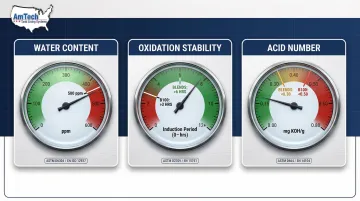
- Water content (ASTM limit: 500 ppm maximum)
- Oxidation stability measured via EN 15751 (minimum 6 hours for B6–B20; 3 hours for B100)
- Acid number via ASTM D664 (maximum 0.3 mg KOH/g for B6–B20; 0.50 mg KOH/g for B100)
Annual laboratory testing is the minimum standard; high-use operations or facilities storing B50–B100 should test quarterly. Rising acid numbers, declining oxidation stability, or water content exceeding 500 ppm signal active degradation requiring immediate intervention.
Major / Overhaul Maintenance
Major overhaul involves full interior tank cleaning to remove sediment, biological matter, and degraded coating. Triggers include biodiesel's solvent action compromising interior surfaces or a transition to higher blend ratios.
Professional relining restores compatibility and adds decades of serviceable life without full tank replacement. AmTech Tank Lining & Repair provides comprehensive field services for this scope of work:
- Vapor purging and desludging
- Ultrasonic gauging for wall thickness assessment
- Abrasive blasting to SSPC-SP5 or SP10 surface profiles
- Structural repairs and welding
- Application of biodiesel-compatible systems (DuraChem 500 series or AT BiFlex fiberglass)
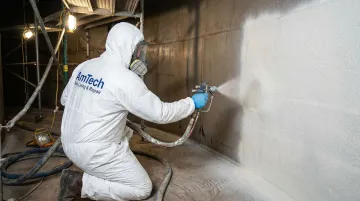
Most tanks return to service within 30 hours of relining completion.
How to Tell If Your Biodiesel Storage Tank Needs Maintenance
Early-warning indicators allow operators to intervene before fuel quality or equipment failure becomes critical.
Fuel Quality Changes
Visual indicators include:
- Fuel that fails the "clear and bright" standard — cloudy, dark, or hazy when sampled in a clear container
- Cloudiness or haze indicating entrained water droplets or microbial growth
- Visible sediment or particulate matter in the sample
Measurable indicators from lab testing:
- Rising acid number above specification limits
- Declining oxidation stability (induction period dropping below 6 hours for blends or 3 hours for B100)
- Water content exceeding 500 ppm
Equipment and Operational Signals
Filters clogging ahead of schedule are a reliable early warning. When replacement frequency increases without a change in usage, the tank likely contains sediment, biological matter, or biodiesel-loosened petroleum deposits. Downstream operational signals include:
- Engine starting difficulty
- Inconsistent fuel flow or pressure
- Fuel injector fouling
- Increased fuel system maintenance frequency
Any combination of these signals warrants immediate tank inspection.
Visible Tank and Component Deterioration
Physical warning signs on the tank itself include:
- Rust streaks or discoloration on tank exterior
- Unusual odors around the tank or vent
- Corroded fittings or flange connections
- Cracked or swelling hoses and seals
- Leaking spill buckets or sumps
These signs are most common in older systems with incompatible rubber or metal components. Keep a written inspection log to track whether issues recur. Recurring problems indicate systemic degradation rather than isolated incidents — and typically require professional assessment or tank relining.
Biodiesel Storage Tank Maintenance Schedule
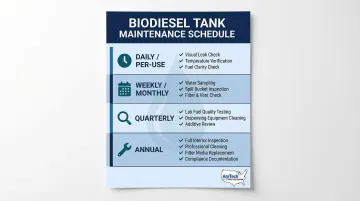
Maintenance frequency scales with usage intensity, biodiesel blend ratio (higher blends require more frequent attention), local climate, and whether the tank is above or below ground.
| Frequency | Maintenance Tasks |
|---|---|
| Daily / Per-Use | Visual inspection for leaks or spills; temperature verification for heated systems; fuel clarity check when dispensing |
| Weekly / Monthly | Tank bottom water sampling (monthly minimum); spill bucket and sump inspection; filter condition check; vent and gasket inspection |
| Quarterly | Fuel quality sampling for lab analysis (water content, oxidation stability, acid number); cleaning of dispensing equipment; review of additive levels (antioxidants, biocides, cold flow improvers) |
| Annual | Full interior inspection; professional cleaning if sediment or microbial contamination found; filter media replacement; component integrity review; compliance documentation update |
Scheduling adjustments:
- High-use operations or those storing B50–B100 should increase fuel quality sampling to quarterly minimum
- Warm, humid climates face higher microbial risk and should prioritize biocide monitoring and more frequent water sampling
- Winter season triggers additional cloud point and cold flow checks before temperatures drop, along with verification of heating systems for aboveground tanks
Maintenance schedules also intersect with federal compliance obligations. Under 40 CFR 280.32, owners and operators must notify their implementing agency at least 30 days before switching to a regulated substance containing greater than 20% biodiesel, and must demonstrate UST system compatibility through a nationally recognized testing laboratory certification or written equipment manufacturer approval.
Conclusion
Biodiesel's unique chemical properties make storage tank maintenance essential. Neglecting compatibility, water exclusion, or regular inspection doesn't just degrade fuel — it creates downstream equipment failures and compliance risks that far exceed the cost of preventive care. A single contamination event can clog filters, damage injectors, and halt operations, while undetected corrosion can lead to regulatory violations and environmental liability.
A structured maintenance plan covering daily monitoring through periodic professional assessment protects long-term tank value, preserves fuel quality, and keeps operations running reliably across B5 blends and pure B100 alike.
For facilities with older tanks or those moving to higher biodiesel blends, professional inspection and relining services — such as those provided by AmTech Tank Lining & Repair — can extend serviceable life by decades, avoiding the disruption and cost of full tank replacement.
Frequently Asked Questions
How long can biodiesel be stored?
Biodiesel typically holds quality for 6 months to 1 year under ideal conditions — sealed, cool, dark, and dry. B20 blends meeting the 6-hour oxidation stability minimum are expected to retain quality for up to 1 year in clean, dry storage. Antioxidant additives and proper tank conditions can extend shelf life; oxidation and microbial activity shorten it.
What are the storage conditions for biodiesel?
Proper biodiesel storage requires attention to four key factors:
- Tank material: Stainless steel, aluminum, or fiberglass (avoid copper and zinc)
- Temperature: Maintain above the fuel's cloud point — ideally 40–70°F for most blends
- Sealed and opaque tank: Minimizes oxygen and UV exposure that accelerate oxidation
- Dry environment: Regular bottom sampling catches moisture accumulation early
Does biodiesel work in cold weather?
Biodiesel gels at higher temperatures than petroleum diesel, so cold-weather management is essential. Lower blend ratios (B5, B20) handle cold climates better than B100. Common strategies include cold flow improver additives, heated storage tanks and fuel lines, and switching to lower blends seasonally.
Can a diesel engine run on 100% biodiesel?
While B100 is technically compatible with many diesel engines, most manufacturers recommend lower blends (B5–B20) for warranty compliance. Cummins approves B20 for specific engines, and Volvo offers trucks that can run on B100. B100 requires heated storage and transport infrastructure, and the engine's fuel system components must be verified as biodiesel-compatible.
Is B5 or B20 better?
B5 (5% biodiesel) offers minimal performance change and is widely compatible with existing infrastructure. B20 (20% biodiesel) provides greater emission reductions and fuel lubricity benefits but requires more careful storage management, particularly in cold climates. B20 increases NOx emissions by approximately 2% while reducing particulate matter by 10.1%. The better choice depends on climate, equipment, and storage capabilities.
Can I use biodiesel instead of ultra-low sulfur diesel?
Biodiesel blends up to B20 are designed to work alongside ultra-low sulfur diesel (ULSD), not fully replace it in most commercial settings. ULSD's lower sulfur content eliminated a natural antimicrobial barrier, leaving biodiesel blends more vulnerable to microbial growth — making routine biocide treatment and tank inspection a standard part of the storage protocol.