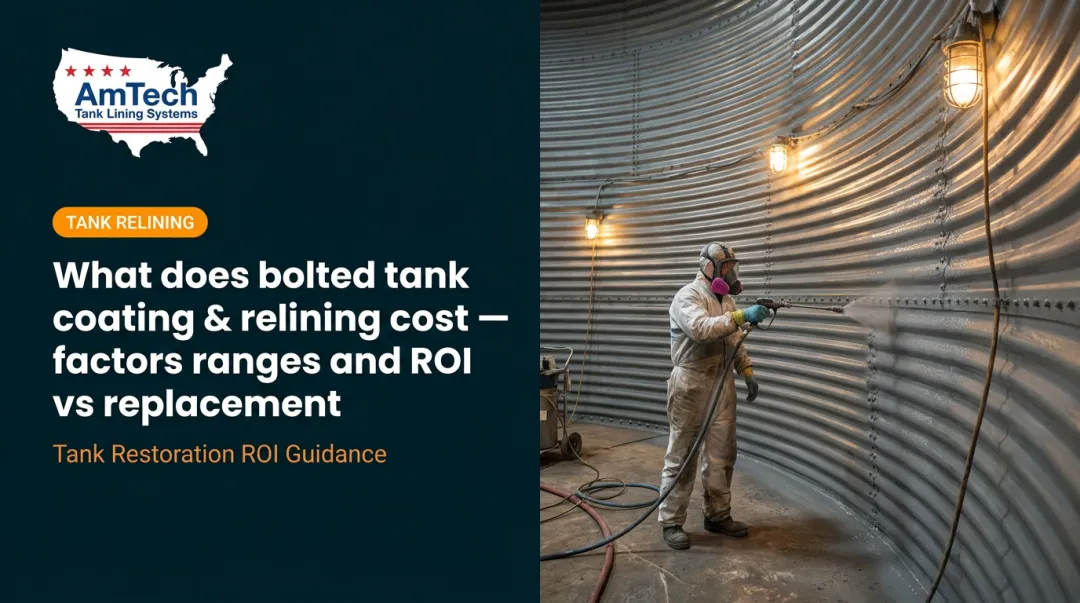
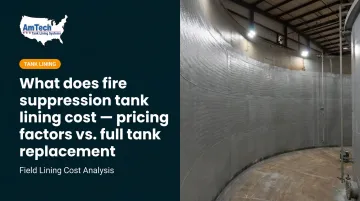
Fire suppression tank lining costs vary widely based on tank size, interior surface condition, lining material specified, and compliance requirements under NFPA 22. Without understanding these drivers, facilities routinely over-budget for replacement when relining is viable, or under-budget for relining and get blindsided by scope-creep costs.
This article breaks down the key cost drivers, explains what goes into a full project budget, and walks through the lining-versus-replacement decision with enough specificity to inform a real budgeting conversation.
Key Takeaways
- Lining cost scales with interior surface area, tank condition, and lining system — not tank capacity alone
- Surface preparation is typically the largest labor cost in any relining project
- Relining a structurally sound tank costs a fraction of replacement and extends service life by 15–25+ years
- Replacement is warranted only when structural integrity is compromised beyond repair
- Only a qualified inspector's formal assessment — not a visual walk-around — determines the right path
Fire Suppression Tank Lining Cost: What to Expect
Tank lining is not a commodity. The same 25,000-gallon steel tank in two different facilities can produce dramatically different quotes based on coating condition, access constraints, the lining system specified, and local labor markets.
Two common misconceptions create budget problems:
- Assuming lining is cheap — Facilities plan for material costs only, then discover that surface preparation, confined space compliance, and mobilization can represent half or more of the total project cost
- Assuming replacement is necessary — A tank with visible corrosion or a failed previous coating may be entirely sound structurally; relining is often viable when replacement is assumed
Both errors are costly. The fix is understanding what actually drives cost before a quote arrives.
Pricing by Tank Size
No publicly available cost database publishes verified installed relining ranges for fire suppression tanks by gallon tier — and any contractor page citing precise figures without project-specific context should be read skeptically. What the industry does support is a general cost structure based on interior surface area, labor intensity, and material volume.
Approximate installed cost framework (surface prep, materials, labor, and holiday testing):
| Tank Size | Relative Cost Range | Notes |
|---|---|---|
| Under 10,000 gallons | Lower end | Smaller surface area, but mobilization cost is similar to larger jobs — cost-per-gallon is higher |
| 10,000–50,000 gallons | Mid-range | Most common fire suppression tank tier; surface area scales proportionally |
| 50,000+ gallons | Higher end | Large industrial/municipal tanks; multiple lining crews, extended cure windows |
Typically included in a lining contractor's scope:
- Interior surface preparation (abrasive blasting)
- Primer and finish coat application to specified dry film thickness (DFT)
- Holiday testing (spark or wet sponge)
- Return-to-service inspection
Typically excluded and scoped or contracted separately:
- Tank dewatering, cleaning, and waste disposal
- Confined space permits and standby personnel
- Structural repairs (bottom plate, seam welds, shell defects)
- Engineering documentation and AHJ submittals
Dewatering and cleaning alone can add significant added cost to a project, particularly when the tank has accumulated sediment or biological growth. Budget for it separately.
Lining System Type and Its Effect on Price
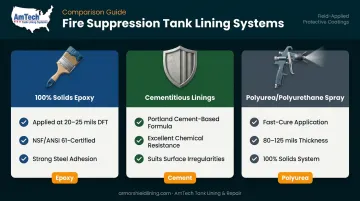
Three primary lining chemistries are used in fire suppression tank applications, and they sit at different price points:
- 100% solids epoxy / solvent-free epoxy — High-build systems applied at 20–25 mils DFT or higher; strong adhesion to steel; widely specified for steel fire suppression tanks; NSF/ANSI 61-certified options available from manufacturers including Sherwin-Williams (DURA-PLATE UHS) and Tnemec (Tank Armor series)
- Cementitious linings (such as HydraStone Alkrete, exclusively installed in the US by AmTech) — Portland cement-based or modified cementitious systems; excellent chemical resistance and long service life; applied thicker than epoxy; well-suited for tanks with minor surface irregularities
- Polyurea/polyurethane spray systems — Fast-cure, high-build coatings applied at 80–125 mils; AmTech's proprietary DuraChem 500 series is a 100% solids polylining system in this category; NSF/ANSI 61-compliant for fire suppression applications
One practical constraint on material selection: NFPA 22-compliant lining systems must meet performance thresholds for the service environment, and the Authority Having Jurisdiction (AHJ) has final approval authority. This limits the use of generic or off-specification coatings and effectively sets a floor on material cost.
Budget for code-compliant materials from the start. A lining system rejected by the AHJ and requiring full removal and reapplication will cost more than the original compliant specification.
Key Factors That Drive Fire Suppression Tank Lining Costs
Lining cost is shaped by technical, logistical, and regulatory factors — and each one can shift the final number significantly.
Tank Size and Surface Area
Lining cost scales with interior surface area, not tank capacity. A tall, narrow 25,000-gallon tank and a wide, shallow 25,000-gallon tank hold the same volume but have different wall areas — and different material and labor costs as a result.
A simple illustration: a cylindrical tank 12 feet in diameter by 30 feet tall has roughly 1,470 square feet of interior surface. A tank 20 feet in diameter by 11 feet tall at the same 25,000-gallon volume has approximately 1,320 square feet. The difference affects both material quantities and labor hours. Always confirm interior surface area when comparing quotes, not just gallons.
Tank Condition and Surface Preparation Requirements
Surface preparation is often the single largest labor cost in a relining project — and it's the variable most likely to increase scope after mobilization.
AMPP defines the primary blast standards used in immersion service:
- SSPC-SP 6 / NACE 3 — Commercial blast; up to 33% staining per unit area
- SSPC-SP 10 / NACE 2 — Near-white metal blast; staining limited to 5% per unit area; standard for most tank lining work in immersion service
- SSPC-SP 5 / NACE 1 — White metal blast; no staining; required by some high-performance lining specifications
Tanks with heavy corrosion, deep pitting, or failed previous coatings require more aggressive preparation. Compared to a tank in fair condition, labor hours for surface prep on a heavily degraded tank can double or triple.
Structural defects found during interior inspection — holed bottom plates, failed seam welds, cracked shell sections — must be repaired before lining and are scoped separately. These repairs can add substantial cost outside the lining contract.
Access and Confined Space Requirements
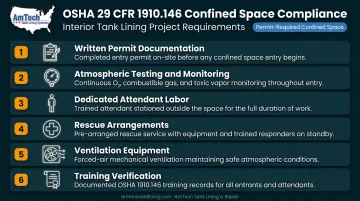
Every interior tank lining project involves confined space entry under OSHA 29 CFR 1910.146. Permit-required confined space work adds:
- Written permit documentation and administration
- Atmospheric testing and continuous monitoring
- Dedicated attendant labor (present throughout all entry periods)
- Rescue arrangements and emergency procedures
- Ventilation equipment and controls
- Training verification for all entrants
Tanks that are underground or partially buried, located in tight mechanical rooms, or accessible only through small manways carry higher mobilization and safety compliance costs than open-top or easily accessible above-ground tanks.
Geographic Location and Mobilization
Specialty tank lining crews are not available in every market. A project requiring mobilization across multiple states carries higher travel, lodging, and equipment transport costs than a regional job. Union labor markets in certain areas also affect hourly rates significantly.
When evaluating contractors, verify that fire suppression tank work is a defined specialty — not an occasional add-on. Key indicators include:
- Documented experience with NFPA 25-compliant tank systems
- In-house field crews rather than subcontracted labor
- Familiarity with the lining materials approved for immersion service in fire protection applications
These factors affect both project execution and the enforceability of any warranty.
Tank Lining vs. Full Tank Replacement: The Real Cost Comparison
This is the decision most facility managers are actually trying to make. The cost difference is often substantial — but only if you count everything.
What Lining Costs vs. What Replacement Costs
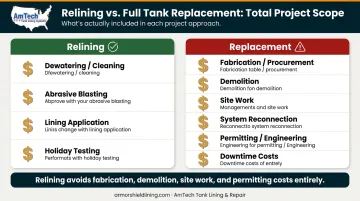
Consider a representative 25,000-gallon above-ground steel fire suppression tank:
Relining scope (installed):
- Tank dewatering and cleaning
- Abrasive blasting to SSPC-SP 10
- Lining system application (primer + finish coats to specified DFT)
- Holiday testing and return-to-service inspection
Replacement scope (total project):
- New tank fabrication and procurement lead time
- Demolition and removal of existing tank
- Site work and foundation preparation
- Installation and fire protection system reconnection
- Permitting, engineering, and AHJ approval for new installation
- System downtime costs and temporary coverage arrangements
Relining avoids fabrication, demolition, site work, and permitting costs entirely — that's the structural cost logic, even without published price databases by tank size tier. The Sherwin-Williams Holyoke case study puts numbers to it: five municipal water storage tanks rehabilitated for $980,000, saving over $1.2 million compared to full restoration. The context is municipal water, but the underlying economics translate directly to fire suppression applications.
When Replacement Becomes the Right Call
Replacement is warranted when:
- The tank shell has lost structural integrity that spot repairs cannot restore
- The tank bottom is severely pitted or holed beyond economical repair
- Multiple compounding failures have accumulated at end of designed service life
- The cost of required structural repairs before lining approaches or exceeds replacement cost
The only reliable way to determine which category a tank falls into is ultrasonic thickness testing by a qualified inspector. An API 653-certified inspector or NLPA Special Inspector can calculate remaining wall thickness, corrosion rates, and minimum allowable thickness for the shell and bottom. Visual inspection alone cannot confirm whether a corroded tank can structurally support a new lining system.
That's exactly what AmTech's assessment process is designed to answer. Led by Greg Comeau, a licensed NLPA Special Inspector, AmTech evaluates structural integrity through ultrasonic thickness testing, coating condition, and NFPA 22 compliance requirements before any lining recommendation is made. Facilities get a clear answer: whether the tank qualifies for relining, needs structural work first, or warrants replacement.
The Hidden Costs of Replacement
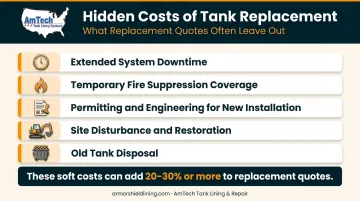
Full replacement quotes frequently undercount total project cost. These line items are commonly underestimated or omitted:
- Extended system downtime — Tank replacement takes weeks to months; relining typically takes days to a few weeks depending on tank size
- Temporary fire suppression coverage — Impaired system status carries insurance and liability exposure; NFPA 25 places impairment management squarely on the owner
- Permitting and engineering for new installation — A new tank installation triggers full permit review; relining a permitted existing tank typically does not
- Site disturbance and restoration — Removal of an existing tank often involves excavation, crane access, and ground restoration
- Old tank disposal — Steel disposal or scrap value can vary; hazardous residue disposal adds cost
These "soft" costs can add 20–30% or more to a replacement quote that only reflects fabrication and installation.
Cost Breakdown: What Goes Into a Fire Suppression Tank Lining Project
Understanding each cost component prevents budget surprises. Costs fall into two categories: one-time project expenses and recurring maintenance costs — and the balance between them determines your long-term spend.
| Cost Component | Type | Notes |
|---|---|---|
| Tank dewatering, cleaning, and waste disposal | One-time | Often outside the lining contractor's scope; includes pumping, hydroblasting, and regulated waste disposal |
| Surface preparation (abrasive blasting) | One-time | Typically the highest labor cost; SSPC-SP 10 is standard for immersion service; SP-5 required by some specs |
| Lining material and application | One-time | Primer plus finish coat(s) to specified DFT; price varies by lining system |
| Holiday testing and inspection | One-time | Spark or wet sponge testing for pinholes; may be required by NFPA 22 or the AHJ |
| Ongoing inspection and maintenance | Recurring | Lining assessment at each NFPA 22 inspection cycle — generally every 3–5 years |
Catching early lining degradation at a routine inspection cycle costs far less than a full relining project triggered by accelerated corrosion — which is why the recurring line item pays for itself.
What Most Facilities Get Wrong About Fire Suppression Tank Lining Costs
Three patterns account for most budget failures on these projects:
1. Pricing the material and ignoring the rest. Per-square-foot lining material cost is one input. Surface preparation, confined space compliance, mobilization, and access logistics can collectively exceed material cost on a complex project. The full installed cost is what matters.
2. Deferring relining because it isn't in this year's budget. A degraded lining accelerates corrosion. Minor coating failure caught at an inspection cycle is a contained repair. The same tank two inspection cycles later may require aggressive blasting to bare metal, structural weld repairs, and a complete relining — at two to three times the earlier cost. As Sherwin-Williams notes, deferred tank maintenance converts minor defects into expensive emergencies, including extended downtime and emergency contractor rates.
3. Selecting the lowest bidder without verifying compliance. A lining contractor who uses non-compliant materials or skips holiday testing can deliver a system that fails AHJ inspection. Full removal and reapplication doubles the project cost. Before award, confirm the contractor meets these minimums:
- Specifies NFPA 22-compatible lining materials
- Employs qualified inspectors with documented holiday testing procedures
- Carries NSF/ANSI 61 compliance and NLPA credentials
Conclusion
Fire suppression tank lining cost varies based on tank size, interior condition, lining material, access constraints, and compliance requirements. In nearly every case where the tank structure is sound, relining is the more cost-effective path — often at a fraction of full replacement cost when all project expenses are accounted for.
The right budgeting decision starts with a proper inspection by a qualified tank specialist, not a visual estimate. Ultrasonic thickness testing, coating condition assessment, and NFPA 22 compliance review give you the verified data needed to make a sound lining-versus-replacement decision.
AmTech Tank Lining & Repair has been lining and repairing fire suppression tanks since the late 1960s. With 55+ years of field experience, NFPA membership, NLPA Special Inspector credentials, and proprietary systems — including the DuraChem 500 series (NSF/ANSI 61-compliant) and HydraStone Alkrete cementitious linings — AmTech's in-house crews serve all 50 states with no subcontracting, backed by the BLUE CHECK warranty program.
Contact AmTech at 888-839-0373 or reach Greg Comeau directly at 603-315-8839 to discuss your project.
Frequently Asked Questions
How much does a tank liner cost?
Cost depends on tank size (interior surface area), lining system selected, and surface preparation requirements — tanks with heavy corrosion require more aggressive blasting, which increases labor cost significantly. See the pricing section above for a framework by size tier; actual numbers require a site-specific assessment and quote.
How long does a tank liner last?
Quality fire suppression tank linings typically last 15–25+ years depending on water chemistry, the lining system applied, and inspection consistency. Manufacturer literature for thick-film systems — including Carboline and STI/SPFA references — cites service life estimates of 18–20+ years under appropriate maintenance conditions.
What lining materials are approved for fire suppression water tanks under NFPA 22?
NFPA 22 does not specify a single approved lining product — it requires linings to meet performance standards for the service environment. Common compliant systems include NSF/ANSI 61-certified epoxies, cementitious linings, and polyurea systems such as AmTech's DuraChem 500 series. The AHJ has final approval authority on any system specified.
When should you reline a fire suppression tank instead of replacing it?
Relining is the correct choice when the tank shell retains structural integrity, confirmed by ultrasonic thickness testing. Replacement is warranted only when structural failure, severe bottom plate corrosion, or beyond-repair pitting is found — a determination that requires qualified inspection, not a visual walk-through.
Does relining a fire suppression tank require taking the system offline?
Yes. The tank must be taken out of service for dewatering, surface preparation, and lining application — typically several days to a few weeks depending on size and condition. Plan for temporary water supply or coordinate impairment procedures with your fire protection contractor before work begins.
How often should a fire suppression tank lining be inspected?
NFPA 25 requires periodic inspection of fire protection water storage tanks; lining condition should be evaluated at each inspection cycle — generally every 3–5 years — to identify early degradation before it requires full relining or structural repair. Early intervention consistently costs less than reactive work.