Introduction
A galvanized water tank that's been in service for 20 or 30 years isn't failing by accident — the zinc coating protecting its steel was always going to deplete. That's how galvanizing works: the zinc layer sacrifices itself through oxidation and chemical attack until bare steel is exposed. At that point, corrosion accelerates fast.
The difference between a manageable repair and a full tank replacement usually comes down to how early that deterioration gets caught.
Once zinc depletion reaches critical levels, cracks and leaks become a real operational risk. The EPA's 7th Drinking Water Infrastructure Needs Survey puts the US water storage rehabilitation backlog at $56.1 billion over the next 20 years — most of it driven by deferred maintenance and reactive run-to-failure approaches that force emergency replacements.
This guide covers what you need to know to act before that happens:
- How to spot early failure signs in galvanized tanks
- The step-by-step repair process for localized damage
- How to decide between repair, relining, or full replacement
- When the damage requires professional intervention
Key Takeaways
- Galvanized tank failures stem from predictable causes: zinc depletion, galvanic corrosion at fittings, and thermal stress cycling
- Patch small, isolated cracks with NSF/ANSI 61-compliant epoxy compounds
- Successful repairs require complete drainage, aggressive surface prep, and proper cure time
- Widespread corrosion or structural thinning requires professional relining or full tank replacement
- Annual inspections and pH-balanced water chemistry stop most failures before they start
Why Galvanized Water Tanks Develop Cracks and Leaks
Understanding Galvanized Steel Construction
A galvanized water tank is carbon steel coated with a layer of zinc applied through one of two processes:
Hot-dip galvanizing (HDG) immerses steel completely in molten zinc, creating multiple zinc-iron alloy layers (Gamma, Delta, Zeta) plus an outer pure zinc layer (Eta). This process delivers complete, uniform coverage including edges and interiors, making it highly suitable for immersion service.
Electrogalvanizing applies a much thinner zinc layer via electrodeposition without forming alloy layers. This significantly thinner coating offers less protection in water immersion environments and is less commonly used for large storage tanks.
The zinc coating is sacrificial—it corrodes preferentially to protect the steel substrate beneath. But this protection has a finite lifespan. In pure or soft water with dissolved oxygen, zinc corrosion rates range from 0.6 to 5.9 mils (15 to 150 µm) per year. Once the zinc is depleted, the base steel oxidizes rapidly, creating the rust, pitting, and structural weakness that leads to leaks.
Primary Failure Mechanisms
Four distinct processes drive galvanized tank deterioration — each attacking the zinc coating through a different pathway:
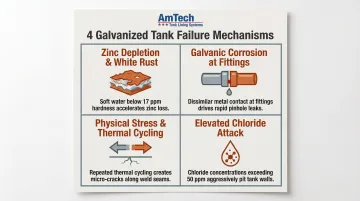
Zinc depletion and white rust — Soft water (less than 17 ppm hardness) prevents protective zinc carbonate scale from forming, accelerating zinc loss. White rust—a porous, chalky zinc hydroxide deposit—is an early warning signal of active corrosion, particularly on newly installed tanks with high pH water.
Galvanic corrosion at fittings — Where dissimilar metals meet (brass or stainless fittings against galvanized steel), a galvanic cell forms in the conductive water. Zinc, being highly anodic (more reactive), corrodes rapidly to protect the fitting. This accelerated attack concentrates at joint interfaces, producing pinhole leaks and premature fitting failures.
Physical stress and thermal cycling — Tanks expand and contract continuously from temperature swings, solar heating, wind deflection, and fill-drain cycles. These movements create micro-cracks in the zinc coating; once steel is exposed, those cracks propagate into visible fractures over years of service.
Elevated chloride levels — Above 50 ppm in soft water, chlorides are particularly aggressive to zinc. Hard water tolerates concentrations up to 700 ppm with minimal damage due to protective scaling, but soft water with elevated chlorides dramatically shortens coating life.
Cost Impact of Ignored Failures
Deferring galvanized tank maintenance carries steep financial consequences. The American Society of Civil Engineers reports that water utility maintenance costs reached $50.2 billion above capital in 2017, with 47% of that work being reactive run-to-failure repairs.
Emergency replacements cost 3–5 times more than planned rehabilitation. They also extend operational downtime, trigger regulatory violations, and generate boil-water advisories that erode public trust — consequences that planned maintenance avoids entirely.
Common Signs Your Galvanized Tank Has a Problem
Most galvanized tank failures follow predictable patterns. Catching them early avoids emergency replacements—and the downtime that comes with them.
Visual Warning Signs
Zinc coating failure signals that the zinc coating has broken down and base metal corrosion has begun. White rust appears as a chalky, waxy deposit; red-brown rust indicates the steel substrate is actively corroding.
Active seam or pinhole leak are often the first visible evidence of a pinhole or seam crack. Check for moisture accumulation during dry weather—if water appears without rain, you have a leak.
Internal corrosion contamination indicates internal corrosion is contaminating stored water. Rusty water suggests advanced iron oxide formation; metallic taste points to dissolved zinc or iron.
Hidden slow leak suggest a slow leak that hasn't yet produced exterior evidence. Monitor water levels over 24–48 hours when the system is static to detect gradual losses.
Professional Inspection Methods
Visual checks catch obvious problems, but ultrasonic thickness (UT) testing is the industry standard for quantifying metal loss and remaining service life. UT gauges measure wall thickness at systematic grid points across the tank shell. By subtracting pit depth from the measured thickness, inspectors calculate net membrane thickness—the key metric for determining whether the tank can still safely hold pressure.
Those measurements then inform how often your tank needs a formal inspection. The two governing standards differ on frequency:
- AWWA M42: Drain and internally inspect at least every 3 years
- API 653: External inspections every 5 years; internal inspections starting at 10 years, then up to 20-year intervals based on corrosion rates and risk-based inspection methodology
For large municipal and industrial tanks, Phased Array Ultrasonic Testing (PAUT) provides broader surface coverage and finer resolution than traditional straight-beam methods, making it well-suited for full corrosion mapping across complex shell geometries.
How to Fix Cracks and Leaks in a Galvanized Water Tank
Critical prerequisite: Attempting to repair a galvanized tank without complete drainage, proper surface preparation, and compatible repair materials will result in short-lived patches or water recontamination. The following steps apply only to tanks with localized, repairable damage—not widespread structural corrosion.
Step 1: Drain and Access the Damaged Area
Completely drain the tank and allow it to dry thoroughly. Wet or damp surfaces prevent repair compounds from bonding effectively. Use a wet-dry vacuum to remove residual moisture from low spots and seams. Mark all visible crack locations and pinhole sites with permanent marker or chalk before beginning surface work—damage is easier to see when wet, harder to locate once dry.
Step 2: Prepare the Surface
Using a wire brush, angle grinder with wire wheel, or abrasive file, remove all rust, white zinc oxide deposits, flaking metal, and contaminants from the repair area. The goal is clean, bare metal—dull gray steel with no coating residue. Degrease the area with an appropriate solvent cleaner (acetone or denatured alcohol work well for small patches).
CRITICAL SAFETY WARNING: Do NOT attempt to repair galvanized steel by welding without first completely removing the zinc coating from the entire weld zone. Heating galvanized steel vaporizes the zinc into toxic zinc oxide fumes, which cause Metal Fume Fever—an acute allergic condition with flu-like symptoms lasting 24-48 hours. OSHA and AWS mandate local exhaust ventilation or supplied-air respiratory protection when welding zinc-coated materials in confined spaces. For most water tank repairs, cold-bonding or epoxy methods are safer and preferred.
For potable water tanks, ensure any surface prep chemicals are safe for drinking water contact or can be completely removed and neutralized before repair material application.
Step 3: Apply the Repair Compound
For small cracks and pinholes (less than 1/4 inch diameter):
Use a two-part epoxy putty or an NSF/ANSI 61-certified repair compound rated for potable water. Mix per manufacturer instructions, then press firmly into the crack—work the compound into the void to eliminate air pockets. Smooth the surface flush with the tank wall.
For larger cracks or areas of significant metal loss:
A cold-bonded metal patch provides a more durable repair. Follow these steps:
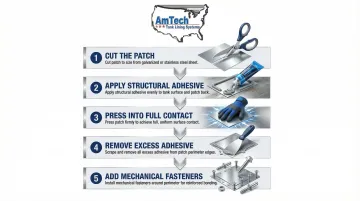
- Cut a patch from galvanized or stainless steel sheet slightly larger than the damaged area.
- Apply structural adhesive (rated for metal-to-metal bonding) to both the tank surface and the back of the patch.
- Press the patch into place, ensuring full contact across the entire surface.
- Remove excess adhesive from the edges with a putty knife.
- For added strength, add mechanical fasteners (rivets or bolts) around the patch perimeter.
NSF compliance for potable water: NSF/ANSI 61 is mandatory in 48 US states for any material contacting drinking water. Using non-certified materials can contaminate the water supply and violate local health codes. Always verify NSF 61 listing before purchase.
Step 4: Allow Full Cure, Then Test
Follow the manufacturer's stated cure time before refilling. Most epoxy putties reach full strength in 4-24 hours; structural adhesives may need 48-72 hours. Cool or humid conditions extend cure time—don't rush this step.
Once cured, slowly refill the tank to operating level and inspect all repair areas for seepage. Monitor for 24-72 hours. Persistent weeping typically means the compound failed to bond to a corroded substrate—at that point, the damage is likely too extensive for surface patching and professional assessment is warranted.
Professional Relining for Long-Term Protection
When localized patches aren't enough—or when a tank shows widespread corrosion—professional relining is the more cost-effective long-term solution. AmTech Tank Lining & Repair applies NSF-compliant lining systems that create a continuous, monolithic barrier across the entire interior surface rather than addressing one leak at a time.
Two systems cover most industrial and municipal water tank applications:
- DuraChem® 500 series (100% solids polyurethane/polyurea): Up to 1,965 PSI adhesion strength with flex/elongation properties that handle thermal cycling and structural movement—common failure points for rigid coatings.
- HydraStone Alkrete® (cementitious calcium aluminate): Rated to 900°F; resists the softened water chemistry that accelerates corrosion in unlined steel.
When to Fix vs. When to Replace (or Reline) Your Galvanized Tank
The repair-versus-replacement decision should be based on the extent of corrosion, remaining structural integrity, tank age, and compliance requirements—not just the visible leak size.
Scenario 1: Repair (Isolated Damage)
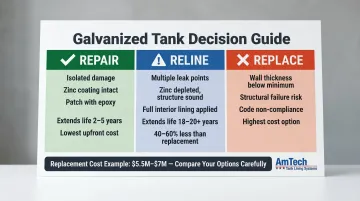
When to patch: The damage is a single pinhole or hairline crack, the zinc coating is intact across most of the tank surface, ultrasonic testing confirms wall thickness is within acceptable limits, and the tank is in early-to-mid service life.
Approach: Targeted patch with NSF 61-compliant epoxy compound. Cost-effective, minimal downtime, extends service life 2-5 years until broader corrosion necessitates relining.
Scenario 2: Reline (Widespread Corrosion)
When to reline: Multiple leak sites, widespread internal corrosion, zinc layer largely depleted, but ultrasonic testing confirms the tank structure is still sound with adequate wall thickness.
Approach: Full-surface internal relining addresses the root cause (exposed base metal), not just symptoms. Industry data consistently shows relining costs 40-60% less than full replacement. For a 1.5 million gallon steel tank, replacement runs $5.5M–$7.0M — making relining the more cost-effective choice when the shell is structurally sound.
Professional relining systems extend service life by 18–20+ years and restore full operational integrity. Common options include:
- Cementitious linings (applied at 5/8 inch minimum thickness)
- Ultra-high solids epoxies (20–25 mils DFT)
- Proprietary polylining systems formulated for potable water or chemical service
Scenario 3: Replace (Structural Failure)
When to replace: Ultrasonic testing confirms wall thickness has fallen below minimum required thickness for the tank's design pressure and diameter, structural seams or base plates are compromised, or the tank no longer meets current code requirements (such as seismic standards or capacity regulations).
Approach: Replacement is the only safe option. API 653 Section 6 establishes minimum thickness requirements based on tank diameter, design pressure, and material properties. Tanks below these thresholds cannot be safely repaired or relined and must be decommissioned.
Scenario 4: Call a Professional Immediately
When professional assessment is mandatory:
- Any signs of internal water contamination (discoloration, odor, metallic taste)
- Cracks near high-stress points (seams, inlet/outlet fittings, structural supports)
- Tank serves potable water and must maintain NSF/ANSI 61 or local health department compliance
- Tank supports fire suppression systems subject to NFPA inspection requirements
- Multiple previous repairs have failed
These scenarios require engineering assessment and potentially comprehensive testing (UT thickness mapping, hydrostatic pressure testing, water quality analysis) before any repair work proceeds.
Preventing Future Cracks and Leaks in Galvanized Water Tanks
Establish a Regular Inspection Schedule
Inspect tanks annually at minimum—more frequently in aggressive water chemistry environments. Inspections should cover:
- External surfaces for rust staining, white powder, and coating degradation
- Interior surfaces for coating condition, pitting depth, and corrosion patterns
- All fittings and connections for galvanic corrosion signs
- Seams and welds for crack initiation
Document findings with photos and measurements. Trending data over multiple inspections reveals deterioration patterns before failures occur.
Control Aggressive Water Chemistry
Water chemistry is the primary driver of zinc depletion. Research shows zinc corrosion is minimized when pH stays between 6.5 and 8.5, hardness exceeds 60 ppm (calcium carbonate), and chlorides remain below 50 ppm in soft water systems.
Particularly damaging conditions:
- Soft water below 17 ppm hardness (prevents protective scale formation)
- pH below 5.5 or above 12 (accelerates zinc dissolution)
- Chlorides above 50 ppm in soft water (highly aggressive to zinc)
- High dissolved oxygen from aeration (accelerates oxidation)
Monitor water chemistry quarterly. When any parameter drifts outside those thresholds, address it through pH adjustment or hardness stabilization before accelerated zinc loss sets in.
Apply Protective Lining as a Preventive Investment
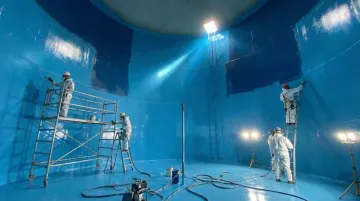
Applying an internal lining before significant zinc loss occurs is the industry-standard long-term strategy for commercial and municipal water systems. AWWA D102-24 defines specific Interior Coating Systems (ICS) for steel tanks—ICS #3 (1-coat ultra-high solids epoxy, 20 mils DFT) and ICS #4 (elastomeric polyurethane, 25 mils DFT)—that deliver 18–20+ years of service life.
Preventive relining eliminates the ongoing repair cycle, protects water quality, and extends total tank service life to 75+ years. Properly maintained welded steel tanks built 75–100 years ago are still in service today—the steel structure outlasts any individual coating system when the maintenance is proactive, not reactive.
Document and Track Maintenance History
Maintain a detailed maintenance log with:
- Inspection dates and findings (photos, UT measurements, corrosion maps)
- Repair history (materials used, locations, dates)
- Water quality test results
- Coating condition assessments
A complete maintenance record also gives regulatory agencies the documented evidence they need—and gives your team a clear picture of when the next major intervention is likely to be required.
Frequently Asked Questions
Can you repair a galvanized water tank?
Yes. Small cracks and pinholes can be addressed with NSF/ANSI 61-compliant epoxy compounds; widespread corrosion typically calls for professional relining. Either approach is viable when ultrasonic testing confirms adequate wall thickness and structural integrity.
Can you weld a galvanized water tank?
Welding galvanized steel is technically possible but dangerous without proper precautions. Heating the zinc coating releases toxic zinc oxide fumes that cause Metal Fume Fever. The zinc must be completely removed from the weld zone first, and local exhaust ventilation or supplied-air respirators are required. For most water tank repairs, cold-bonding or epoxy methods are safer and preferred.
What repair materials are safe to use on a galvanized water tank used for drinking water?
Any repair compound used inside a potable water tank must carry NSF/ANSI 61 certification, meaning it has been tested and approved for contact with drinking water without leaching harmful chemicals. Using non-certified materials can contaminate the water supply and violate local health codes.
How long does a galvanized water tank typically last?
Galvanized water tanks generally last 20-40 years, depending on water chemistry, operating conditions, and maintenance history. Hot-dip galvanizing offers 35-40 years of protection in favorable conditions, though immersion life varies with pH, hardness, and chloride levels. Internal relining can add another 20-40 years of service.
What is the difference between patching a galvanized tank and relining it?
Patching addresses a specific leak point but leaves the rest of the tank's interior exposed to ongoing corrosion. Relining applies a continuous protective coating across the entire interior surface, stopping corrosion at every location rather than treating a single failure point.
How do I know if my galvanized water tank needs professional repair vs. DIY?
DIY patching is reasonable for small, isolated pinholes in non-potable tanks with no regulatory requirements. Professional assessment is required when:
- Corrosion is widespread or structural integrity is in question
- The tank holds drinking water subject to NSF/ANSI 61 compliance
- Previous DIY repairs have failed
Municipal and fire suppression tanks always require professional engineering oversight.