Most hot water heater tank problems follow predictable patterns: sediment accumulation, internal corrosion, component wear, and neglected maintenance. The difference between a simple repair and a costly replacement often comes down to catching problems early and applying the correct fix.
This article covers the most common hot water heater tank problems, their root causes, a step-by-step diagnostic and repair process, and a clear framework for deciding when to fix versus when to replace.
Key Takeaways
- Common symptoms—insufficient heat, noisy operation, discolored water, and leaks—typically trace back to sediment buildup, anode rod failure, or worn components
- Catch most issues early and they're repairable; left unchecked, internal corrosion advances to the point where professional relining or full replacement is the only viable path
- A structured diagnostic process prevents repeat failures and unnecessary part replacement
- Tanks older than 10–15 years with recurring problems are better candidates for replacement than continued piecemeal repair
- Regular maintenance—annual flushing, anode rod inspection, valve testing—is the most cost-effective way to extend service life
Common Problems With Hot Water Heater Tanks
Most tank failures present in predictable ways. Recognizing the symptom pattern is the first step toward an accurate diagnosis.
Problem 1: No Hot Water or Insufficient Hot Water
Symptoms:
- Cold or lukewarm output
- Hot water running out faster than usual
- Inconsistent temperature across fixtures
Likely Causes:
On electric units, the culprit is typically a failed heating element or a tripped high-temperature limit switch. On gas units, look for pilot light failure, a clogged burner or inlet air screen, or thermopile issues.
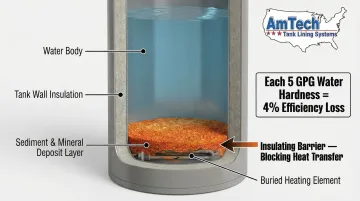
Sediment accumulation commonly plays a role. Mineral deposits coating the heating element or burner create an insulating barrier that prevents efficient heat transfer to the water. Research shows that each 5 grains per gallon of water hardness causes a 4% efficiency loss in gas storage tank water heaters, directly impacting hot water production.
Problem 2: Tank Leaking
Symptoms:
- Pooling water around the base or top of the unit
- Drips from valves or pipe connections
- Water streaking down the tank exterior
Likely Causes:
The leak location points to the likely cause:
- Top leaks: Loose inlet/outlet connections
- Base leaks: Failing drain valve
- Valve discharge: Activated or faulty temperature-and-pressure (T&P) relief valve
- Body leaks: Internal corrosion that has breached the tank wall
Internal corrosion that permeates the outer steel wall represents the most serious scenario and typically requires replacement or professional relining.
Problem 3: Rusty or Discolored Water
Symptoms:
- Brown, red, or yellow-tinted hot water from taps
- Foul or sulfur-like odor from hot water
- Staining on fixtures or laundry
Likely Causes:
A depleted or failed anode rod is the primary suspect. Once the sacrificial anode can no longer protect the tank interior from oxidation, the steel tank itself begins to corrode.
Two secondary causes are also worth evaluating:
- Advanced internal corrosion — when tank wall degradation progresses beyond the anode rod's protective capacity
- Bacterial growth — in tanks where water is stored at lower temperatures, bacterial colonies can produce both discoloration and odor
Problem 4: Noisy Tank Operation
Symptoms:
- Rumbling, popping, banging, or hissing sounds during heating cycles
- Sounds that intensify over time
Likely Causes:
Sediment accumulating at the tank bottom causes water to boil beneath the layer, creating pressure-release pops and rumbles. This ongoing sediment buildup accelerates tank wear and reduces efficiency. Just 0.06 inches of lime scale can reduce heat transfer efficiency by 11%, forcing the system to work harder and creating the characteristic noises.
Problem 5: Water Overheating
Symptoms:
- Scalding hot water from taps
- T&P relief valve discharging frequently
- Water temperature well above the set point
Likely Causes:
A stuck or malfunctioning thermostat set too high or failing to cycle off is the most common cause. On gas units, a stuck-open gas valve or a "stacking" condition from back-to-back usage cycles can drive temperatures dangerously high.
A repeatedly discharging T&P valve requires immediate attention. Persistent activation signals that the tank is producing excessive temperature or pressure — conditions that can result in tank rupture, scalding, or a pressure relief failure if the valve itself becomes damaged.
Why Hot Water Heater Tanks Fail
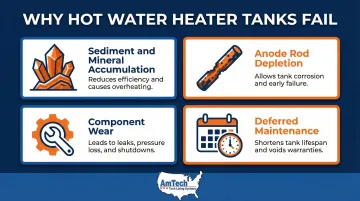
Most tank failures share common root conditions. Problems rarely emerge overnight; they build over months or years from a combination of operational stress and deferred maintenance.
The Four Primary Failure Drivers
Sediment and Mineral Accumulation
Hard water affects the majority of the U.S., and calcium carbonate deposits are inversely soluble—meaning they precipitate more as temperature increases. When hard water is heated in a storage tank, solid deposits form and sink to the bottom, creating an insulating barrier between the heating source and the water.
This sediment layer forces the system to work harder, causing the bottom of the tank to overheat. Repeated overheating stresses the metal, leading to fatigue, cracks, or leaks that can appear suddenly.
In electric storage water heaters, sediment can eventually bury the bottom heating element, causing it to burn out prematurely.
Anode Rod Depletion
Glass-lined steel tanks rely on sacrificial anode rods to prevent internal corrosion. The anode sacrifices its own electrons to protect exposed steel at pipe connections, weld areas, and microscopic imperfections in the glass lining.
Once the anode is consumed, the tank itself begins to corrode. In extremely soft or artificially softened water, tank lifetimes can be reduced by 50% or more due to accelerated anode decomposition. Water softeners exchange calcium for sodium, increasing water conductivity and sharply accelerating anode consumption.
Component Wear and Deferred Maintenance
Thermostats, heating elements, valves, and connections experience years of thermal cycling and water chemistry exposure. When routine tasks go unaddressed—annual flushes skipped, anode rods left unchecked, early warning signs ignored—those gradual component failures compound into tank-threatening damage.
Consequences of Ignoring Early Signs
- Consumes more energy as sediment forces the system to work harder to maintain temperature
- Causes facility damage and business interruption when leaks go uncontrolled
- Produces rusty or discolored water that affects operations and raises health concerns
- Creates compliance risk and lost productivity in commercial and industrial settings
How to Fix Common Hot Water Heater Tank Problems (Step-by-Step)
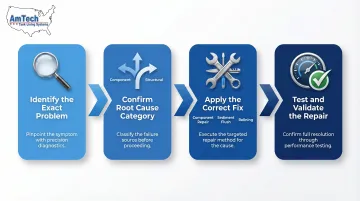
Attempting a fix without confirming the root cause leads to unnecessary part replacement, recurring failures, and serious safety risk if the tank is structurally compromised. This four-step process ensures the right fix is applied the first time.
Step 1: Identify the Exact Problem
Document visible symptoms:
- Location of leaks
- Color and odor of water
- Type and timing of noises
- Temperature output versus set point
Check system status:
- Tripped circuit breakers
- Pilot light status (gas units)
- Error codes (modern digital units)
- T&P valve discharge
Note when the problem occurs:
Timing often points directly to the failure mode—does it happen at startup, during the heating cycle, under high-demand conditions, or continuously?
Step 2: Confirm the Root Cause Category
Distinguish between a component failure (thermostat, element, valve, anode rod) and a structural/tank integrity issue (corrosion, cracking). The repair path diverges completely depending on this determination.
Before committing to a repair path, rule out external factors:
- Water supply pressure (high pressure above 80 psi stresses valves)
- Incoming water quality and hardness
- Usage pattern changes
Step 3: Apply the Correct Fix Based on the Confirmed Problem
For Component Failures:
Thermostats, heating elements, T&P valves, and anode rods are serviceable repairs:
- Shut off power and water supply
- Drain to the appropriate level
- Remove and replace the failed component using manufacturer-matched parts
- Apply Teflon tape on threaded connections
- Test for leaks before restoring power
For Sediment Buildup:
Flush the tank completely:
- Shut off power/gas and water supply
- Connect a hose to the drain valve
- Open the T&P valve to allow airflow
- Drain fully until water runs clear
Severely silted tanks in commercial settings may require professional sediment removal.
For Internal Tank Corrosion:
This is the critical decision point. Minor internal corrosion can be addressed through professional tank relining using cementitious or epoxy lining systems. NSF/ANSI 61-compliant cementitious linings — such as HydraStone Alkrete®, applied by specialist contractors like AmTech Tank Lining & Repair — restore tank integrity and can extend service life by decades, often at significantly lower cost than full replacement.
For T&P Valve Issues or High Water Pressure:
Replace the valve if it fails the lift-and-release test. Install a pressure-reducing valve or thermal expansion tank if system pressure is the underlying driver.
Step 4: Test and Validate the Repair
- Restore power/gas and water supply
- Allow the tank to reach full operating temperature before drawing water
- Verify temperature output matches the set point
- Check all connections and replaced components for leaks
- Confirm no recurrence of noises or discoloration over the following days
Document the repair, parts replaced, and date—especially important in commercial and institutional settings for maintenance records and warranty compliance.
When to Fix vs Replace Your Hot Water Heater Tank
Three factors drive the fix-vs-replace decision: repair cost relative to tank value, remaining useful life, and the risk of repeat failure or safety compromise. The scenarios below map each situation to the right call.
Scenario 1: Single Failed Component in a Tank Under 10 Years Old
Fix: Replace the specific component (thermostat, heating element, anode rod, drain valve, T&P valve). Repair cost is typically a fraction of replacement and the tank has meaningful life remaining.
Scenario 2: Sediment Buildup With No Structural Damage
Fix: Annual flushing and, if needed, a professional flush service. If the tank has not been maintained and sediment is severe, assess whether the heating surface or tank walls show erosion damage before committing to the flush alone.
Replace: If inspection reveals the tank floor has thinned or pitted from sediment-accelerated corrosion.
Scenario 3: Internal Corrosion With Structurally Intact Tank
Fix (via relining): Tanks with internal corrosion but no through-wall breach are candidates for professional relining. A structural lining system applied to the interior surface stops corrosion progression, restores water quality, and can extend service life by a decade or more.
This option is especially cost-effective for large commercial and industrial tanks where replacement involves significant capital expenditure and downtime. Relining a commercial tank can cost roughly 60% of full replacement. In municipal applications, overcoating water storage tanks has saved facilities over $1 million compared to full rehabilitation.
Replace: If corrosion has compromised the tank wall or the unit is already near end of life.
Scenario 4: Tank Wall Breach, Severe External Rust, or Unit Over 10–15 Years Old
When relining is no longer viable — due to a wall breach, severe external rust, or a unit already past its service window — replacement is the only safe path forward.
Replace: A tank leaking from its body (sides or bottom) due to structural corrosion cannot be safely patched. Industry guidance follows the "50% Rule": if repair cost exceeds 50% of replacement cost and your unit is out of warranty or over 10 years old, replace it.
Consider upgrading to a more energy-efficient or appropriately sized unit.
Preventive Maintenance to Extend Hot Water Heater Tank Life
Most of the problems covered in this article are preventable. Tanks that fail prematurely almost always share a history of deferred or absent maintenance.
Key Preventive Actions
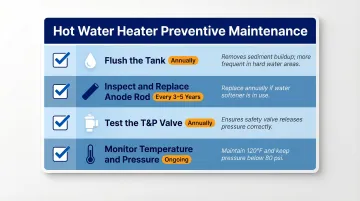
Four maintenance tasks do most of the heavy lifting:
- Flush the tank annually to remove sediment — more often in hard water areas. This prevents bottom-element burial, maintains heat transfer efficiency, and reduces localized overheating risk.
- Inspect and replace the anode rod every 3–5 years. Facilities with water softeners should inspect annually — increased water conductivity accelerates anode consumption.
- Test the T&P valve annually. Lift the lever to confirm the waterways are clear and the mechanism moves freely. Mineral deposits can cause the valve to stick, leaving it inoperative during an over-pressurization event.
- Monitor temperature and pressure. Keep water temperature at the 120°F standard set point and pressure below 80 psi. In commercial and industrial settings, also track incoming water quality — particularly where chemistry fluctuates by season or source.
Professional Inspection for Commercial and Industrial Tanks
For commercial, municipal, or industrial hot water tanks, schedule periodic professional inspections that include interior assessment for corrosion and lining integrity. The CDC and ASHRAE recommend storing hot water above 140°F to prevent Legionella growth, but water at 140°F causes third-degree burns in just 5 seconds.
Managing that temperature tension — alongside corrosion, sediment, and pressure demands — is where professional intervention pays off. AmTech Tank Lining & Repair provides interior tank inspection, structural restoration, and protective lining services for large-capacity commercial and industrial tanks. These services can extend a tank's service life by 20+ years, avoiding full replacement costs while keeping the system in regulatory compliance.
Frequently Asked Questions
What is the life expectancy of a hot water heater tank?
Most residential tank water heaters last 8–12 years on average. Commercial and industrial tanks vary by size, usage, water quality, and maintenance history, with typical lifespans ranging from 8 to 20 years. Tanks with proper maintenance and protective lining systems can significantly exceed this range.
Can a hot water heater tank be repaired?
Yes. Component failures, sediment buildup, and minor internal corrosion are all repairable in most cases. Tanks with structural breaches or through-wall corrosion typically require replacement — though internal relining is often a cost-effective alternative for commercial and industrial tanks, avoiding full replacement costs.
What causes a hot water tank to stop working?
Common causes fall into two categories:
- Sudden stoppages: tripped circuit breaker, failed heating element (electric), or pilot light/ignition failure (gas)
- Gradual performance loss: thermostat malfunction or sediment insulating the heating surface
Component failures drive most sudden outages; sediment buildup is the leading cause of gradual decline.
What is usually the most common water heater problem?
Sediment buildup is the most frequently cited cause of water heater inefficiency and failure. It insulates the heating surface, creates noisy operation, and accelerates internal corrosion. Annual flushing is the most effective preventive measure to combat sediment accumulation.
How do I know if my water heater tank has internal corrosion?
Watch for these warning signs:
- Rust-colored or discolored hot water
- Metallic taste or sulfur odor
- Visible rust staining on the tank exterior
- Water pooling at the base
Visual symptoms indicate a problem, but professional interior inspection — using ultrasonic testing (NDT) or camera assessment — is the only reliable way to confirm the extent of corrosion. AmTech's field crews use ultrasonic NDT testing to assess tank wall integrity without full tank entry.