Introduction
Fire suppression tanks sit idle for months or years, then must perform without hesitation when it matters most. That combination — indefinite static water hold, zero tolerance for failure, and strict compliance scrutiny — makes lining selection far more consequential than it would be for a regularly cycled process tank.
Unlike active service tanks, fire suppression systems can go years between inspections, which means a lining failure may go undetected until an AHJ inspection or, worse, an actual fire event.
Both polyurea and epoxy are proven in industrial tank lining. The problem is that they perform very differently under fire suppression conditions, and choosing the wrong one based on general coating knowledge can result in premature delamination, compliance rejection by the authority having jurisdiction (AHJ), or costly downtime during an emergency reline.
This guide breaks down both materials specifically for fire suppression tank service — covering cure behavior, compliance documentation, substrate compatibility, and the decision factors that determine which system belongs on your tank.
Key Takeaways
- Return to service: Polyurea cures in seconds to minutes — tanks can typically return to service within hours
- Compliance track record: 100% solids epoxy holds the broadest NSF/ANSI 61 listing base and is most widely accepted by AHJs
- Substrate condition drives the choice: Polyurea's high elongation handles cracked or aged steel; epoxy performs best on sound, well-prepared substrates
- Surface prep standard: SSPC-SP 10 near-white blast is required for immersion service regardless of which system is specified
- NSF/ANSI 61 compliance: Not always legally required for non-potable fire water, but many AHJs mandate it — confirm with your AHJ before specifying
Polyurea vs. Epoxy: Quick Comparison
| Factor | Polyurea | 100% Solids Epoxy |
|---|---|---|
| Cure time | Seconds to minutes | 8–24 hrs between coats |
| Return to service | Hours | Several days |
| NSF/ANSI 61 listings | Available; fewer options | Broad selection widely accepted |
| Elongation | 300–400%+ | Low; rigid film |
| Crack bridging | Strong | Poor unless glass-flake specified |
| Service life (water immersion) | >15 years (water tank data) | 15–20 years conservative; some systems approach 30 years |
| Upfront cost | Higher (plural-component rig) | Lower material and applicator cost |
| Applicator availability | Specialized equipment required | Wider applicator base |
The sections below break down what these differences mean in practice for fire suppression tank projects.
Cure Time & Return to Service
Polyurea's fast cure is its biggest practical advantage. Applied via heated plural-component spray equipment, it reaches handling strength in seconds and full cure within hours. A tank that went offline for surface preparation can often return to service the same day or the next morning.
Epoxy runs on a completely different timeline. Multi-coat systems need 8–24 hours between coats, then a full immersion cure period before the tank returns to service. For most fire suppression tank projects, total downtime runs several days to a week.
NSF/ANSI 61 & Compliance
NSF/ANSI 61 establishes minimum health-effects requirements for drinking water system components — technically a drinking water standard, not a fire water mandate. Many U.S. AHJs still require NSF/ANSI 61 documentation for any water storage tank lining, regardless of service classification.
Epoxy has the deeper product listing base here. Systems like Sherwin-Williams DuraPlate 6000 appear on NSF's certified tank coatings registry, and 100% solids epoxy formulations are the established default for AHJ-compliant fire water tank lining. Certified polyurea systems exist but are less common; confirm specific product listings before specifying.
What Is Polyurea Tank Lining?
Pure polyurea forms through the reaction of a polyisocyanate component and an amine-terminated resin blend. The reaction is fast, exothermic, and moisture-insensitive, which is why it's applied via heated high-pressure plural-component spray equipment rather than brush or roller. The result is a 100% solids, zero-VOC seamless membrane with no solvent off-gassing in enclosed tank spaces.
Key Performance Characteristics for Fire Suppression Service
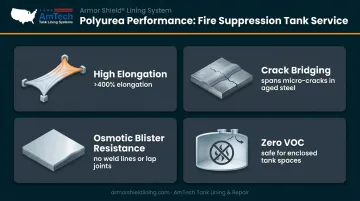
- High elongation: Products like AquaVers 405 report >400% elongation, allowing the film to stretch with substrate movement rather than crack
- Crack bridging: Bridges minor surface irregularities and micro-cracks in aged steel without film failure
- Osmotic blister resistance: Seamless application with no weld lines or laps reduces initiation points for blistering under static immersion
- Zero VOC: No solvent evaporation, safe for enclosed tank environments during and after application
Pure Polyurea vs. Hybrid Systems
This distinction matters for immersion service. Pure polyurea uses only amine-terminated resin components. Hybrid polyurea-polyurethane systems may incorporate hydroxyl-terminated resins, which can improve pot life and adhesion but often reduce elongation and chemical resistance.
When specifying for fire water immersion, confirm whether the product is pure polyurea or a hybrid. They are not interchangeable in performance.
That specification decision requires both product knowledge and compliance context. AmTech's DuraChem 500 series is a proprietary 100% solids poly lining system engineered for immersion service, and their NFPA membership positions field crews to navigate the documentation and system selection that fire suppression tanks require.
There is a practical constraint worth noting: plural-component heated spray rigs are not standard equipment for all coating contractors. Not every lining contractor can apply polyurea systems, which affects both contractor selection and project scheduling.
When Polyurea Is the Right Call
Polyurea is the stronger candidate when:
- The tank substrate has existing micro-cracking or surface irregularities that a rigid epoxy film would bridge poorly
- The facility needs the fastest possible return to fire service
- Thermal cycling or structural movement is a known factor for the tank
- The AHJ accepts polyurea-class systems with appropriate documentation
What Is Epoxy Tank Lining?
Epoxy lining is a two-part thermosetting system (resin plus hardener) that crosslinks into a hard, chemically resistant film. For fire suppression tank service, only 100% solids (solvent-free) formulations are appropriate.
Solvent-containing epoxies shrink during cure, leave VOCs trapped in enclosed spaces, and underperform in continuous immersion. Products like Carboline Plasite 4500 — a solvent-free system with 100% ±2% volume solids designed for water-treatment immersion — represent the appropriate class of material.
Compliance Strength
Epoxy's primary advantage in fire suppression tank work is compliance documentation. A wide selection of 100% solids epoxy products carries NSF/ANSI 61 tank coating listings, and these systems are the default specification accepted by most AHJs in the U.S. For project engineers and facility managers who need a straightforward compliance path, epoxy typically offers the least friction.
AWWA D102-related guidance supports 15–20 years as a conservative service life planning range for 100% solids epoxy interior systems in steel water storage tanks, with some high-performance systems reported to approach 30 years under controlled conditions.
Glass-Flake Epoxy for Challenging Water Chemistry
Standard epoxy performs well with municipal water sources. For tanks filled from high-chloride borehole water, coastal supplies, or reclaimed water, glass-flake epoxy provides notably stronger protection. The glass platelets create a tortuous diffusion path that slows moisture ingress, extending service life in chemically aggressive environments. Sherwin-Williams Sher-Glass FF and Carboline Phenoline 1205 are examples of glass-flake-filled systems formulated for this purpose.
Epoxy's Key Limitation
Epoxy forms a rigid, relatively brittle film. Under thermal cycling or minor tank movement, that rigidity becomes a liability — small cracks initiate at stress points, and once water reaches the steel substrate, blistering spreads rapidly.
Preventing that failure path requires strict controls at both ends of the project — before the coating goes on and before the tank returns to service:
- Surface prep: SSPC-SP 10 near-white blast with a minimum 3 mil anchor profile (per Carboline Plasite 4500 specs)
- Chloride threshold: ≤3 µg/cm² — the limit U.S. Navy immersion service specs set before coating application, and a benchmark worth carrying into fire suppression work
- Holiday detection: 100% low-voltage wet sponge testing per NACE SP0188 to catch pinholes and discontinuities before the tank goes back into service
Which Is Right for Your Fire Suppression Tank?
No single material wins across all fire suppression tank scenarios. Five factors drive the decision:
| Decision Factor | Points Toward Polyurea | Points Toward Epoxy |
|---|---|---|
| Substrate condition | Cracked, aged, or irregular steel | Sound, well-prepared steel |
| AHJ compliance requirement | Polyurea listing accepted | NSF/ANSI 61 explicitly required |
| Water chemistry | Standard municipal supply | High-chloride or aggressive source (glass-flake epoxy) |
| Downtime window | Hours available | Days available |
| Contractor availability | Plural-component applicator accessible | Standard epoxy applicator network |
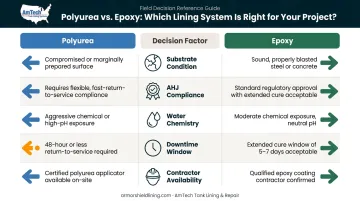
Use those factors as a filter, then match your project to the guidance below.
Choose Polyurea When:
- The steel substrate has micro-cracking, prior coating holidays, or significant age-related surface variation
- Downtime must be measured in hours, not days
- The tank experiences thermal movement or is in a location with significant temperature swings
- The project AHJ accepts polyurea-class system documentation
Choose Epoxy When:
- The AHJ explicitly requires NSF/ANSI 61 certification documentation
- The substrate is in sound condition and blast preparation can achieve SSPC-SP 10
- Project budget favors lower upfront material cost
- A wider pool of qualified applicators is needed for remote locations
The Compliance Grey Area
Fire water is not potable water. NFPA 22 governs water tanks for private fire protection — it is the controlling standard for this application, not NSF/ANSI 61. That said, many U.S. AHJs require NSF/ANSI 61 documentation for any lining that contacts stored water, regardless of service classification. The practical guidance: confirm with the local fire authority before finalizing a specification that lacks NSF/ANSI 61 documentation.
Conclusion
Neither polyurea nor epoxy is the automatic answer for fire suppression tank lining. Polyurea earns its place on aging steel substrates with tight downtime windows and tolerance for movement. Epoxy has the stronger compliance documentation trail and is the lower-risk choice when the AHJ is strict about NSF/ANSI 61 listings.
What's consistent across both: surface preparation quality and correct application execution determine whether the lining performs for its intended service life. A well-specified epoxy on a poorly blasted substrate will fail faster than a polyurea applied correctly to sound steel.
A sound lining specification starts with three things: an engineer-reviewed assessment of the tank's current condition, a confirmed read on the AHJ's documentation requirements, and a contractor with genuine fire suppression tank experience.
AmTech Tank Lining & Repair has been relining fire suppression tanks since the late 1960s, with the credentials to back a specification through AHJ review:
- NFPA membership
- UL listed lining systems
- NLPA Special Inspector on staff for system selection and compliance oversight
Frequently Asked Questions
Which is better for fire water tanks: stainless steel or polyethylene?
Stainless steel offers superior structural strength and is suited to large fire suppression systems, while polyethylene suits smaller, lower-pressure installations. Polyurea vs. epoxy is a steel tank interior question — it doesn't apply to polyethylene construction.
For fire water tank liners, is a 3-layer or 5-layer system better?
More layers generally improve barrier performance, but surface preparation quality and material selection matter more than layer count alone. The system specification — including primer selection, intercoat adhesion, and DFT targets — should be matched to the tank's specific service conditions, not defaulted to a layer count.
How long does a fire water tank liner last?
For 100% solids epoxy in steel water storage tanks, 15–20 years is a realistic planning range, with high-performance systems sometimes reaching 30 years. Polyurea water immersion data points to comparable longevity, though fire-water-specific benchmarks are less documented. Both materials depend heavily on surface preparation and water chemistry.
Does NSF/ANSI 61 certification matter for fire suppression tank linings?
Fire water is technically not potable water, so NSF/ANSI 61 is not automatically legally required. Many U.S. AHJs require it anyway — confirm with the local fire authority before finalizing a lining specification that lacks this certification.
What surface preparation is required before applying polyurea or epoxy to a fire suppression tank?
Both materials require abrasive blast cleaning to at minimum SSPC-SP 6, with SSPC-SP 10 near-white blast the standard for immersion service. Test and control chloride contamination before coating — Navy immersion protocols set the threshold at ≤3 µg/cm², and falling short of that specification is the leading cause of premature failure in both systems.
Can a fire suppression tank be relined without taking the system completely offline?
No. Relining requires the tank to be fully drained, cleaned, blast-prepared, coated, cured, inspected, and refilled before returning to fire service. Facilities where suppression coverage cannot be interrupted should arrange a temporary water supply before work begins.