Introduction
A fire suppression tank inspection is a structured evaluation of the water storage tank feeding your sprinkler or suppression system — covering structural integrity, water supply readiness, and NFPA 25 compliance.
For facility managers, building safety officers, and operations teams at industrial, commercial, municipal, and institutional sites, this inspection is non-negotiable. According to NFPA research on U.S. sprinkler experience, sprinklers operated effectively in 89% of fires large enough to activate them. When systems do fail, inadequate water delivery accounts for roughly 10% of non-operation causes — and an undermaintained tank is a direct contributor.
That risk is preventable. This article walks through what inspectors examine, the violations they most commonly find, and what the repair path looks like from identified deficiency to restored compliance.
Key Takeaways
- NFPA 25 sets inspection frequencies from monthly water level checks to full interior evaluations every 3–5 years
- Each inspection covers the exterior shell, interior surfaces, coatings, water level, temperature, and ancillary components
- The most common findings include interior corrosion, coating failure, sediment accumulation, and structural deterioration
- Deficiencies are classified as noncritical, critical, or impairments under NFPA 25 — each carrying distinct correction timelines
- Tank relining resolves most coating and corrosion deficiencies without the cost or downtime of full replacement
What Is a Fire Suppression Tank Inspection?
A fire suppression tank inspection is a systematic evaluation of the physical condition and operational readiness of a water storage tank supplying a fire sprinkler or suppression system. It covers the tank shell, interior surfaces, coatings, supporting structure, connected components, and water supply adequacy.
Two NFPA standards apply:
- NFPA 22 (2023 edition) — the design, construction, installation, and maintenance standard for private fire protection water tanks and accessories
- NFPA 25 (2026 edition) — the inspection, testing, and maintenance standard for water-based fire protection systems, including water storage tanks
Tank types covered include elevated/gravity tanks, at-grade suction tanks, and pressure tanks.
Who Conducts the Inspection?
Routine exterior checks can be handled by trained facility personnel. Interior inspections and any evaluations following identified deficiencies require a qualified inspector — someone familiar with NFPA 25 Chapter 9 requirements and capable of conducting confined-space assessments and structural evaluations.
Interior tank entry also triggers OSHA obligations. Under 29 CFR 1910.146, tanks qualify as permit-required confined spaces. Before entry, the following are required:
- Written confined-space entry program
- Atmospheric testing (oxygen levels, combustible and toxic gases)
- A designated attendant stationed outside
- Rescue planning and emergency procedures
- Trained, authorized entry personnel
NFPA 25 Inspection Frequencies
NFPA 25 (2026 edition, Chapter 9, Table 9.1.1.2) establishes a tiered schedule based on component type and tank configuration.
| Component | Frequency |
|---|---|
| Water level (no supervised alarm) | Monthly |
| Water level (supervised alarm to attended location) | Quarterly |
| Exterior components (structure, foundation, vents, ladders, catwalks) | Quarterly |
| Exterior coatings/paint | Annually |
| Interior — steel tanks without corrosion protection | Every 3 years |
| Interior — all other types (coated steel, concrete, wood, fabric) | Every 5 years |
| Heating system (no supervised low-temp alarm) | Daily during heating season |
| Heating system (supervised low-temp alarm) | Quarterly during heating season |
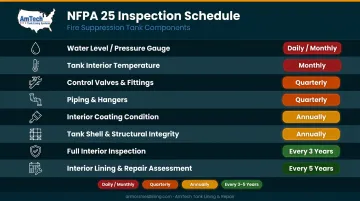
Cold-climate facilities take note: NFPA 25 requires water temperature to stay at or above 40°F — well above the 32°F freezing point. Stagnant water in fire protection systems can freeze at temperatures a standard thermometer won't flag as dangerous.
Freeze damage is also one of the conditions that can trigger an accelerated interior evaluation. When interior pitting, corrosion, or coating failure is found, NFPA 25 requires additional assessment beyond the standard visual inspection. Non-destructive testing — such as ultrasonic wall thickness measurement — is a common method, with the specific approach determined by AHJ requirements and documented in the inspection report.
What Happens During a Fire Suppression Tank Inspection
The inspection follows a logical sequence: exterior components first, then interior evaluation, then documentation. Here's what each phase involves.
Pre-Inspection Preparation
Before the inspector arrives, the facility should:
- Pull prior inspection reports and confirm inspection history
- Clear physical access to all exterior components (debris, ice, vegetation)
- Establish confined-space entry permits and safety protocols if an interior inspection is planned
- Coordinate any required system impairments with the AHJ
Exterior Inspection
A quarterly exterior inspection covers:
- Tank shell condition — looking for visible corrosion, pitting, deformation, or leaks at weld seams and nozzles
- Supporting structure and foundation — cracking, anchor bolt condition, soil erosion near embankment-supported tanks
- Access hatches, vents, catwalks, and ladders — structural integrity and damage
- Exterior coatings — blistering, cracking, or delamination (assessed annually)
- Surrounding area — combustible materials, standing water, or ice buildup near the tank base
- Wooden tanks specifically — condition of hoops, grillage, and expansion joints
Any visible corrosion, paint failure, structural deformation, or active leaks observed externally triggers escalation — either a drained internal inspection or ultrasonic thickness testing on the shell.
Interior Inspection
Interior inspections assess:
- Tank floor, walls, and ceiling for pitting, active corrosion, coating failure, spalling, or rot
- Anti-vortex plate condition and potential blockage
- Heating system and associated piping
- Sediment and debris on the tank floor — silt must be cleared before a meaningful visual assessment is possible
- For tanks on ring-type foundations — evidence of voids beneath the floor
Three methods are used to conduct interior inspections:
- Dry inspection — tank is drained and taken out of service; most thorough but requires system downtime
- Diver inspection — a certified confined-space diver enters with appropriate lighting; avoids draining but adds safety complexity
- ROV inspection — a remotely operated vehicle provides visual coverage without entry; growing in use for facilities that want to avoid both downtime and diver risk
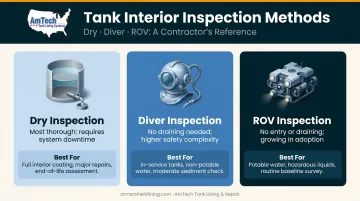
Most facility owners favor ROV or diver inspections to avoid taking the tank offline, though a dry inspection remains the most complete option when coating or structural repairs are planned.
At the close of inspection, the inspector delivers a written report cataloging each item evaluated — deficiencies cited by specific NFPA 25 requirement, supported by photographic evidence. That report determines violation classification, repair urgency, and whether the AHJ must be notified before the system returns to service.
Common Inspection Findings and Violations
Interior Corrosion and Pitting
The most frequently cited finding in steel tanks. Uncoated or inadequately protected steel corrodes from the inside out — general surface rust is common, but deep, localized pitting is the structural concern. Pitting can compromise shell integrity and create leak pathways.
When pitting is found, NFPA 25 requires additional evaluation beyond visual inspection. Ultrasonic wall thickness measurement is the typical next step, confirming whether remaining material meets minimum serviceability thresholds.
Coating and Lining Failures
Interior coatings protect the substrate from corrosion and preserve water quality. When coatings blister, delaminate, or crack, exposed steel degrades rapidly. Inspectors document coating failure through:
- Cross-hatch or pull-off adhesion testing (ASTM D3359-23 / ASTM D4541-22)
- Dry film thickness (DFT) measurement to confirm coating hasn't thinned below specification
- Holiday/spark testing per AMPP SP0188-2024 or ASTM G62, which identifies pinholes and voids where corrosion is already starting
Any area with compromised adhesion or holidays is a deficiency — and widespread failure typically triggers a full relining scope.
Sediment Buildup and Aquatic Growth
Silt, sand, and biological matter accumulate on the tank floor over time. Inspectors document sediment volume, character, and any biological growth present. Citable findings in this category include:
- Sediment depth sufficient to obstruct suction line intake
- Biological growth (algae, biofilm) affecting water quality
- Evidence of anaerobic conditions at the tank floor
Structural and Support Deficiencies
Citable structural findings include:
- Foundation cracking or settlement
- Deteriorating anchor bolts
- Soil voids beneath the tank floor (ring-type foundations)
- Deteriorating wood hoops or grillage on wooden tanks
- Ice accumulation around support structures
Extreme weather events — earthquakes, high winds, flooding — are also triggers for unscheduled structural evaluations, independent of the normal inspection cycle.
Water Level and Temperature Violations
If the water level is below the fill mark at the time of inspection, or if water temperature has dropped below 40°F during the heating season, these are immediate, citable deficiencies under NFPA 25. The system cannot be considered operationally ready until these conditions are corrected, and AHJ notification may be required.
The Repair Path: From Violation to Restored Compliance
How Deficiencies Are Classified
NFPA 25 establishes three deficiency classifications:
- Noncritical deficiency — does not materially impact system performance, but should be corrected
- Critical deficiency — if not corrected, can materially affect the system's ability to function during a fire
- Impairment — the system is out of service and will not function in a fire event
Impairments carry the most urgent obligations. Per NFPA 25 Section 15.5.2(4), the owner must notify the AHJ, fire department, and insurance carrier.
If an impairment exceeds 10 hours in a 24-hour period, a fire watch must be implemented, a temporary water supply provided, or the building evacuated. Correction timelines for lesser deficiencies are determined by the AHJ.
Corrective Action Decision Tree
The inspection report's deficiency list directly drives the repair scope:
- Minor surface corrosion: spot surface prep and recoating
- Widespread interior coating failure: full lining system restoration
- Structural deficiencies: engineering assessment first, then welded repairs, concrete patching, or foundation stabilization before any lining work proceeds
- Water level or temperature issues: operational correction before system returns to service
Not every finding escalates to a full relining project — but coating and corrosion findings typically do.
What a Professional Tank Relining Engagement Looks Like
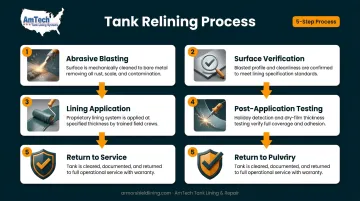
For tanks with interior coating or corrosion deficiencies, the relining process generally follows this sequence:
- Abrasive blasting removes failed coatings, corrosion product, and contaminants to achieve the required surface cleanliness and anchor profile
- Surface verification confirms cleanliness standard and anchor profile before any coating is applied
- Lining application uses a compatible system based on service conditions (epoxy, polyurea, or cementitious)
- Post-application testing includes DFT measurement for thickness, holiday testing (spark or wet sponge) for voids, and adhesion testing per ASTM D3359-23 or D4541-22
- Return to service occurs only after all test results meet specification
AmTech Tank Lining & Repair has performed fire suppression water tank lining and structural repair work for over 55 years. Lining systems include the DuraChem 500 series and the HydraStone Alkrete cementitious system. NLPA Special Inspector Greg Comeau can assess structural condition and oversee lining application under a single engagement, from inspection findings through post-repair testing documentation.
Reinspection and Documentation Closure
Once repairs are complete:
- Post-repair testing records (DFT results, adhesion data, holiday test results) must be documented
- A follow-up inspection should confirm that every deficiency cited in the original report has been resolved
- These records must be retained for AHJ review, insurance audits, and future inspection reference
Facilities that maintain this documentation chain are also better positioned when AHJ requirements or insurance terms change — the records demonstrate a pattern of proactive compliance, not just reactive repair.
Frequently Asked Questions
What should I expect during a fire suppression tank inspection?
The inspector will work through water level verification, exterior structural components, and interior surfaces in sequence, referencing NFPA 25 Chapter 9 requirements throughout. You'll receive a written report documenting each item evaluated, any deficiencies found, and repair recommendations.
How often should fire suppression tanks be inspected?
Water levels are checked monthly or quarterly (depending on alarm supervision), exterior components quarterly, and exterior coatings annually. Interior inspections follow every 3 years for unprotected steel tanks or every 5 years for all other types, per NFPA 25 Chapter 9 Table 9.1.1.2.
What are the most common violations found during a fire suppression tank inspection?
Interior corrosion and coating failure top the list, followed by sediment accumulation, structural deterioration of supports or foundations, and water level or temperature deficiencies. These findings appear across steel, concrete, and wood tank types.
What happens if my fire suppression tank fails inspection?
Deficiencies must be corrected per NFPA 25 timelines established by the AHJ. Impairments that render the system non-operational require immediate action: fire watch implementation and AHJ notification. Less critical findings receive a correction window before reinspection.
Can a fire suppression tank be relined instead of replaced?
In most cases, yes. Professional relining addresses corrosion, pitting, and coating failure while extending service life significantly — provided the tank shell still meets minimum wall thickness requirements. It avoids the cost and downtime of full replacement.
Who is qualified to perform a fire suppression tank interior inspection?
Interior inspections require a qualified professional familiar with NFPA 25: typically a licensed fire protection contractor or a credentialed inspector. Confined-space diver inspections additionally require OSHA 29 CFR 1910.146 compliance and commercial diving certification per ADCI standards.