Introduction
Wooden fire suppression tanks — constructed from Douglas fir, redwood, or other rot-resistant timber staves — are still in active service at industrial plants, older high-rises, municipal facilities, and institutional campuses across the US. Many have performed reliably for decades. But wood is not steel or concrete.
Without active maintenance or a properly applied internal lining, deterioration accelerates in ways that aren't always visible — until a failure forces the issue, a fire suppression system falls out of NFPA 22 compliance, or a full tank replacement becomes the only option left on the table.
This article covers the warning signs that a wooden fire suppression tank needs attention, the step-by-step repair and relining process, how to decide between restoration and full replacement, and the NFPA 22 compliance obligations that govern the entire lifecycle of these tanks.
Key Takeaways
- Wood decay, joint failure, water loss, and lining breakdown are the most common failure patterns in wooden fire suppression tanks
- Relining a structurally sound wooden tank is significantly more cost-effective than full replacement
- Surface preparation and moisture control are the most critical steps before lining application — and the most frequently skipped
- NFPA 22 governs tank design and installation; NFPA 25 covers ongoing inspection, testing, and maintenance
- Professional assessment should precede any repair decision — misdiagnosed repairs fail early and compound costs
What Is a Wooden Fire Suppression Tank and Why Does It Degrade?
Wooden fire suppression tanks are large-capacity water storage vessels built from timber staves — Douglas fir and redwood being the most common species — that supply pressurized water to fire sprinkler and standpipe systems.
They fall under NFPA 22, Standard for Water Tanks for Private Fire Protection, which governs their design, construction, installation, and maintenance.
As a passive component of a fire suppression system, a wooden tank must hold its full rated capacity, maintain structural integrity under emergency demand, and deliver water at required flow and pressure. Its physical condition is a life safety issue, not a routine maintenance concern.
How Wood Degrades Over Time
Unlike steel or concrete, wood degrades through a combination of biological and physical mechanisms:
- Fungal decay — Brown rot removes cellulose, leaving wood brittle and cube-cracked. White rot attacks both cellulose and lignin, producing bleached, spongy material
- Moisture cycling — Wood is hygroscopic; it gains and loses moisture with ambient conditions. These dimensional changes stress stave joints, cause checking, and can distort tank geometry over time
- UV exposure and drying — Exterior staves exposed to sunlight shrink and check, breaking the natural swelling seal that keeps stave joints watertight
- Lining breakdown — Once the internal protective coating fails, raw wood is exposed to continuous water contact, accelerating both biological and physical deterioration
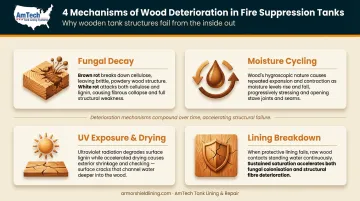
According to USDA Forest Products Laboratory research, serious decay typically begins above the fiber saturation point — averaging 30% moisture content — with optimal fungal growth occurring between 25–30% MC and 21–32°C.
Warning Signs Your Wooden Tank Needs Repair or Relining
Catching deterioration early is the difference between a targeted repair and a forced replacement. During any visual inspection, watch for these indicators.
Visible Wood Decay and Structural Deterioration
- Soft, punky, or spongy surfaces on staves — particularly at or below the waterline
- Brown discoloration with cube-like cracking (brown rot) or bleached, fibrous surfaces (white rot)
- Dark discoloration at stave joints or band attachment points
- Visible fungal fruiting bodies — mushrooms, brackets, or crusts — on interior or exterior surfaces
Surface decay signals deeper wet rot. Don't assess severity by what you can see from the exterior alone.
Water Loss and Joint Failure
Hairline leaks at stave joints, seeping seams, or unexplained drops in water level between fill cycles all indicate that the tank's natural wood-swelling seal has failed. NFPA guidance establishes that water level must be maintained within 4 inches (100 mm) of the required fire protection level. Any measurable loss warrants investigation.
Common causes include:
- Drying and UV shrinkage of wood staves
- Degraded caulking or sealant at joints
- Band-tension loss that allows stave separation
Structural Movement, Warping, and Hoop Failure
- Stave cupping or out-of-round tank geometry
- Loose, corroded, or visibly failed tension bands or hoops
- Any lean or settlement in the tank structure
These signs indicate advanced deterioration. A tank showing structural movement needs professional assessment before relining can even be considered — applying a lining to an out-of-round shell will not fix the underlying problem.
Failed Internal Lining or Biological Fouling
- Peeling, blistering, or delaminating coating on interior surfaces
- Visible biological slime, sediment accumulation, or biofilm deposits (MIC indicators)
- Discolored or odorous water from the tank
When a lining fails, the raw wood substrate is exposed to continuous water contact. Biological fouling compounds the problem by trapping moisture against wood surfaces and accelerating decay.
How to Repair and Reline a Wooden Fire Suppression Tank: Step-by-Step
Relining a wooden tank without first completing proper decay treatment and surface preparation is the single most common reason relining projects fail prematurely. These steps must be followed in sequence.
Step 1: Full Tank Inspection and Structural Assessment
Drain the tank and conduct a confined space entry evaluation under OSHA 29 CFR 1910.146 before anyone enters. Where the interior atmosphere presents hazardous conditions, a full permit-required confined space program applies.
Once entry is authorized, the inspection should document:
- All areas of active rot, noting decay type (brown, white, or soft rot)
- Hoop and band condition and tensioning
- Stave joint integrity and any through-gaps
- Existing lining adhesion and coverage
- Structural geometry — out-of-round or leaning conditions
Use ultrasonic or physical probing to determine decay depth and whether the structural shell remains viable. That finding drives the entire repair-versus-replace decision.
Step 2: Decay Treatment and Structural Repairs
- Treat all affected wood surfaces with an EPA-registered fungicide and wood preservative to arrest active rot
- Confirm the selected product's EPA registration and label use-pattern before applying inside a water-contact tank
- Replace or sister structurally compromised staves
- Re-tension hoop bands to restore round geometry
No surface preparation should begin until structural repairs are complete. Preparing a surface on a tank that still needs band re-tensioning will damage the profile before lining is ever applied.
Step 3: Surface Preparation
- Pressure wash all interior surfaces to remove biological fouling, sediment, and loose or delaminating coating
- Mechanically abrade or sand to achieve the surface profile required by the selected lining system's manufacturer specifications
- Test wood moisture content — lining systems for wood substrates each have specific moisture acceptance thresholds defined in their technical data sheets; applying any lining to wood above the specified threshold is a direct path to early delamination
- Confirm surface cleanliness — biological residue left on the substrate will prevent proper adhesion regardless of how well the mechanical profile is achieved
Moisture content is the step most often skipped or rushed. It cannot be estimated visually — it requires measurement with a calibrated moisture meter.
Step 4: Select the Appropriate Lining System for a Wood Substrate
Not all lining systems are compatible with wood. The right system must be flexible enough to accommodate wood movement, capable of bonding to a porous substrate, and rated for continuous water immersion. Three primary system types are used on wooden fire suppression tanks:
| System Type | Key Properties | Best Fit |
|---|---|---|
| 100% Solids Polyurea/Polyurethane | High flexibility, fast cure, excellent adhesion to prepared wood | Most wood stave applications; accommodates movement |
| Cementitious Lining | Chemical resistance, long-term durability, hard surface | Denser substrates with good structural integrity |
| Fiberglass/FRP | Adds structural reinforcement in addition to watertight lining | Tanks with localized stave weakness needing structural supplement |
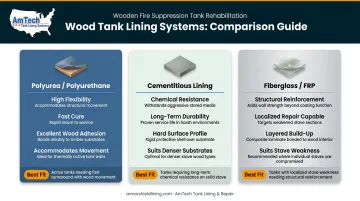
AmTech's portfolio covers all three categories: the DuraChem 500 series 100% solids poly systems, HydraStone Alkrete cementitious lining, and AT BiFlex fiberglass systems. Selection is based on inspection findings, not a default formula — substrate condition and service requirements determine the right fit.
Step 5: Lining Application and Cure
Apply the selected system strictly per manufacturer specifications:
- Correct primer coat(s) and specified intercoat intervals
- Base coat and topcoat applied at specified wet film thickness
- Controlled temperature and humidity during application and cure
Premature filling is a leading cause of lining failure. Cure time is a performance requirement, not a guideline. Filling before full cure voids the work.
Step 6: Post-Installation Testing, Final Inspection, and Return to Service
With cure confirmed, testing and documentation close out the project before return to service:
- Perform holiday (spark) testing on the cured lining where the lining system and substrate configuration allow valid testing per AMPP/NACE standards; confirm methodology with the lining manufacturer for wood substrates
- Record DFT (dry film thickness) readings against specified values per SSPC-PA 2
- Fill the tank slowly and inspect all joints, penetrations, and the base for leaks during initial fill
- Document all findings — lining system used, DFT records, inspection report — to satisfy NFPA 22 maintenance recordkeeping requirements before returning the tank to active service
Repair vs. Replace: How to Make the Right Decision
The repair-versus-replace decision comes down to three factors: depth of structural decay, whether NFPA 22 compliance is achievable through repair, and whether the shell can hold geometry and capacity after restoration.
When Relining Is the Right Choice
Relining makes sense when:
- The core structure is sound — no through-decay on staves, tension bands serviceable, geometry intact
- Decay is localized to surface layers or joint areas
- This is a first or second relining of the tank
- The tank can be returned to full NFPA 22 compliance after repair
Relining avoids the capital cost of new tank fabrication, foundation work, system reconnection, and the downtime of a full replacement project. For a structurally sound shell, it is the economical choice.
When Replacement Is Warranted
Replacement becomes the right answer when:
- Widespread through-thickness stave decay cannot be arrested with treatment
- Multiple hoop bands have failed and cannot be re-tensioned to restore geometry
- The tank has a history of repeated relining failures on the same shell
- The tank can no longer hold required capacity or deliver required flow under emergency demand
Relining a structurally failed shell produces a short-lived result — the investment doesn't extend service life, it defers an inevitable replacement at greater total cost.
Compliance-Driven Replacement
If a wooden tank cannot be brought into full NFPA 22 compliance through repair, replacement is not optional — it is a code obligation.
A formal structural and compliance assessment — conducted by an NFPA-member engineer and a licensed NLPA Special Inspector — gives facility managers a documented, defensible basis for whichever path they take. AmTech provides exactly that, with engineering staff who handle both the evaluation and, where repair is viable, the restoration itself.
NFPA 22 Compliance, Preventive Maintenance, and Common Mistakes
What NFPA 22 and NFPA 25 Require
NFPA 22 governs the design, construction, installation, and maintenance framework for private fire protection water storage tanks, including wooden ones. For the ongoing inspection, testing, and maintenance schedule, NFPA 22 refers to NFPA 25 — the baseline ITM standard for water-based fire protection systems.
NFPA 25 sets inspection frequencies for all critical tank components:
- Structural condition and hoop/band tension
- Interior lining condition
- Water level and heating provisions (where applicable)
- Inlet and outlet fittings
Property owners are responsible for correcting identified deficiencies. A tank out of service due to an unresolved deficiency constitutes a system impairment.
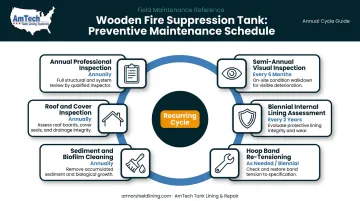
Preventive Maintenance Schedule
The difference between a wooden tank that lasts decades and one that fails prematurely comes down to maintenance consistency. Key activities include:
- Annual professional inspection per NFPA 25 requirements
- Semi-annual visual inspections recommended for wooden tanks, given their biological decay vulnerability
- Biennial internal lining assessment to catch delamination or coating breakdown before water reaches raw wood
- Hoop band re-tensioning as needed to maintain structural geometry
- Sediment and biofilm cleaning to remove biological material before it attacks wood substrates
- Roof framing and cover inspection to prevent water intrusion into the wood structure from above
Common Mistake: Lining Over Wet or Unprepared Wood
Any lining applied without meeting moisture content, surface cleanliness, and profile specifications will delaminate under hydraulic pressure and thermal cycling. This is not a theoretical risk — it is the most frequently observed cause of premature lining failure on wooden tank projects. Moisture content must be measured, not assumed.
Deferring Minor Decay: A Costly Calculation
Early-stage fungal rot and joint deterioration caught at 6–12 months can be treated with preservative and localized stave replacement. The same decay left untreated for 3–5 years often renders the tank beyond economical repair — a full replacement that routine maintenance would have prevented. USDA Forest Products Laboratory research confirms that under favorable conditions, substantial decay in untreated wood specimens can develop in a matter of weeks — the key word being favorable, meaning persistent moisture and oxygen exposure. That describes the interior of a tank with a failed lining.
Frequently Asked Questions
How often should a fire suppression tank be inspected?
NFPA 22 sets the maintenance framework, while NFPA 25 governs the inspection, testing, and maintenance schedule — with some components requiring monthly, quarterly, or semi-annual attention. For wooden tanks specifically, semi-annual visual inspections are advisable in addition to the NFPA-required annual formal assessment, given their biological decay vulnerability.
What is fire suppression tank repair?
Fire suppression repair refers to any corrective work performed on a water storage tank or system component to restore it to code-compliant, operationally reliable condition. For wooden tanks, this ranges from targeted decay treatment and joint resealing to full interior relining.
How long will a wooden fire suppression tank last?
Service life depends almost entirely on whether an internal lining is in place and maintained, and whether regular NFPA-compliant inspections occur. A properly maintained and relined wooden tank can remain in service for many decades; a neglected tank may fail structurally in 15–20 years. Base decisions on current condition at inspection, not calendar age.
What is NFPA 22?
NFPA 22 is the National Fire Protection Association's standard governing the design, construction, installation, and maintenance of water storage tanks used for private fire protection, including wooden gravity tanks. It covers structural requirements, water level and refill specifications, heating provisions, and materials standards.
Can a wooden fire suppression tank be relined instead of replaced?
Yes. A structurally sound wooden tank can be successfully relined using compatible systems such as 100% solids polyurea coatings, cementitious linings, or fiberglass systems, extending service life significantly at a fraction of full replacement cost. Proper decay treatment and surface preparation must be completed first.
What are the warning signs a wooden tank needs immediate repair?
Key red flags include: unexplained water loss between fill cycles, soft or visibly rotted stave surfaces, joint seepage, peeling or blistered interior lining, loose or broken hoop bands, and biological fouling or odorous water. Any of these warrants a professional inspection before the next fire season.