Introduction
When a fire suppression tank goes offline for relining, the clock starts immediately — and it runs expensive. According to NFPA's U.S. Experience with Sprinklers report, sprinkler system shutoff accounts for 59% of all suppression failures in fires large enough to activate sprinklers. That's not a malfunction statistic. It's a planning problem.
Every hour a fire suppression tank sits offline, NFPA 25 impairment protocols are active, fire watch costs are accumulating, and your facility is carrying coverage risk it shouldn't have to. Most of that offline time is optional.
Downtime during tank relining comes down to lining system chemistry, project preparation, and contractor capability. Choose the wrong coating and you're waiting 3–14 days for cure. Choose the right one and you're back online the same day. This article breaks down where time actually gets lost — and what decisions close that gap.
Key Takeaways
- 100% solids instant-cure lining systems cure in minutes, not days — the single biggest lever for reducing tank downtime
- NFPA 25 impairment protocols trigger the moment the tank goes offline, making fire watch a real, billable cost
- Pre-bid inspection eliminates mid-project scope surprises that can stretch a 2-day job to 5 days
- Regulatory coordination, equipment staging, and interim fire protection must be locked in before the tank drains
- Contractor qualifications — certifications, rapid-cure experience, emergency response capability — determine whether schedule gains hold in practice
Why Downtime Accumulates When Relining a Fire Suppression Tank
Relining downtime doesn't show up as a single block on a schedule. It builds across every phase: draining and cleaning, surface preparation, lining application, cure time, inspection, and refill. Each adds time. Most teams focus on the application window — which is actually the shortest part.
Cure Time Is the Dominant Variable
The biggest and most variable phase is almost always cure. Conventional epoxy systems used in immersion service show how severe this can get:
- Tnemec Series 141 (high-solids epoxy): 3-day immersion cure at 75°F — extending to 14 days at 50°F and 30 days at 35°F
- Multi-coat systems multiply this: each additional coat adds another full cure cycle before the next can be applied
- Real field conditions — humidity, temperature swings, confined space airflow — routinely push cure times beyond manufacturer minimums
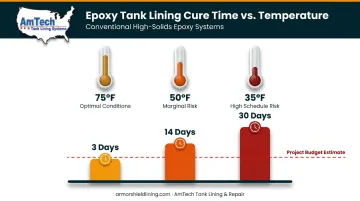
A tank relining project planned for two days with a conventional epoxy system can easily become four to six days once temperature effects and multi-coat sequencing are accounted for.
That schedule extension doesn't just affect operations — it triggers formal regulatory obligations.
The Regulatory Cost of Being Offline
When a fire suppression tank is offline, it carries an immediate compliance burden. Under NFPA 25 Chapter 15 and FM Global Data Sheet 10-7, impairment management requirements apply immediately. FM DS 10-7 specifically classifies a fire protection water supply taken out of service as an impairment, requiring:
- Notification to the fire service and insurance carrier
- Ongoing fire watch patrols for unprotected areas
- Formal documentation of estimated impairment duration
- Management review if the scope or duration must be extended
A federal AHJ interpretation (NIH ORS 19-2) makes the threshold explicit: if a fire protection system is out of service for more than 10 hours in a 24-hour period, the impairment coordinator must arrange evacuation, an approved fire watch, a temporary water supply, or ignition and fuel controls.
These aren't optional contingencies — they are required responses, and each one carries a direct cost.
Fire watch staffing isn't free. Boston Fire Department detail rates run $54–$55/hour per firefighter, with higher overtime and holiday rates — and most impairments require continuous coverage until the tank is back in service. Multiply that by shift length, patrol area, and impairment duration, and the fire watch cost alone can rival the relining contract.
Key Drivers of Extended Downtime in Fire Tank Relining
Understanding what actually drives a long offline window makes it possible to attack the right problems.
Lining Material Chemistry
This is the primary driver. Solvent-based epoxies, coal tar coatings, and moisture-cure urethanes all carry long cure windows that are sensitive to temperature and humidity. In cold weather, what's listed as a 3-day immersion cure at 75°F can stretch to two weeks at 50°F.
100% solids polyurethane systems behave very differently. Fast-cure formulations like AmTech's DuraChem 500 series achieve cure-to-touch in under 10 minutes at standard conditions, and polyurea systems routinely hit return-to-service within 24 hours versus multiple days for epoxy alternatives. That gap — same-day return versus a week-long impairment — is driven entirely by chemistry, not workmanship.
Surface Preparation Surprises
The second major driver is substrate condition discovered after the project starts. Unexpected corrosion, deep pitting, or coating adhesion failures can require additional abrasive blasting, structural repair, or substrate conditioning before any lining can be applied.
Projects planned as two-day jobs become five-day projects almost exclusively because of surface issues that weren't identified before mobilization. Sherwin-Williams notes that premature coating failure in water infrastructure is typically driven by a combination of factors including poor surface preparation — meaning skipping prep steps creates a future outage that costs far more than the time saved.
AMPP/SSPC surface prep standards set clear benchmarks: SP 10 (Near-White Metal Blast) is the common target for high-performance immersion linings. Reaching that standard requires pre-job inspection, properly sized blasting equipment, and realistic scheduling — compress any of those and the lining pays for it later.
Contractor Capability and Scheduling Gaps
Two underrecognized contributors:
- Contractor experience with fast-cure systems: Plural-component polyurethane and polyurea systems require specialized proportioning equipment that must be properly calibrated and heated before application. Crews unfamiliar with these systems need more setup time, and may lack the equipment entirely.
- Pre-project regulatory coordination: AHJ notification, insurance carrier documentation, and impairment coordinator communication don't happen automatically. Teams that don't complete these steps before mobilization often face mandatory hold periods that add days to the offline window before any work has been done.
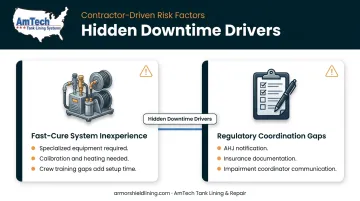
Contractors with in-house field crews trained on fast-cure systems — and pre-mobilization regulatory coordination built into their standard process — consistently avoid both of these delays. The contractor selection decision, made weeks before the job starts, often determines more of the final downtime than any single on-site variable.
Strategies to Minimize Relining Downtime
The most effective downtime-reduction moves don't come from speeding up the relining work. They come from changing which materials are specified, how the project is sequenced, and what's in place before the crew arrives.
Strategies That Change the Material Decision
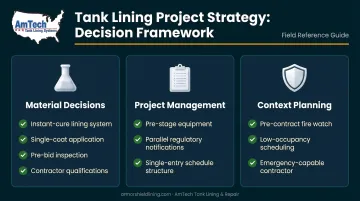
Select an instant-cure or rapid-return-to-service lining system. 100% solids polyurea and plural-component polyurethane systems cure in minutes to hours rather than days. AmTech's DuraChem 500 series is engineered for fire suppression tank applications, enabling same-day or within-24-hour return to service — a fraction of the multi-day cure windows that conventional epoxies require.
Specify single-coat application where structurally appropriate. Multi-coat epoxy systems double or triple the cure window with each additional coat. A high-build, single-application 100% solids system achieves required film thickness in one pass.
Require a pre-bid on-site inspection. AmTech conducts pre-project inspections — including ultrasonic thickness testing and substrate evaluation — before contract execution, not after the tank is drained. This converts unpredictable mid-project discoveries into a defined scope before mobilization begins.
Require documented contractor qualifications at procurement. Contractors with NFPA membership, NSF/ANSI compliance, API experience, and verifiable rapid-cure system history carry measurably lower risk of application errors, rework, and delays. AmTech holds NFPA membership and ANSI/NSF/API compliance, with in-house field crews covering all 50 states.
Strategies That Change Project Management
Pre-stage all equipment before the tank goes offline. For instant-cure plural-component systems, proportioning equipment needs to be on-site, heated, and calibrated before the drain starts. Application begins immediately after surface prep, with no mobilization lag between prep and coating.
Run regulatory notifications in parallel with pre-project prep. Impairment coordinator notification, AHJ coordination, and insurance carrier documentation can all be completed before the tank goes offline. Running these in the week before project start eliminates hold time that would otherwise delay return-to-service authorization.
Structure a single-entry, single-exit project schedule. Every re-entry into the tank for additional coats, touch-ups, or repairs resets access protocols, confined space entry procedures, and inspection hold points. Compressing application, inspection, and sign-off into one sequential window avoids these repeated resets.
Strategies That Change the Context Around the Project
Pre-contract interim fire protection before the tank drains. Reactive fire watch arrangements typically take 24–48 hours to mobilize. If the tank finishes relining on schedule but fire watch logistics aren't in place, the impairment window extends past the lining completion date. Pre-positioning a contracted fire watch means the clock stops the moment the lining inspection clears.
Align the project schedule with low-occupancy windows. Facilities with predictable shutdown schedules, planned maintenance windows, or overnight low-occupancy periods can time the relining to reduce concurrent risk exposure and the intensity of compensatory protection measures required.
Use contractors with nationwide emergency-capable crews. When unexpected substrate conditions extend a project's scope, having a contractor who can expand the crew or pivot without a new procurement cycle matters. AmTech deploys in-house field crews across all 50 states with no subcontractors, and emergency project capability is built into standard service delivery.
Conclusion
Minimizing downtime when relining a fire suppression tank is a planning problem, not an execution problem. The time is won or lost before the tank drains — in the materials specified, the contractor selected, and the pre-project coordination completed.
The combination that consistently produces same-day or next-day return-to-service outcomes is specific:
- An instant-cure 100% solids lining system
- A contractor with documented rapid-cure application capability and relevant certifications
- Proactive coordination of regulatory notifications and interim fire protection logistics — completed before the tank drains
These are planning decisions. None of them require luck or extraordinary circumstances. They require choosing the right materials, the right contractor, and executing the pre-project checklist completely.
To discuss a fire suppression tank relining project, contact AmTech at 888-839-0373 or reach Greg Comeau, NLPA Special Inspector, directly at 603-315-8839.
Frequently Asked Questions
What is tank relining?
Tank relining is the process of applying a protective coating or liner system to the interior of an existing tank to restore corrosion resistance and extend service life — without requiring full tank replacement. It's the standard restoration approach for steel, concrete, and fiberglass tanks that pass structural inspection.
How much does it cost to reline a fire suppression water tank?
Relining costs vary based on tank size, substrate condition, lining material, and access complexity. Contact a qualified contractor for a site-specific estimate. Relining is consistently less expensive than full tank replacement, typically by 40–60% or more.
Can an internal lining be added to an existing tank?
Yes — internal linings can be applied to existing steel, concrete, and fiberglass tanks. This is the most common restoration approach, provided the substrate passes inspection and meets minimum thickness and adhesion requirements prior to application.
How long does a tank liner last?
Service life depends on material type, application quality, and operating conditions. High-quality 100% solids systems in fire suppression service can last 15–20+ years when properly applied. AmTech backs qualifying installations through its BLUE CHECK warranty program — ask your project engineer for applicable terms.
How long does it take to reline a fire suppression tank with an instant-cure system?
With a 100% solids instant-cure lining system and proper pre-project preparation, a fire suppression tank can often return to service within 24 hours of going offline. Conventional moisture-cure or solvent-based epoxy systems typically require several days to a week or more.
Is a fire watch required when a fire suppression tank is offline for relining?
Under NFPA 25 Chapter 15 impairment management requirements, a fire watch or equivalent compensatory measure is typically required when a fire suppression water supply is taken offline. Minimizing cure time directly reduces both the duration and cost of the required fire watch.