Introduction
On January 9, 2014, approximately 11,000 gallons of Crude MCHM leaked from a Freedom Industries storage tank in Charleston, West Virginia. The chemical escaped through corrosion holes in the tank floor. The deteriorated secondary containment wall failed to stop it, letting the spill reach the Elk River and contaminating water for 300,000 residents. The company faced a $900,000 criminal fine and a $151 million class-action settlement. The U.S. Chemical Safety Board cited the failed secondary containment wall as the primary pathway for environmental contamination.
When primary containers fail, secondary containment is the last line of defense between a spill and an environmental disaster. The EPA's SPCC rule (40 CFR Part 112) and OSHA standards place clear legal obligations on facilities storing oil and hazardous chemicals.
As of January 2025, EPA civil penalties for SPCC non-compliance can reach $295,564 per violation, with gross negligence minimums starting at $236,451. Those numbers make secondary containment failures expensive in every sense.
This guide gives compliance officers, facility managers, and plant operators a clear breakdown of secondary containment requirements — what the regulations demand, how to implement compliant systems, and how to keep them inspection-ready.
Key Takeaways
- Secondary containment captures spills from primary containers before they reach soil or waterways
- EPA's SPCC rule applies to facilities with aggregate aboveground oil storage exceeding 1,320 gallons
- Capacity requirements start at 110% of the largest single container — outdoor installations must also account for precipitation freeboard
- System options include concrete berms, earthen dikes, portable spill pallets, and double-wall tanks — each with distinct compliance and cost implications
- Facilities must document their containment strategy in a formal SPCC Plan, which may require Professional Engineer certification
What Is Secondary Containment and How Does It Differ from Primary Containment?
Secondary containment is a backup barrier—a wall, basin, liner, or structure—placed around a primary storage container to capture leaks or spills before they spread to the surrounding environment. This system creates an interstitial space between the primary vessel (which holds the substance) and the secondary barrier (which contains any release).
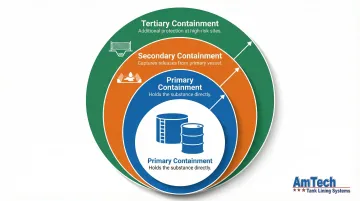
Primary vs. secondary vs. tertiary containment:
- Primary containment: The tank, drum, pipe, or vessel that directly holds the substance
- Secondary containment: The outer barrier or structure (berm, basin, double-wall) that captures material if the primary vessel fails
- Tertiary containment: Additional protective layers used at large tank farms or high-risk chemical sites, beyond secondary barriers
Industries That Rely on Secondary Containment
SPCC regulations and similar rules apply across a wide range of industries — any facility storing petroleum or hazardous chemicals in meaningful quantities typically needs a compliant secondary containment system. The sectors most commonly affected include:
- Oil and gas operations handling petroleum storage, refining, and distribution
- Petrochemical and chemical processing plants storing corrosive acids, alkalis, and solvents
- Municipal water and wastewater treatment facilities with chemical feed tanks and digesters
- Power generation plants managing fuel oil storage and chemical treatment systems
- Manufacturing facilities storing process chemicals and lubricants
- Airports and municipalities using de-icing chemical storage
In each of these settings, the secondary containment structure itself — the basin, berm, or vault — must be lined or sealed to resist the specific chemicals it may contact. AmTech Tank Lining applies field-tested lining systems to both primary tanks and secondary containment structures across all these industries.
The Regulatory Landscape: SPCC, EPA, and OSHA Requirements
EPA's Spill Prevention, Control, and Countermeasure (SPCC) Rule
The EPA's SPCC rule under 40 CFR Part 112 serves as the primary federal regulation governing oil storage containment. It exists to prevent oil from discharging into navigable waters or adjoining shorelines.
The rule mandates:
- A written SPCC Plan documenting containment strategy, spill response procedures, and facility design
- Physical containment structures sized to capture the largest credible spill scenario
- Regular inspection and testing of containment integrity
- Employee training and emergency response protocols
OSHA's Role in Containment and Spill Response
While EPA focuses on environmental protection, OSHA 29 CFR 1910.120 (HAZWOPER) addresses worker safety during spill response. OSHA requirements overlap with EPA in several areas:
- Labeling and signage requirements for hazardous materials
- Employee training for spill response operations
- Emergency response plan development
- Personal protective equipment (PPE) specifications during cleanup
Both sets of rules can apply simultaneously to the same facility: EPA governs containment structure design and capacity, while OSHA dictates worker safety protocols during spill events.
Additional Regulatory Layers
Federal rules set the compliance floor — but two additional layers often apply on top of them:
- State and local regulations may impose requirements beyond federal standards. Consult your state environmental agency for jurisdiction-specific rules.
- RCRA hazardous waste regulations (40 CFR 264.175) apply to facilities storing hazardous waste, adding distinct sizing requirements that can conflict with SPCC standards (addressed below).
Who Needs SPCC Compliance? Applicability Thresholds Explained
SPCC Applicability Triggers
The SPCC rule applies to facilities meeting both of these criteria:
Storage capacity threshold (either one triggers applicability):
- Aboveground oil storage capacity greater than 1,320 gallons in aggregate (counting only containers of 55 gallons or greater capacity)
- Underground storage capacity greater than 42,000 gallons
Geographic risk factor:
- Reasonable expectation of oil discharging into navigable waters or adjoining shorelines (determined solely by geographical and locational aspects, excluding manmade features like dikes)
Qualified Facility Tiers and Certification Requirements
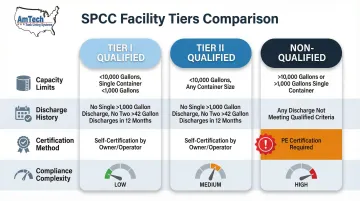
Smaller facilities with clean spill histories qualify for streamlined compliance paths:
| Facility Tier | Capacity Limits | Discharge History | Certification Method |
|---|---|---|---|
| Tier I Qualified | ≤ 10,000 gallons total; no single container > 5,000 gallons | No discharge > 1,000 gallons OR no two discharges > 42 gallons in prior 3 years | Self-certify using streamlined template |
| Tier II Qualified | ≤ 10,000 gallons total | Same as Tier I | Self-certify full SPCC Plan |
| Non-Qualified | > 10,000 gallons total OR any larger spill | Any | Professional Engineer (PE) certification required |
Under §112.7(c), secondary containment requirements apply to all containers at SPCC-regulated facilities. Section §112.8(c)(2) requires each bulk storage container installation to have containment for the entire capacity of the largest single container plus freeboard for precipitation.
Note: Separate containment systems are not required for every individual drum — a shared collection area serving multiple containers is acceptable, provided it meets the sizing requirements for the largest single container within that area.
The 110% Rule: Sizing Your Secondary Containment Correctly
Understanding the Largest Single Container Rule
The foundation of secondary containment sizing is this: containment must hold the entire capacity of the largest single container within the containment area, plus sufficient freeboard to contain precipitation.
Simple calculation example: A 10,000-gallon aboveground storage tank requires secondary containment capable of holding at least 11,000 gallons (10,000 gallons × 110% = 11,000 gallons).
This 10% buffer accounts for freeboard—the additional capacity needed to prevent overtopping from rain accumulation.
Freeboard Requirements for Outdoor Containment
The EPA recommends designing for a 25-year, 24-hour storm event when calculating freeboard, but declined to mandate this as a rigid standard because of the difficulty and expense of securing local precipitation data.
Practical implication: While "110%" has become industry shorthand, actual freeboard requirements vary based on:
- Local precipitation patterns and intensity
- Containment area surface dimensions (larger areas collect more rain)
- Presence of drainage controls and precipitation management systems
- Whether the containment is covered or open to weather
Covered or enclosed containment systems eliminate precipitation sizing complexity and reduce the effective required volume to approximately 100% of the largest container.
Multiple-Container Scenarios
When a secondary containment structure houses multiple containers, sizing is based on the volume of the largest single container, not the aggregate total of all containers.
Common compliance gap: Facility designers sometimes undersize shared containment areas by calculating based on a percentage of total volume rather than the full capacity of the largest unit. This creates a regulatory deficiency even though the shared approach is explicitly permitted.
Impermeable Flooring and Wall Integrity
A correctly sized containment basin that leaks through cracks or chemically degraded concrete fails the regulation regardless of volume. The containment must be sufficiently impervious to contain the stored substance until cleanup occurs.
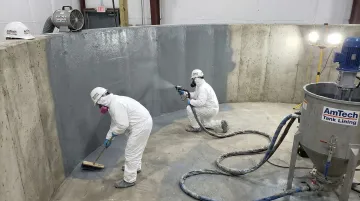
Concrete and steel containment structures are highly susceptible to chemical attack from acids, fuels, solvents, and alkaline substances — degradation that undermines impermeability over time. Protective lining systems address this directly. AmTech Tank Lining's DuraChem 500 series polylinings and HydraStone Alkrete cementitious systems are applied on-site to restore and maintain chemical resistance, keeping containment structures compliant through years of service.
RCRA vs. SPCC Sizing Conflicts
Sizing calculations get more complicated when a facility stores both oil and hazardous waste. RCRA 40 CFR 264.175 applies a different standard than SPCC:
| Standard | Sizing Requirement |
|---|---|
| SPCC | 100% of largest single container + freeboard |
| RCRA | 10% of total container volume OR 100% of largest container, whichever is greater |
When a facility stores many small hazardous waste drums, RCRA's 10% aggregate rule can require more total volume than SPCC's largest-single-container approach. Facilities must evaluate both metrics and build to whichever is more stringent.
Types of Secondary Containment Systems
Under 40 CFR 112.7(c), secondary containment may be active or passive and must prevent discharges from escaping before cleanup occurs. Acceptable systems include:
Concrete Berms and Dikes
Reinforced concrete walls and sloped floors create a basin around storage tanks. This traditional approach offers structural durability and permanence.
Critical vulnerability: Concrete is highly susceptible to chemical attack from stored substances like acids, fuels, and solvents. The interior surfaces must be coated with a chemical-resistant lining to maintain structural integrity and regulatory compliance.
Field-applied lining systems — such as AmTech's DuraChem 500 series polyurethane linings and HydraStone Alkrete cementitious systems — address this directly. These systems resist acidic and alkaline liquids, petroleum distillates, and select corrosives, extending the service life of concrete containment structures significantly.
The DuraChem 500 series is spray-applied to form a seamless, monolithic barrier with high adhesion strength, preventing disbonding under hydrostatic pressure or thermal cycling.
Earthen Dikes or Berms
Compacted soil or gravel berms lined with impermeable geomembrane liners are typically used for large outdoor tank farms storing petroleum products. This approach offers cost-effectiveness for high-volume containment.
Key considerations:
- Liner selection must account for chemical compatibility (EPA Method 9090 or ASTM D5747 testing recommended)
- Regular inspection for erosion, animal damage, or liner punctures
- UV degradation of exposed liner materials
- Drainage controls to manage precipitation accumulation
Portable and Modular Systems
Spill pallets, drip trays, collapsible containment berms, and IBC containment decks provide flexible solutions for drums, intermediate bulk containers, and mobile equipment.
Regulatory note: EPA requires containers of 55 gallons or larger (or aggregate volumes exceeding 1,000 gallons) to have secondary containment, making portable spill pallets a practical compliance tool for warehouses and smaller facilities.
Portable systems work well for lower-volume or temporary storage situations:
- Low upfront cost with no permanent construction required
- Easy reconfiguration as storage layouts change
- Quick deployment for temporary storage scenarios
They do have practical limits worth noting:
- Capacity suits drum and IBC storage only — not bulk tanks
- May not meet freeboard requirements without careful sizing
- Subject to material degradation from UV exposure and chemical contact
Double-Wall (Tank-within-a-Tank) Systems
A sealed outer vessel surrounds the primary tank, creating an enclosed interstitial space that captures leaks without exposure to weather or personnel.
This design offers several compliance advantages:
- Eliminates precipitation sizing concerns (no freeboard calculation required)
- Provides immediate leak detection through interstitial monitoring
- Protects leaked material from environmental exposure
- Common in chemical processing and fueling operations
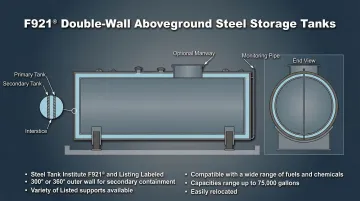
Important limitation: Double-walled tanks do not provide adequate secondary containment to address transfer-related overfills from the tank vent—additional containment may be required for fill connections and piping.
Developing and Maintaining Your SPCC Plan
Required SPCC Plan Contents
- Facility description and operational overview
- Complete oil storage inventory with container capacities and locations
- Site map showing tank locations, drainage pathways, and containment structures
- Identification of discharge pathways to navigable waters
- Description of secondary containment structures with capacity calculations demonstrating compliance with the 110% rule
- Spill response procedures and emergency contact information
- Inspection and testing schedules for containment integrity
- Employee training records and certification documentation
Note: The Plan must be kept on-site (if the facility is attended at least four hours per day) and available to EPA inspectors upon request.
Inspection and Testing Requirements
SPCC-regulated facilities must conduct regular inspections of:
- Containment structure integrity (cracks, spalling, liner degradation)
- Tank shell condition and corrosion status
- Drainage controls and valve operability
- Precipitation accumulation levels
- Coating and lining condition on containment surfaces
Common deficiencies found during EPA audits:
- Deteriorated containment liner coatings (chemical attack, UV degradation, delamination)
- Inadequate freeboard due to precipitation accumulation
- Missing or inoperable drain valve controls
- Outdated plan documentation not reflecting current facility configuration
- Lack of documented inspection records
Several of these deficiencies — particularly liner degradation and wall thinning — aren't visible to the naked eye. AmTech's ultrasonic testing and non-destructive inspection services can identify these issues before they become audit failures or containment breaches.
Amendment and Review Obligations
Inspection findings often trigger plan updates — which is why understanding your amendment obligations matters as much as the inspections themselves.
Five-year review cycle: Facilities must complete a review and evaluation of the SPCC Plan at least once every five years.
Technical amendments required within six months when:
- Facility design, construction, or operation changes materially affect discharge potential
- Containment structures are added, removed, or modified
- Storage capacity increases beyond qualified facility thresholds
- A spill exceeding reportable quantities reaches navigable waters
- Any technical amendment is made (requires Professional Engineer re-certification; non-technical changes like contact updates do not)
Penalties for Non-Compliance
As of January 2025, EPA civil penalties for SPCC violations include:
- Class II violations: $23,647 per day, up to $295,564 maximum
- General civil penalties: $59,114 per day
- Gross negligence or willful misconduct: $236,451 minimum, $7,093 per barrel
Criminal liability applies in cases of willful violations, creating direct personal exposure for facility managers and compliance officers.
Steps to Achieve and Maintain Compliance
Initial compliance:
- Inventory all oil storage containers (55 gallons or larger)
- Calculate aggregate aboveground storage capacity
- Determine whether SPCC applies based on 1,320-gallon threshold and geographic risk
- Assess whether existing containment structures meet 110% sizing requirements
- Evaluate containment structure integrity (lining condition, drainage controls, impermeability)
- Develop or update the SPCC Plan with PE certification if required
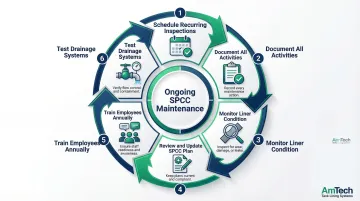
Ongoing maintenance:
- Schedule recurring containment inspections (quarterly minimum recommended)
- Document all inspections and maintenance activities
- Monitor containment liner condition and repair degraded coatings before failure
- Review and update SPCC Plan every five years
- Train employees on spill response procedures annually
- Test drainage valves and precipitation management systems regularly
Frequently Asked Questions
What is secondary containment?
Secondary containment is a backup barrier system surrounding a primary storage vessel—designed to capture spills or leaks before they reach soil, drains, or waterways. It serves as a critical component of both EPA SPCC and OSHA compliance programs.
What is the difference between primary and secondary containment?
Primary containment is the vessel or container that directly holds the substance (tank, drum, pipe), while secondary containment is the outer structure or system (berm, basin, double-wall) that captures material if the primary vessel fails.
What is the 110% rule for secondary containment?
The 110% rule requires secondary containment to hold at least 110% of the largest single container it surrounds—enough to capture the full contents if the primary container fails completely. The extra 10% accounts for precipitation accumulation and freeboard.
When is secondary containment required and how large should it be?
SPCC requires secondary containment when aggregate aboveground oil storage exceeds 1,320 gallons (or underground storage exceeds 42,000 gallons) and there's a reasonable potential to reach navigable waters. Sizing must meet the 110% rule, with additional freeboard required for outdoor installations based on local precipitation data.
What are the containment requirements for oil tanks?
EPA §112.8(c)(2) requires secondary containment sized for the entire volume of the largest single tank, plus sufficient freeboard for precipitation. All containment structures must be impermeable and kept in good condition to prevent leakage into soil or groundwater.
What regulations govern secondary containment and chemical storage?
EPA's SPCC rule (40 CFR Part 112) governs oil storage, EPA's RCRA regulations (40 CFR 264.175) govern hazardous waste storage containers, and OSHA standards (29 CFR 1910.120) address worker safety during spill response. State and local rules may add further requirements beyond federal standards.
Properly designed and maintained secondary containment systems are your first defense against environmental incidents and regulatory penalties. AmTech Tank Lining provides inspection, surface preparation, and lining application services that keep containment structures compliant and functional for decades. With over 55 years of experience serving oil and gas, petrochemical, municipal, and industrial facilities across all 50 states, AmTech's engineer-led field crews bring the technical depth your containment structures require.
Contact AmTech at 888-839-0373 to discuss your secondary containment compliance requirements and schedule a facility assessment.