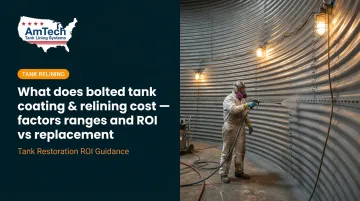
Getting that decision wrong in either direction is expensive. Replacing a structurally sound tank wastes capital. Relining a tank with compromised panels buys time you won't actually get.
This article breaks down realistic cost ranges for bolted tank coating and relining, the factors that push those numbers up or down, what a full project actually includes, and how relining ROI compares to full replacement — using a real 2025 municipal case as a benchmark.
Key Takeaways
- Relining costs vary enormously by tank size, surface condition, and lining system — no reliable per-square-foot benchmark applies universally
- Surface preparation, not lining material, typically drives the largest share of labor cost
- Relining a 600,000-gallon bolted tank runs $275,000–$450,000 versus $1,000,000+ for full replacement with demolition
- Relining makes financial sense when the tank shell is structurally sound and corrosion is surface-level
- Skipping pre-project inspection is the single most common cause of budget overruns
What Does Bolted Tank Coating and Relining Cost?
There is no universal price per gallon or per square foot for bolted tank relining. Cost is calculated from scope, tank size, lining system, surface preparation requirements, and site conditions. Facilities that budget from generic estimates rather than actual condition assessments typically either underfund the project or over-specify it.
The most useful public benchmark available comes from a 2025 engineering memo prepared by HDR for Minturn, Colorado, analyzing rehabilitation options for an existing 600,000-gallon chime-style bolted steel tank. It's the clearest apples-to-apples comparison found in recent public project data.
Tier 1: Spot Treatment and Localized Recoating
This tier covers targeted repairs to specific failing areas: bolt-head sealing, seam touch-up, and localized patch-and-recoat on smaller tanks or tanks with limited deterioration.
Best for:
- Tanks where most of the existing lining remains intact
- Early-stage coating failure or isolated problem areas
- Single leaking seam or one corrosion pocket
This scope makes sense when a full interior reline isn't warranted, but only if the rest of the coating system is genuinely sound. Spot treatment on a tank with generalized degradation is a short-term fix that will require full relining within a few years anyway.
Tier 2: Full Interior Relining — Standard System
This tier covers complete interior surface blast-prep and single or dual-coat lining application (typically epoxy or cementitious) across the shell, floor, seams, and bolt heads.
Best for:
- Tanks with generalized coating degradation but no major structural damage
- Water, wastewater, and light chemical storage tanks
- The most common relining scenario in municipal and industrial settings
The HDR/Minturn memo documents a plural-component lining system for a 600,000-gallon bolted tank at $275,000–$450,000, including $50,000 in mobilization. This is the most current public figure available for a mid-to-large bolted tank full interior reline. Note that it excludes engineering fees, permitting, testing, and any tariff-related material cost changes.
Tier 3: Full Rehabilitation — Premium or Specialty Lining
Full interior and/or exterior rehabilitation using high-performance systems such as 100% solids polyurea, multi-coat epoxy, or cementitious systems like HydraStone® Alkrete. Scope includes structural seam repair, bolt replacement, floor repair, and compliance testing.
Best for:
- Potable water tanks requiring NSF/ANSI 61 compliance
- Tanks storing aggressive chemicals or petroleum products
- Tanks with significant seam/structural deterioration where the shell and foundation remain structurally sound
The same HDR/Minturn analysis lists overall rehabilitation and recoat at $1,500,000 for the 600,000-gallon tank — above the replacement cost in that specific case, because unresolved roof deterioration added significant scope. When one component (here, the roof) drives costs past the replacement threshold, rehabilitation only pencils out if the remaining structure has meaningful remaining service life.
Typical scope inclusions and exclusions:
| Details | |
|---|---|
| Usually included | Surface prep, materials, labor, mobilization, standard QC testing |
| Usually excluded | Structural panel replacement, foundation work, permitting, engineering fees, remote-site surcharges |
Key Factors That Drive Bolted Tank Relining Costs
Pricing is shaped by a mix of physical, operational, and regulatory variables. Knowing which factor carries the most weight — surface prep and structural condition, in most cases — is what keeps projects on budget.
Tank Size and Interior Surface Area
Relining is fundamentally a square-footage job. Larger tanks require more material, more labor hours, and longer downtime. Unit cost per square foot often decreases at scale — but total project cost increases substantially.
For a rough estimate, calculate the cylindrical shell area (circumference × height) plus the floor area, then add 10–15% for seam coverage and bolt-head detail work.
Surface Preparation Requirements
According to AMPP CoatingsPro, 75% of coating failures are caused by poor surface preparation — not lining system defects. This makes prep quality the highest-impact variable in long-term relining ROI.
Tnemec's coating project cost guide puts application labor at 30–60% of total coating project cost and surface preparation itself at 15–40%. Material price is a poor proxy for total project cost.
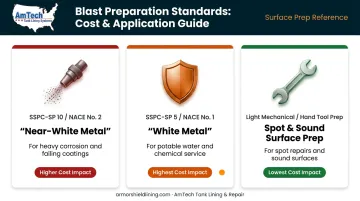
Blast standard requirements also affect cost significantly:
| Blast Standard | When Required | Cost Impact |
|---|---|---|
| SSPC-SP 10 / NACE No. 2 (Near-White Metal) | Heavy corrosion, failing coatings | Higher — full abrasive blast to bare metal |
| SSPC-SP 5 / NACE No. 1 (White Metal) | Potable water, chemical service | Highest — most stringent standard |
| Light mechanical/hand tool prep | Mint-condition tanks, spot repairs | Lowest — limited to sound surfaces only |
Bolted tanks add complexity beyond flat steel surfaces. Bolt heads, seam edges, and gasket areas all require special attention — hand tooling, detailing work, and compatible sealants that don't apply to welded tank interiors.
Lining System Selection
Coating type drives both material cost and application complexity:
- Standard epoxy systems — Lower material cost, widely applicable, but require strict surface prep and may not suit chemically aggressive environments
- Cementitious systems (HydraStone® Alkrete) — Well-suited for potable water contact with a long municipal service history; AmTech is the exclusive U.S. licensee and largest North American field installer
- 100% solids polyurea (DuraChem® 500 series) — Fast cure times, strong chemical resistance, and compliance advantages for demanding storage applications
- Fiberglass-reinforced systems — Specialized applications with specific structural requirements
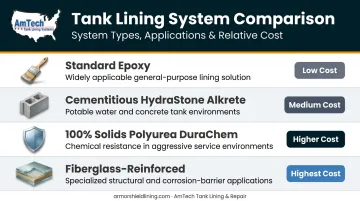
Cementitious and polyurea systems cost more per square foot upfront. Over a full service cycle, though, their longer recoat intervals typically reduce total lifecycle cost compared to standard epoxy.
Regulatory and Compliance Requirements
Compliance requirements add cost — but they're non-negotiable for regulated industries:
- Potable water tanks must use NSF/ANSI/CAN 61-certified products; NSF product listings include specific restrictions on coating type, temperature, and application conditions
- Petroleum storage tanks fall under API 12B (bolted production tanks) and API 652 (tank-bottom linings); NFPA 30 governs flammable and combustible liquids storage
- Regulated facilities require compliance documentation: material certifications, application logs, inspector credentials, and post-application test results
Note on NLPA: NLPA standards and inspector credentials are primarily associated with underground storage tank (UST) regulations. For aboveground bolted tanks, applicable standards depend on tank type and jurisdiction — verify requirements with your project engineer before specifying inspector credentials.
Structural Condition: Seam, Bolt, and Panel Repair
Per STI/SPFA guidance, bolted tank seams must be made watertight with gasket materials, and many joints may require sealant — with potable-contact materials requiring NSF/ANSI 61 certification.
If seam repair, bolt replacement, or localized panel repair is needed before relining, this adds labor and materials cost. A pre-project inspection — including ultrasonic thickness testing and structural assessment — should be treated as a required line item, not an optional add-on. Discovering structural issues mid-blast is the most common driver of project cost overruns.
Relining vs. Replacement: ROI Comparison
The core financial question is whether relining delivers better value than starting fresh. When the tank's structural condition is sound, relining consistently costs a fraction of replacement — but condition is the deciding variable, and that answer requires an inspection, not a spreadsheet.
The Replacement Cost Baseline
Full tank replacement involves more than buying a new tank. The complete scope includes:
- Decommissioning, draining, and decontamination
- Demolition or disassembly
- Disposal (including environmental considerations for contaminated tanks)
- New tank procurement or fabrication
- Site preparation and reinstallation
- Commissioning and compliance testing
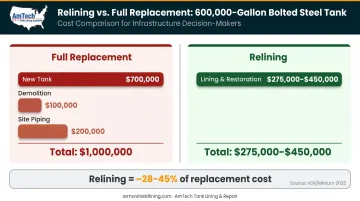
The HDR/Minturn 2025 analysis puts full replacement of a 600,000-gallon bolted steel tank at $700,000 for the tank alone, and $1,000,000 total with demolition and site piping — including an estimated $100,000 for demolition and $200,000 for site piping reconnection.
That same analysis puts the plural-component relining option at $275,000–$450,000. The math in that specific case shows relining at roughly 28–45% of full replacement cost — though this is one project, not a universal benchmark.
| Scope | HDR/Minturn Estimate |
|---|---|
| New tank only | $700,000 |
| Full replacement (tank + demo + piping) | $1,000,000 |
| Plural-component relining | $275,000–$450,000 |
| Relining as % of replacement | ~28–45% |
When Relining Makes Financial Sense
Relining delivers clear value when:
- The tank shell and structural panels are sound (confirmed by ultrasonic testing)
- Corrosion is surface-level or limited to coating failure
- Seam and gasket issues are addressable without panel replacement
- Downtime for relining (typically days) is shorter than for replacement (typically weeks)
- The facility cannot absorb the capital outlay of full replacement
- Remaining operational requirements are met by the existing tank capacity
When Replacement Is the Better Decision
Replacement is justified despite the higher cost when:
- Structural panel failure or corrosion-through has compromised the shell
- Foundation failure requires a complete rebuild regardless
- Tank capacity no longer meets operational requirements
- Repeated relining failures have created regulatory or liability exposure
- Total rehabilitation cost approaches or exceeds replacement cost — as the HDR/Minturn case shows can happen when roof deterioration adds scope
The HDR analysis illustrates both outcomes: relining was cost-effective for the lining scope alone, but full rehabilitation exceeded replacement cost once roof issues were factored in. That's why a qualified structural inspection — not a budget estimate — should drive the go/no-go decision on relining.
What a Bolted Tank Relining Project Actually Includes
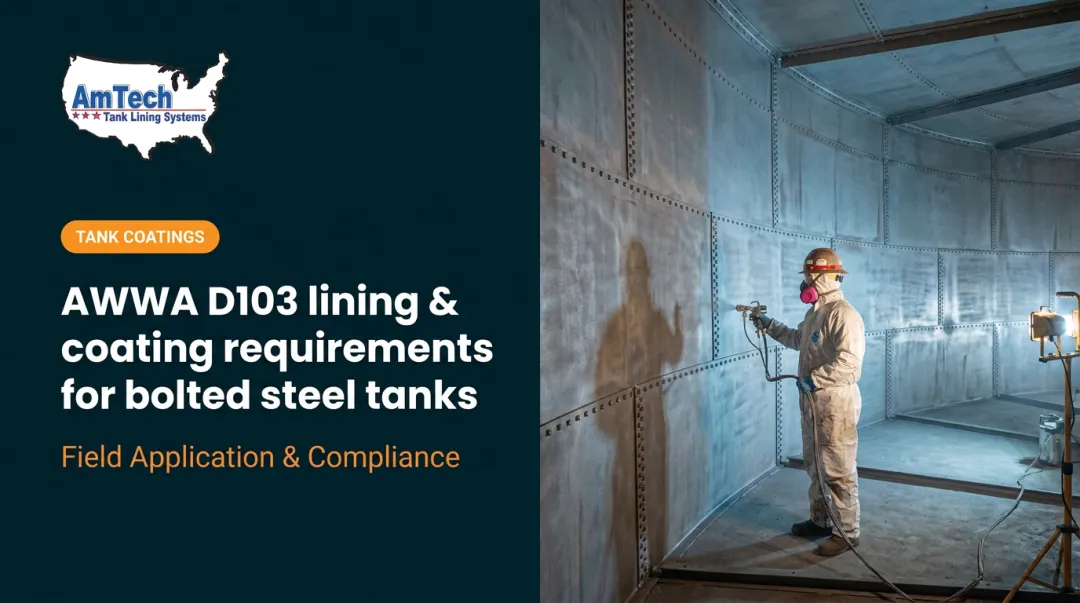
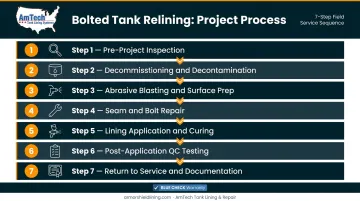
A properly scoped bolted tank relining project follows a defined sequence. Contractors who skip steps — particularly inspection and surface prep — create the conditions for early lining failure. Here's what a complete project looks like from start to finish.
Standard project sequence:
- Pre-project inspection and condition assessment — Ultrasonic thickness testing, structural review, existing coating assessment, and fitness-for-service evaluation. This determines whether relining is viable and defines the scope.
- Tank decommissioning, draining, and decontamination: Full cleaning removes product residue, sludge, and biological matter before any blasting begins.
- Abrasive blasting and surface preparation — Blast to the standard specified for the lining system and stored product. For potable water and chemical service, this typically means near-white or white-metal blast standards.
- Seam and bolt repair: Sealant application, bolt replacement, and gasket repair are completed before lining, using materials compatible with the stored product and compliance requirements.
- Lining application and curing — Applied per manufacturer specifications. Plural-component and 100% solids systems require specialized spray equipment and trained applicators.
- Post-application QC testing: Holiday detection (wet sponge or high-voltage, depending on coating thickness), dry film thickness measurement, and adhesion testing.
- Return to service and maintenance plan documentation — Including all compliance records, material certifications, application logs, and recommended inspection intervals.
Compliance documentation is a deliverable for regulated projects, not an afterthought. For potable water tanks, this includes NSF/ANSI 61 product certification records and confirmation that all contact materials — including gaskets and sealants — meet listing requirements.
Mobilization costs can add $3,000–$15,000+ to a project budget for remote or hard-to-access facilities. Contractors with their own field crews already distributed nationally — like AmTech Tank Lining, which deploys in-house crews across all 50 states, Canada, and the Caribbean — typically carry lower mobilization overhead than sourcing and qualifying local labor for specialty lining work.
Common Budgeting Mistakes That Lead to Cost Overruns
Focusing Only on Lining Material Cost
Surface preparation — not material — typically represents the largest share of labor cost on a relining project. A facility that selects a contractor based on a lower material price while accepting reduced surface prep scope is likely to see lining failure within a few years, requiring the entire project to be repeated at full cost.
Skipping the Pre-Project Inspection
Accurate budgeting is impossible without a proper condition assessment. Facilities that issue relining RFPs without an inspection commonly receive wide bid ranges — because contractors are pricing unknown risk — or discover hidden structural costs mid-project. Ultrasonic testing and structural assessment before the RFP eliminates this variable.
Choosing the Lowest Bid Without Evaluating System Suitability
A lining system specified for water storage may not be appropriate for chemical or fuel storage. A lower-cost epoxy applied to a tank with active seam movement may fail within a few years. Long-term value must be weighed alongside upfront cost. Evaluate each bid on:
- Warranty coverage — duration and what failure scenarios are included
- Proven service life — documented performance in comparable applications
- Compliance certification — NSF, API, or NFPA listing for the specific stored product
A proven system may cost marginally more upfront. Repeating a failed reline costs the full project price again.
Frequently Asked Questions
What is the difference between welded and bolted tanks?
Welded tanks are fabricated as a single continuous structure with no panel seams, making them inherently more leak-resistant and lower-maintenance. Bolted tanks are assembled from pre-fabricated steel panels joined by bolts and gaskets, which creates potential seam failure points over time but also allows for easier transport, on-site assembly, and panel-level repair or relining.
What is the life expectancy of a bolted steel tank?
Design lifespan varies by coating type, storage conditions, and maintenance history. With proactive relining and inspection programs, bolted steel tanks can remain serviceable well beyond their original design life. Actual service life extension depends on the lining system applied, the stored product, and the shell's structural condition at the time of relining.
How much does it cost to replace a bolted storage tank?
Based on the 2025 HDR/Minturn analysis, full replacement of a 600,000-gallon bolted steel tank ran approximately $1,000,000 including demolition and site piping — versus $275,000–$450,000 for a plural-component interior reline. Replacement costs scale with tank size, site conditions, and demolition complexity.
How long does a bolted tank relining last?
Lifespan depends on the lining system, stored product, and maintenance practices. High-performance systems such as 100% solids polyurea or cementitious linings deliver longer service intervals than standard epoxy when applied with proper surface prep. Per AWWA D102, no single coating is universally best — site-specific conditions and lifecycle costing should drive selection.
Can all bolted steel tanks be relined, or are some beyond repair?
Tanks with severe structural panel failure, corrosion-through, or compromised foundations may not be suitable relining candidates. A professional inspection including ultrasonic testing and structural assessment is required before committing to either path. Attempting to reline a structurally compromised tank will not deliver lasting results regardless of the lining system applied.
Does relining a bolted tank affect regulatory compliance certifications?
It depends on the lining system and documentation. For potable water tanks, NSF/ANSI/CAN 61-listed systems properly applied and documented can maintain or restore compliance, while non-listed or improperly documented work creates gaps that can affect operating status. Verify the exact product listing and use conditions for your specific tank before specifying a system.