The interior lining of a fire suppression water tank is a code-governed component, not a maintenance preference. A deteriorating coating can reduce usable water volume, accelerate wall corrosion, and shift your tank onto a more frequent — and more costly — inspection cycle. Under 2018 IBC Section 1604.5, fire suppression water storage facilities are classified as Risk Category IV — the same category as hospitals — which means compliance failures carry disproportionate consequences.
This guide covers what NFPA 22 and NFPA 25 specifically require for tank linings, how to identify lining failure before an inspection flags it, which lining systems satisfy compliance, and how to build a maintenance schedule that keeps your tank on the right side of both standards.
Key Takeaways
- NFPA 22 governs tank design and installation; NFPA 25 governs ongoing inspection and maintenance — both apply simultaneously
- Steel tanks with qualifying corrosion protection are inspected internally every 5 years; without it, every 3 years
- Interior coating failure can make a structurally sound tank non-compliant by dropping usable capacity below design demand
- Professional relining typically restores compliance after a lining deficiency at a fraction of tank replacement cost
- Inspection records, as-built drawings, and maintenance documentation must be retained for the life of the system
Why Tank Lining Compliance Matters Under NFPA 22 and NFPA 25
Fire suppression water storage tanks fall under Risk Category IV — the highest structural consequence classification in ASCE 7. That designation isn't bureaucratic formality. It means failure of these facilities is considered to carry severe public safety consequences, and regulators, insurers, and courts treat it accordingly.
The Lining-Capacity Connection
Interior lining failure doesn't just create a maintenance problem — it creates a capacity problem. A structurally intact tank can still fail to deliver the flow rate and pressure duration required by NFPA 13 if any of the following reduce usable water volume:
- Corrosion pitting that narrows effective storage capacity over time
- Sediment accumulation from unprotected steel surfaces
- Liner delamination that introduces debris and flow restriction
The tank passes a visual exterior check and fails the test that actually matters.
Inspection Cycle Economics
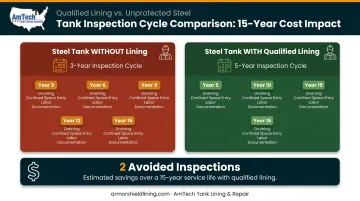
Inspection frequency under NFPA 25 depends directly on whether qualifying corrosion protection is present:
| Protection Status | Internal Inspection Cycle |
|---|---|
| Steel tank with qualified interior lining | Every 5 years |
| Steel tank without corrosion protection | Every 3 years |
Over a 15-year tank lifecycle, that gap means two additional internal inspections — each requiring tank draining, confined space entry, inspection labor, and post-inspection documentation. The cost of a properly specified lining system is typically recovered through avoided inspection cycles alone, before accounting for the corrosion damage those inspections would have found.
Insurance and PPC Scoring
The Verisk/ISO Fire Suppression Rating Schedule allocates up to 40 points out of 105.5 total possible points to Water Supply — roughly 38% of a community's full fire protection score. A lower PPC rating directly affects commercial property insurance premiums. While no specific per-tank penalty for NFPA 25 non-compliance has been universally codified, documented compliance lapses — especially for a Risk Category IV component — create measurable exposure during underwriting reviews and claims adjustments.
The Documentation Standard of Care
NFPA codes establish recognized standards of care. Facility managers who cannot demonstrate that NFPA 25 inspection and maintenance requirements were followed face meaningful liability exposure if a fire occurs during a period of documented non-compliance.
NFPA 25 requires documented records of inspections, tests, and maintenance activities — including dates, findings, corrective actions, and the identity of qualified personnel who performed the work. A gap in that record chain is itself a compliance deficiency, independent of the tank's physical condition.
NFPA 22 and NFPA 25 Lining Requirements for Facility Managers
These two standards divide responsibility cleanly: NFPA 22 governs what the interior surface must achieve at installation; NFPA 25 governs how that condition is verified and maintained over the tank's service life.
NFPA 22 Interior Coating Requirements at Installation
NFPA 22 requires that interior surfaces of steel tanks exposed to water immersion be coated in accordance with AWWA D102, which establishes minimum requirements for materials, coating systems, surface preparation, application, inspection, and testing for steel water storage tanks.
NFPA 22 does not specify a brand or product — it requires that the coating system maintain structural integrity and usable capacity. AWWA D102 provides the minimum thickness and performance benchmarks that engineers and Authorities Having Jurisdiction (AHJs) use during plan review.
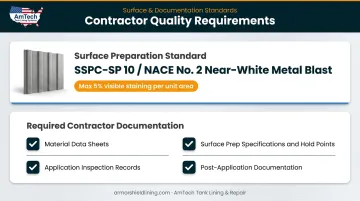
Of all the requirements AWWA D102 imposes, surface preparation is where most lining failures begin. Interior wet systems are mapped to SSPC-SP 10 / NACE No. 2 Near-White Metal Blast Cleaning — a standard that permits visible staining on no more than 5% of each unit area, with the surface otherwise free of all visible contaminants.
Contractor documentation required for AHJ approval includes:
- Material data sheets for the specified coating system
- Surface preparation specifications and hold points
- Application inspection records
- Post-application documentation confirming the coating meets the referenced standard
NFPA 25 Ongoing Lining Inspection Requirements
NFPA 25 Chapter 9 mandates interior tank inspection as a code-required scope — not discretionary maintenance. Inspectors must evaluate for:
- Pitting and corrosion
- Spalling and surface deterioration
- Sediment accumulation and aquatic growth
- Local or general failure of interior coating
When inspection reveals coating failure that materially affects the tank's ability to perform, NFPA 25 classifies this as a Critical Deficiency requiring remediation within specified timeframes.
Follow-up inspection and documentation are required before the system is returned to service. Facility managers should verify exact remediation timeframes directly in NFPA 25 or through their AHJ, as section numbering has varied across editions.
Warning Signs Your Fire Suppression Tank Lining Needs Attention
Waiting for an NFPA 25 inspection to identify lining problems is a reactive strategy. These indicators give you early warning between inspection cycles.
Visible Interior Indicators
- Rust-colored water discharging from the tank outlet or during flushing
- Visible rust streaking on interior surfaces during visual checks through the manway
- Sediment accumulation visible at the tank bottom during partial drain inspections
- Blistering, flaking, or delaminated coating on interior walls or floor
Any one of these conditions warrants accelerating your inspection timeline.
Structural and Performance Indicators
Three conditions suggest the lining has already failed or is failing at the structural level:
- Reduced usable water volume — documented against the original hydraulic design demand, indicating capacity loss that affects system performance
- Accelerated wall thinning — confirmed through ultrasonic thickness testing (UTT), which can detect metal loss without draining the tank
- Microbiologically influenced corrosion (MIC) — identified through water sampling; stagnant water supports sulfate-reducing bacteria that can accelerate corrosion far beyond normal physical wear, making this especially relevant in tanks with low water turnover
External Indicators
Interior and structural warning signs get most of the attention, but exterior conditions often tell the same story:
- Unexplained moisture at shell seams or the floor-to-shell junction
- Foundation staining below the tank perimeter
- Advanced external coating failure — interior and exterior coating systems typically degrade in tandem when maintenance has been deferred
Lining System Options That Satisfy NFPA Compliance Standards
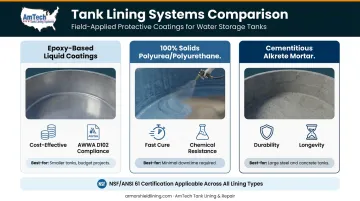
Three main lining system categories are used in compliant fire suppression tank applications. Each has distinct performance characteristics, installation requirements, and ideal use cases.
| Lining Type | Key Characteristics | Best For |
|---|---|---|
| Epoxy-based liquid coatings | Cost-effective, widely available, proven AWWA D102 track record | Smaller tanks, budget-constrained projects |
| 100% solids polyurea/polyurethane | Fast cure, higher chemical resistance, thicker film build | Tanks requiring minimal downtime |
| Cementitious (alkrete mortar) | Troweled or spray-applied, highly durable, long performance history | Large steel and concrete tanks |
NSF/ANSI 61 Certification
For fire suppression tanks supplied by or sharing infrastructure with a municipal potable water source, the lining system must carry NSF/ANSI 61 certification. NSF/ANSI 61 establishes minimum health-effects requirements for protective barrier materials — including coatings and cements — in contact with drinking water.
Whether this requirement applies to your tank depends on three factors:
- The water source feeding the tank
- AHJ requirements for your jurisdiction
- Project specifications from your engineer or designer
Verify applicability with your AHJ during plan review.
AmTech's Fire Suppression Tank Lining Systems
AmTech Tank Lining & Repair offers field-applied lining systems for fire suppression water tanks, including the proprietary DuraChem 500 series (a 100% solids polyurea system) and the HydraStone Alkrete cementitious lining system.
Key credentials for fire suppression work:
- Exclusive U.S. licensee of the HydraStone Alkrete system
- Largest field installer of cementitious tank linings in North America
- All work performed by in-house, engineer-trained crews (no subcontractors used)
- Surface preparation meets SSPC, NACE, and ASTM standards
For project-specific technical specifications and compliance documentation, contact Greg Comeau, AmTech's NLPA Special Inspector, at 603-315-8839.
NFPA 25 Tank Lining Maintenance Schedule for Facility Managers
The NFPA 25 inspection schedule for fire suppression tanks isn't uniform. Frequency depends on four key variables:
- Whether qualifying corrosion protection is present
- Tank material (steel, concrete, fiberglass)
- Environmental exposure conditions
- AHJ-specific requirements
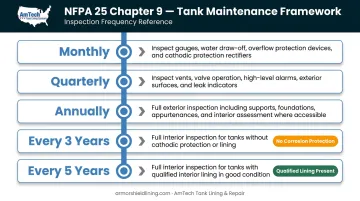
A proactive lining maintenance program keeps a steel tank on the 5-year internal inspection cycle rather than the 3-year cycle. The table below reflects the general framework from NFPA 25 Chapter 9 — verify specific section references in the current edition or through your AHJ.
| Frequency | Scope |
|---|---|
| Monthly | Visual check of exterior, water level indicator, and heating systems |
| Quarterly | Supervised alarm testing, exterior structural inspection including foundation and catwalks |
| Annually | Comprehensive exterior inspection of coatings, expansion joints, ladders, and vents |
| Every 3 Years | Internal inspection for steel tanks without qualifying corrosion protection — evaluate coating, sediment, pitting, anti-vortex plate |
| Every 5 Years | Internal inspection for steel tanks with qualifying corrosion protection — full cleaning, coating integrity evaluation, ultrasonic thickness testing if pitting is found |
Record-Keeping Requirements
NFPA 25 places record-keeping obligations directly on building owners. According to guidance from the National Fire Sprinkler Association referencing NFPA 25 (2020):
- As-built drawings, acceptance test records, and manufacturer documentation must be retained for the life of the system
- Inspection, testing, and maintenance (ITM) reports must be kept for at least one year after the next ITM activity
- All records must be available to fire marshals, insurance adjusters, and AHJs on request
Missing documentation can independently trigger a non-compliance finding — regardless of the tank's physical condition. Maintain a centralized compliance file for each tank that includes:
- Original installation records
- All inspection and ITM reports
- Corrective action documentation
- Material data sheets for the lining system
Frequently Asked Questions
What are the NFPA 25 requirements?
NFPA 25 establishes inspection, testing, and maintenance intervals for all water-based fire protection components, including storage tanks. Coverage spans monthly visual checks through 5-year internal inspections, with defined deficiency classifications and documentation requirements owners must meet to show ongoing compliance.
What is the NFPA code for water tanks?
NFPA 22 is the design and installation standard for water tanks used in private fire protection. NFPA 25 governs ongoing inspection and maintenance of those same tanks. Both apply simultaneously — NFPA 22 compliance at installation doesn't satisfy NFPA 25's continuing inspection, testing, and maintenance (ITM) obligations.
How often does a fire suppression tank lining need to be inspected under NFPA 25?
Interior lining condition is evaluated during internal inspections — every 5 years for steel tanks with qualifying corrosion protection, or every 3 years for steel tanks without it. The presence of a properly specified and installed lining system is what determines which cycle applies.
What type of lining is required for NFPA 22 compliance?
NFPA 22 does not mandate a specific product. It requires interior surfaces of steel tanks to be coated in accordance with AWWA D102. For tanks in contact with potable water, the coating must also carry NSF/ANSI 61 certification. AHJs review the full specification during plan approval.
What happens when lining failure is found during an NFPA 25 inspection?
NFPA 25 classifies the finding as a Critical Deficiency if it materially affects system performance, requiring remediation within specified timeframes. Follow-up inspection and documentation are required before the system returns to service. In most cases, professional relining resolves the deficiency at a fraction of the cost of full tank replacement.
How does tank lining condition affect fire insurance coverage?
Documented NFPA 25 compliance, including lining maintenance records, supports a facility's standing as a low-risk property during underwriting reviews. Gaps in that documentation can trigger premium adjustments or create claim exposure if a fire occurs while the system is in a non-compliant state.